// words and wonders. patents, again. travel between times.
subtractive failures. colorant layers. Kubelka-Munk — stuff posted in the past month.
Cost of Film
Portra 160. coated by Kodak for Kodak Alaris
(4×5) $700 for 100 sheets
Kodak Aerocolor IV. Kodak can sell rolls direct
(4×5) $400 for 100 sheets
Cinestill 4×5. Kodak coats ECN, sells to Cinestill
(4×5) $400 for 100 sheets
cost compare Kodak to consumer; Kodak to KA to consumer.
Kodak patented everything. This is early backing paper. It was based upon carbon-paper.the home of photochemistry for Freestyle, Kodak, Cinestill…
The telling point, to me, is the relative size of the industry. A local cabinet maker is much larger than PSI. The dollar volume is almost that of a Waffle House.
Woodburytype is a matrix formed of soft metal (like lead) by pressing a hardened gelatin image by high-pressure. The stannotype is made using very thin foil as the plate eliminating the need for the high pressure hydraulic machine[The Tangye Bros 18” Hydraulic Ram Press]. The woodburytype as made are tipped into publications. Three-color wasn’t achieved using the process because fine alignment was not achieved.
Intaglio is a broad term encompassing press process in which the ink sits in “carved site.” Printing is categorized by where the ink lies on the plate (matrix) not how the image is formed. Relief: ink is on raised portion; intaglio: the ink lies below the surface; planographic: the ink is on the surface of the matrix[ collotype].
a family: collotype, woodburytype, stannotype, photogravure
Barret Oliver’s book is a history rather than a how-to. It is much about the past of the process. In 2007, his book A History of the Woodburytype was published by Carl Mautz Publishing He establishes his interest in an opening quote from William Crawford’s Keepers of Light, 1979:
“Every time a photographer solves an aesthetic problem he has to solve an underlying technical problem. One solution supports and influences the other. Granted, the photographer is infinitely more interesting than the photographic machine, and so are the things the photographer uses the machine to capture. But unless you understand the ways the machine cajoles and begrudges, you will never know how truly interesting the photographer is. You will not see the compromises he had to make in order to put his vision on paper.”
Barret: I use historic techniques, basically pre-industrial technologies. There's a point somewhere between 1885 and the turn of the century when industrially produced photographic materials become readily available, and they're manufactured in factories. They're industrially made and commercially sold. Before that, everything was made pretty much by the photographer or by small shops by hand. Those are relatively, and I use that word loosely, relatively easy to do on a small scale in a studio. The industrial stuff, like roll film, it's just impossible to do in a studio. [ link ]
This is more about his beginnings, and his reading of William Ivins. " As a photographer I have always relied on visual images as my primary means of communication ideas. But I realized I would have to start looking at the prints the way a historian would, and I would have to become versed in the language about communication of ideas, both through words and through images."

His book is interesting for his reasons of making images, as well as his interpretations of reproduction goals. As a text for production, that is yet to be written. My preference in ink&paper is the collotype. That information has been written for the updated world.
Two Palms [Craig Zammiello, etcher]
It is actually quite rare to have access to a hydraulic press that is as powerful as ours, and when our two master etchers joined the team, one of the first things they realized was the press’ potential to produce a Woodburytype. Our printers spent 10 years trying to perfect the necessary gelatin to make the lead printing plates (another failure).
We happened upon Barret Oliver during our research. He had just claimed to have successfully produced a Woodburytype print. We invited him to New York and brought him to meet Chuck Close. Over the course of a year, they made a group of fantastic Woodburytype portraits. Chuck’s Woodburytype image of Barack Obama is the first Woodburytype of an American President since Hessler & Ayer’s Woodburytype portrait of Abraham Lincoln, printed in 1881.
Two Palms...Evelyn Lasry: Our job is to help artists find new ways to make their work. We start somewhere and then try different approaches - the innovation comes out of process and necessity, rather than preconceived ideas.My husband David, who started the studio in 1994, was never officially trained as a printmaker so he has always been inclined to try things from out of left field. I think any good artist pushes boundaries, and we are lucky enough to get to help them do that.The biggest challenge in making art is keeping small failures from becoming large ones and never resting when we have success. Almost all of our great discoveries have come from some mistake, or even disaster, in the studio. If you can repeat a disaster twice, it becomes a technique.
REFERENCES
1. Twyman Michael, “Printing 1770-1970 an illustrated history of its development and uses in England,” Eyre and Spotiswoode, London (1970). Google Scholar 2. Thirkell, Paul, Hoskins, Stephen, “A reassessment of past colour collotype printing achievements as a model for current digital, archival printing practice,” in IS&T SPIE PICS Digital Photography Conference, (2003). Google Scholar 3. Hoskins, Stephen, Thirkell Paul, “The relevance of 19th century continuous tone photomechanical printing techniques to digitally generated imagery IS&T,” in SPIE Electronic Imaging Conference, (2003). Google Scholar 4. Woodbury, Walter Bentley, “Woodbury’s New Printing Process,” British Journal of Photography, XII Google Scholar 5. Atkinson, A., “The creation of Digital Photographic Fine Art Print through the Woodburytype Model. 4.5.3 Alternatives to the Traditional Papers,” 76 (2005). Google Scholar
McCallion, P. (2014). The development of methods for the reproduction of texture in digitally printed artworks. In P. L. Harrison, E. Shemilt, & A. Watson (Eds.), Borders and Crossings: The Artist as ExplorerDuncan of Jordanstone College of Art and Design, University of Dundee
Wall, E.J. (1912) The Dictionary of Photography and Reference Book for Amateur and ProfessionalPhotographers. 9th ed. London: Hazell, Watson & Viney, Ld.
Tissandier, Gaston. History and Handbook of Photography. 1876. Gives a detailed account of how the process was used at the Goupil works in France, where it was known as Photoglyptie. Lon. Gaz. 23/3/1877, p. 2221.
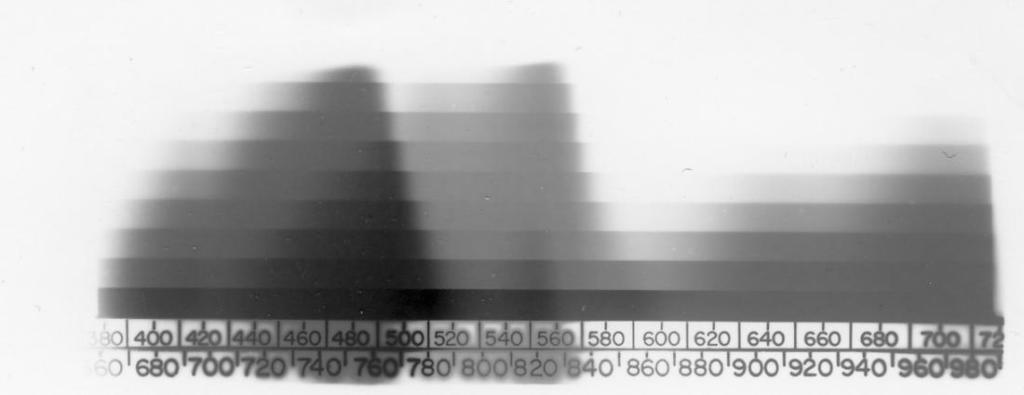
Much is said about masks. This is what one looks like. Thin, blurry piece of film.
What to get for a retouching text — these are from last century. Reed’s is the key reference to have.
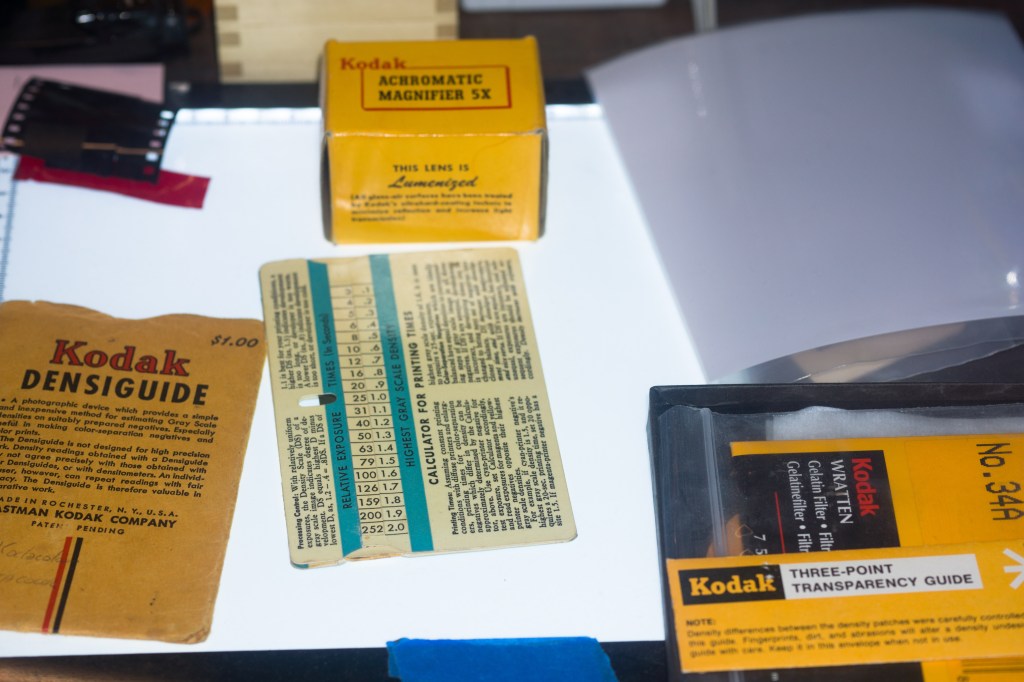
tools of the trade: Dye Transfer lab. some early essentials.
densiguide instead of densitometer
diffusion sheets
Kodak 5x Achromatic magnifier.. to align masks as you tape them
Kodak transparency Q card. This is the hardest to locate these days. They can be made. Sometime I will /have posted how.
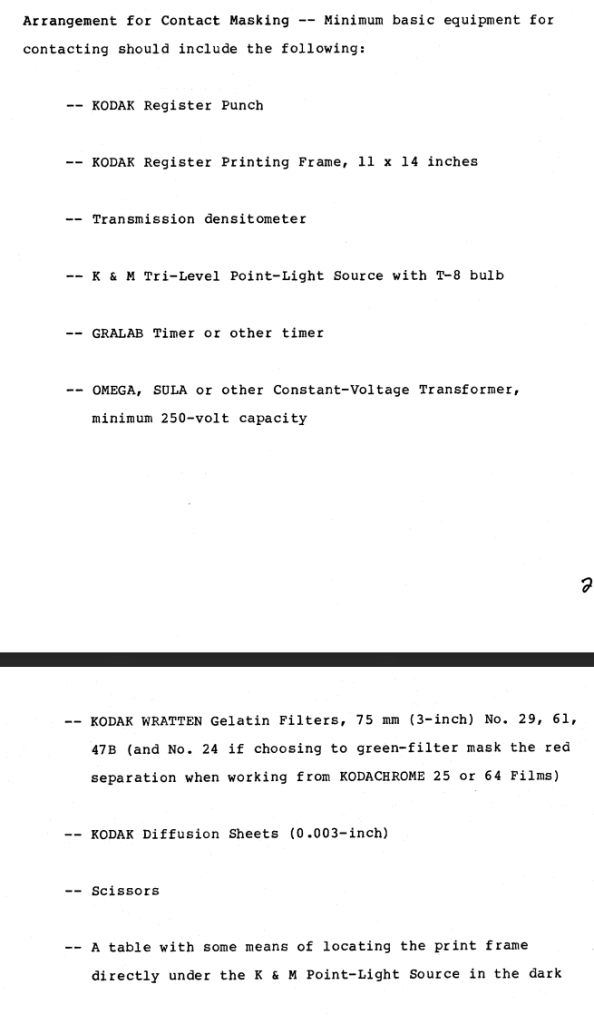
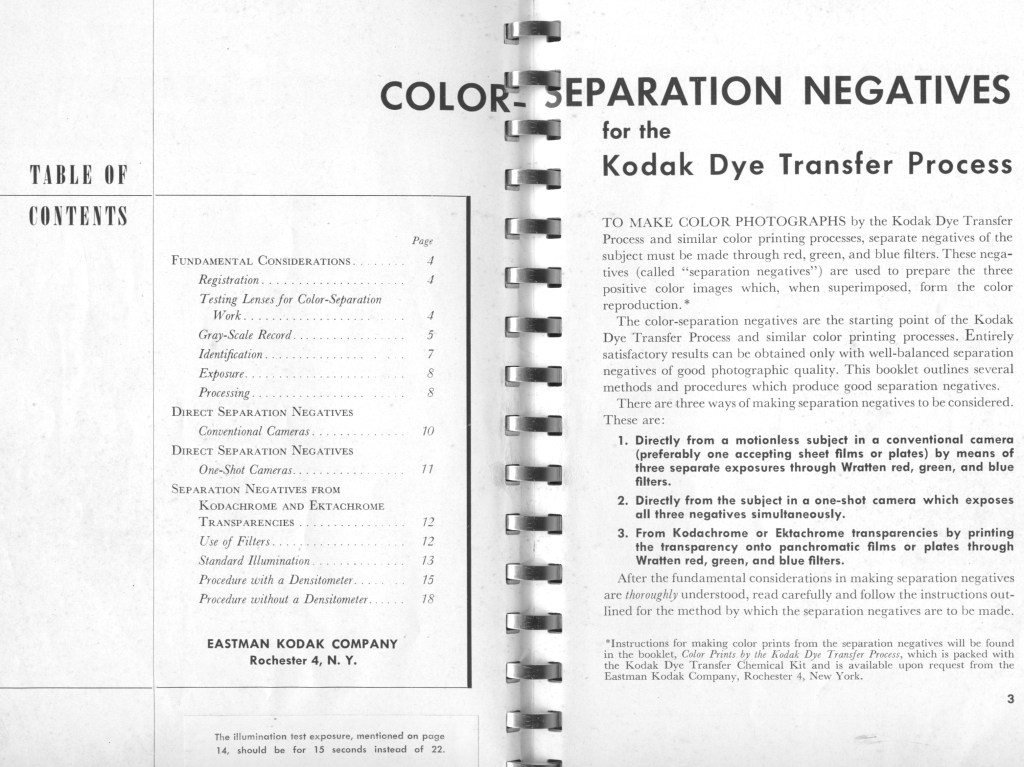
from Brokaw’s section of E-81, Kodak’s unpublished, last dye transfer guide, written and edited by Frank McLaughlin. The first materials written about Dye Transfer came from those in their lab. Later materials, E-80 were written by market support staff, including Frank McLaughlin. The last time materials were updated, Mr. McLaughlin arranged for an updated manual to be written by many members of the dye transfer community.
Dennis Brokaw : Large Format Separations for Dye Transfer Printing
<<–This is his supply list.
Mr Brokaw was cited by Forumatti Wiley as a credential for Drew’s powers of photography.






You must be logged in to post a comment.