at First Grok…

What the web didn’t know… understanding “first” — if I say “first” it isn’t always in the same context. Most people know that if I ask for the first page something occurs the “first page” isn’t the only page I am asking about. Oh well, if at first you don’t succeed, try using a person with a book at hand.
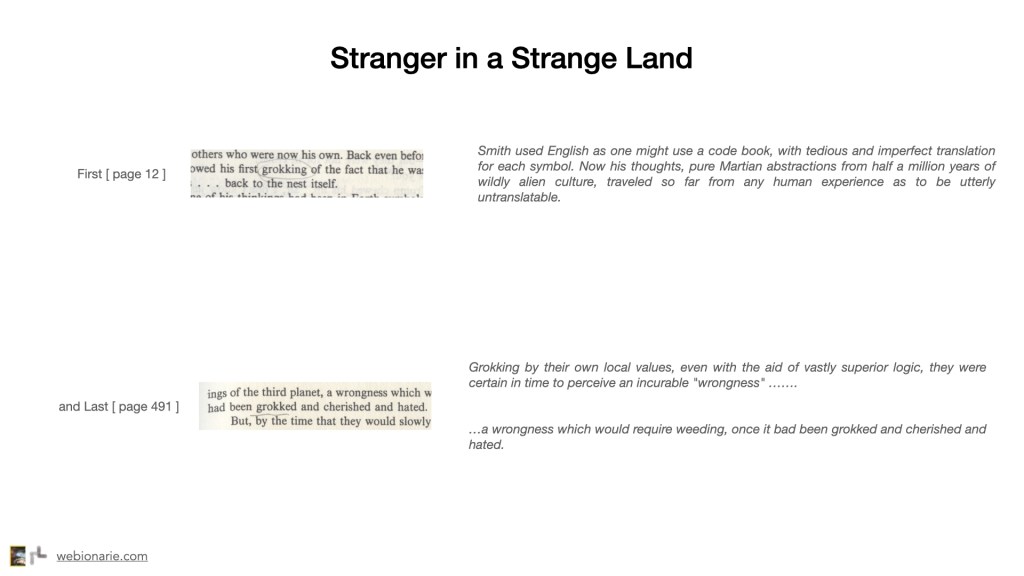
Stranger in a Strange Land

Author: Robert A. Heinlein
Publication Year: 1961
Premise: Valentine Michael Smith, a human born and raised on Mars, is brought to Earth as an adult. He is a “stranger” who must learn what it means to be human, and his journey challenges Earth’s culture, religion, and social institutions.
Key Themes: The meaning of love, sex, religion, and money; challenging social norms.

Origin: The term was coined by American author Robert A. Heinlein in his science fiction novel Stranger in a Strange Land, published in 1961.
Fictional Meaning: In the book, “grok” is a Martian word with no direct English equivalent. Its literal translation is “to drink,” but its conceptual meaning is far more profound.
Profound Understanding: To “grok” something means to understand it so thoroughly and intuitively that the observer and the observed merge into a single entity; the observer becomes a part of the observed. It implies a deep, empathic comprehension and integration of something on a molecular or fundamental level.
Cultural Adoption: The term was adopted by the counterculture of the 1960s and later became popular in computer programming and tech circles to describe the deep, immersive understanding required to master complex systems. Robert Anton Wilson “Schrodinger’s Cat” … Tom Wolfe “Electric Kool-Aid Acid Test” John Muir “Volkswagen repair manual” used in many DIY for women car workshops.

Pages p.12 "Back even before the healing which had followed his first grokking … p.14 "Smith had been aware of the visit by the doctors but he had grokked at once that their intentions were benign. p.43 lawyers and owning a planet p.57 girls … p.67 martian held still p.72 the man from mars. p.221 used as the 50s “dig”

https://en.wikipedia.org/wiki/Hackers_on_Planet_Earth

Footnotes from this week
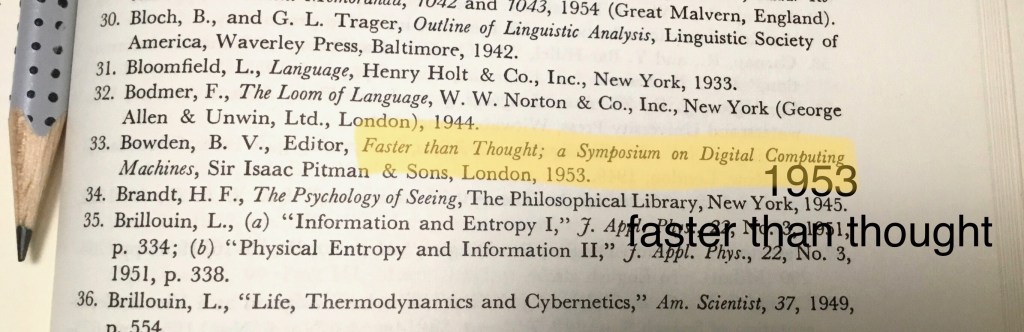
conceptual history… how long machines have been thinking… actually, how long people, aka blood-brains have been considering turning some of the workload over to other-brains.

seems much slower than first thought.

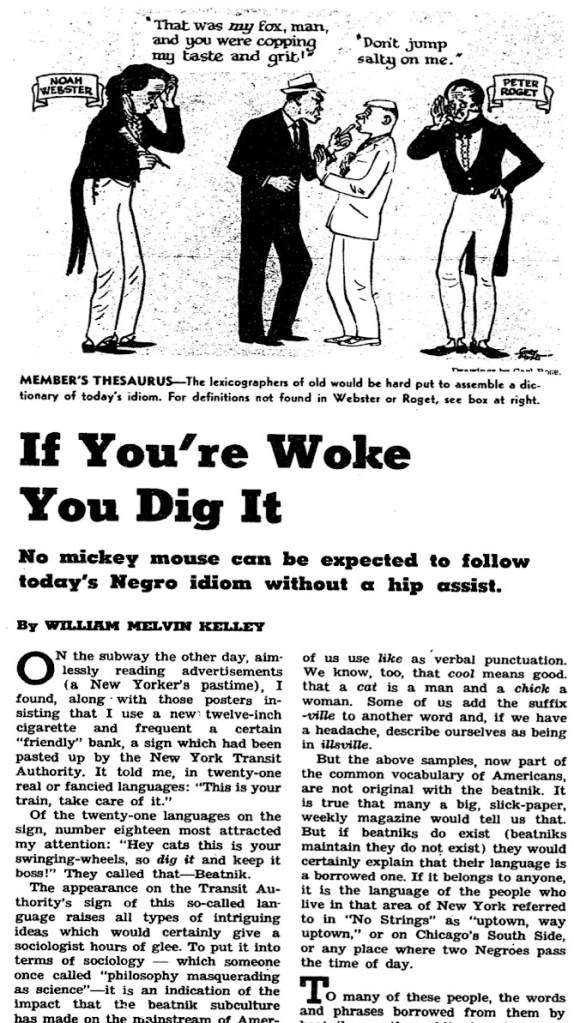
all jive. all jibe. words so far apart… Mindfulness, typically cultivated through deliberate practices, is characterized by non-judgmental attention to the present moment —

Sideband: name taken over by the weakling of tech. using as opposite of Woke, all the while being mere substitution for Grope. Make up your AWKen GREP will ya.

οἶδα the wordle RAH groped for but didnt grasp

OpenMemory treats time as a first-class dimension, letting your agent reason about changing facts.
LLMs are probabilistic – 1% chance of disaster makes it a matter of when, not if.

friday: figs and chords

[A cord is a long flexible string or rope, often made of thinner pieces woven together. A chord is “three or more musical tones played together.”

how multiple meanings can multiply intent . 

The fig tree is about choices of paths .. Sylvia Plath […I saw myself sitting in the crotch of this fig-tree, starving to death, just becaus I couldn’t make up my mind which of the figs I would choose. I wanted each and every one of them, but choosing one meant losing all the rest, and, as I sat there, unable to decide, the figs began to wrinkle and go black, and, one by one they plopped to the ground at my feet….]

and, taking a break from my fig tree thinking I returned to a question about musical chords ..arriving at :

nick drake… success after death.. finding the commercial in the commercial . The time for memory selling the past .. The acoustic over automobile speakers … mechanized memory .

https://youtu.be/fBdbRoSrWr4?si=-S9K02k4Qc3OPSir

Even successful artists carry doubts. Success is never fully sustaining. Success never reduces doubt among the most creative artists.

[ often grouped with existentialist thinkers, Camus consistently rejected the existentialist label, insisting that his philosophy of the absurd was distinct from both Kierkegaard’s leap of faith and Heidegger’s ontology of Being. Instead, Camus argued that the confrontation between humanity’s “appetite for meaning” and the universe’s “unreasonable silence” constituted the absurd, which must be lived with clarity rather than resolved by appeal to transcendence ]

https://www2.hawaii.edu/~freeman/courses/phil360/16.%20Myth%20of%20Sisyphus.pdf

Camus, Albert, The Myth of Sisyphus, Translated by Justin O’Brien, Penguin Books, London (1955) ISBN 978-0-14-102399-1

Monthday

As the month rolls over, I charge the ‘tronics carried on my walks. These guys are a decade old, which seems forever. The covers are wearing. Adhesives failing, but only to a point, a physical pressure point — where my hand has made a mark. The cliche of using objects.

I have multiple batteries which I cycle thru the charge-use cycle. Much of the work from these serve as prompts — training my eye-foot coordination. If my digital comp skills were better, my time in chair more patient, then I would use them in extended form. As soon as I write that, I feel the need to grow. Plant myself into learning, meaning, disciple into effort until a solution happens. Perhaps.

A bit of Burke’s [5/5/1897 – 11/19/1993] grammar: the PENTAD — act, scene, agent, agency, and purpose

  • act: “names what took place, in thought or in deed”
  • scene: “the background of the act, the situation in which it occurred”
  • agent: “what person or kind of person performed the act”
  • agency: “what means or instruments he used”
  • purpose: though not formally defined like the others, this is the motive.

Osborn expands this: “… a truly rigorous attempt to account for a single work on the grounds of poetics alone should force recognition that it is necessary to go beyond poetics-in-particular to language-in-general…”

Back to Burke: ““any nomenclature necessarily directs the attention into some channels rather than others. This can be obvious, such as how different academic subjects direct the attention, or more subtle. Burke illustrates the latter point with an example of how photos of the same objects using different color filters reflected and deflected his attention in different ways, depending on the filter “ [ concept is: terministic screens]

Ref:

  • Osborn, Neal J. “Toward the Quintessential Burke.” The Hudson Review 21.2 (1968): 320.
  • Burke, Kenneth. Language as Symbolic Action: Essays on Life, Literature, and Method. (Berkeley: University of California Press, 1966) 16.

Theory will not make pictures. The obvious reason I take walks is to enter the think, walk, do momentums.

Your turn.