drilling for silver

bits of things. if you have to moderate the topic, you have the wrong gathering — 

VCP, bring out the prints. generous support of Mark Tarmy. Joshua Farr and Mitch Weiss  curators

What they announce:

Drawn from a remarkable local collection, these prints invite you to get close—see the paper, the grain, the edge of the negative—and slow down with images that carry time and story across generations. It’s a chance to experience iconic photographs as objects, not just pictures on a screen: how they’re printed, toned, and cared for, and why those choices matter to what we see and feel.

The exhibition brings together 36 works by 31 artists, spanning nearly a century of photographic history, with dates ranging from 1916 to 2004. The selection highlights both silver gelatin and platinum prints, offering a rich material and historical range that underscores the enduring power and evolution of the photographic print

UP TO DATE:

They will discuss specific images in the show and their significance from the perspectives of technique, meaning, and place in history. This conversation opens a window into the relationships between artists and collectors, and why photographic prints continue to matter in a screen-saturated world.

IN CONVERSATION: Mark Tarmy & Lynne Weinstein | VCP

the collector’s start:

Like most American business stories, Vermont Plank Flooring was born of a degree of foresight, a little bit of luck, and a lot of hard work.]

Our Story – The History of Vermont Wide Plank Flooring

Instead of collecting stories of drillbits , rather than collecting boxes of future used\ items, he collected photographs .

the why of this aside: Drillbits from one Plant in China are produced at 20 Tons a day.. packaged and over 100 brand going to the United States Germany even Austria… with Austria importing specialists steal from China for their use in machine tool making..

caution of the long tail: people thinking their experience is more useful than it is; that they bring more knowledge than they do . they have a view of a business — they think that that view, and experience applies across all business… ADDITIONAL. the china syndrome:

the problem is some forums are populated by a very few highly skilled honest members … how can you tell; they give references. they show their work. you are welcome to the table ;their ideas grow. they have new stories…

prejudice is often a mask itself.. revealing itself. prejudice is a mask that sometimes shows;it has dominance…you married an asian to dominate one. prejudice is often inscrutable… I can’t be prejudiced I married one; yet you’re married to dominate; reminder, prejudice is about domination…

see YouTube bit test … left as an exercise.


drill bits.. footnote. https://www.ncl.ac.uk/press/articles/latest/2026/02/ancientegyptiandrillbit/ This re-analysis suggests that Egyptian craftspeople mastered reliable rotary drilling more than two millennia before some of the best-preserved drill sets.

imagine having a collection of prints instead of bits n bobs

Continue reading “drilling for silver”

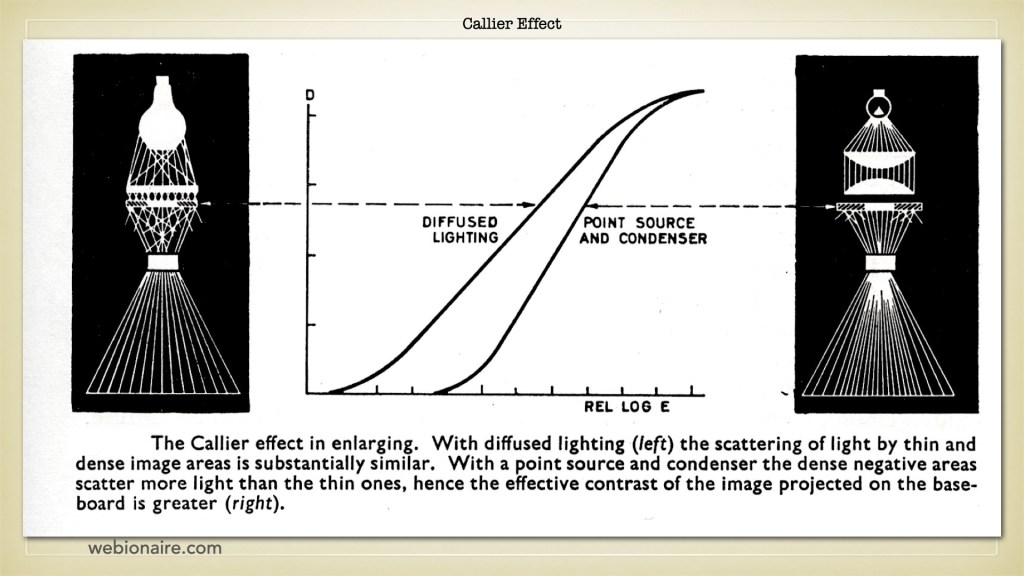
callier confusion

Intelligent individuals learn from every thing and every one; average people, from their experiences. The stupid already have all the answers.”  ― Socrates

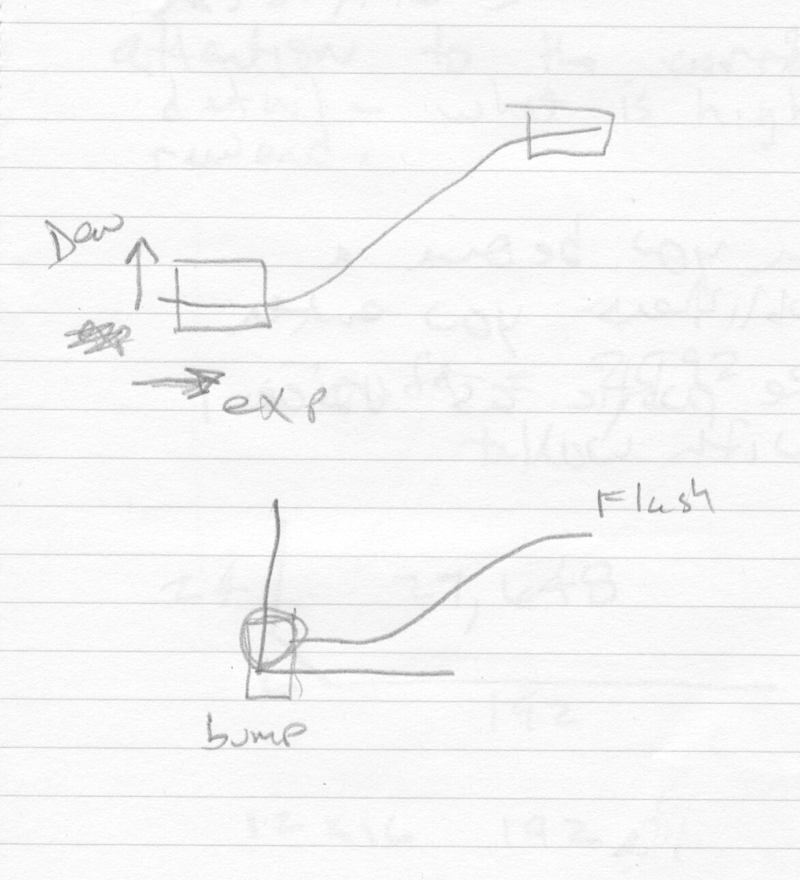
one of the optiquals… using light for means, by means other than image-formed pattern. Sometimes the H&D curve is more bendable than others. More details follow…

:the mysterious Q is called upon from the shadows as explanation for almost any effect. What does it explain? Do you use it… that other light; that other exposure summation. Think weeding … sometimes it makes tea.

Photography is a simplified form of drawing; let the thing draw itself.. the law, rather, the principle of exposure holds for most of the time. Like all real things the exposure rule varies. This variance provides confusion or useful options, even if you don’t know the names of the various effects. Reject before using is a rule of turds. Well known, widely influential resources gain stature by passing along their approach; their dictionary, complete with conceptual restrictions takes hold.

if not controlled, at least understood — edge of distinction —

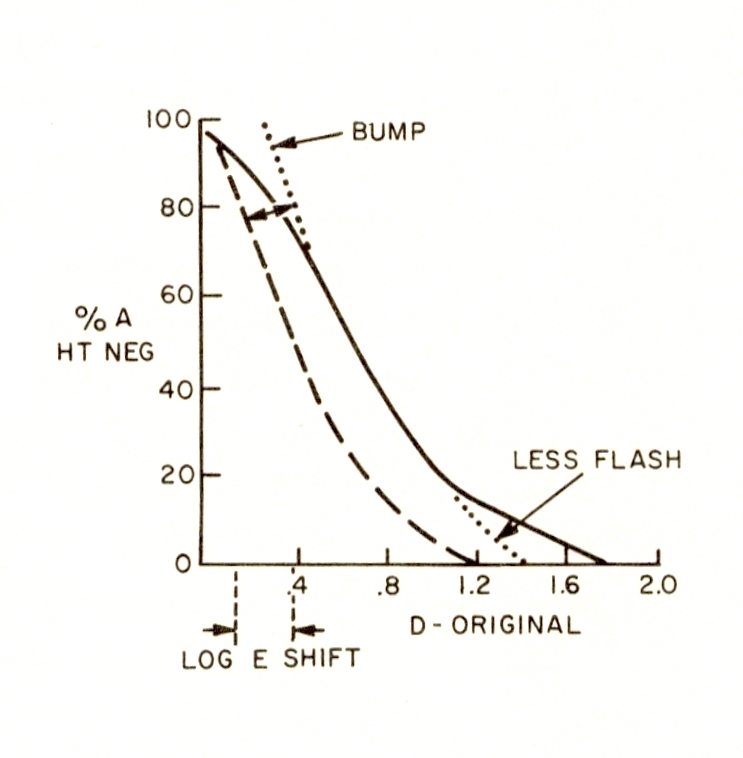
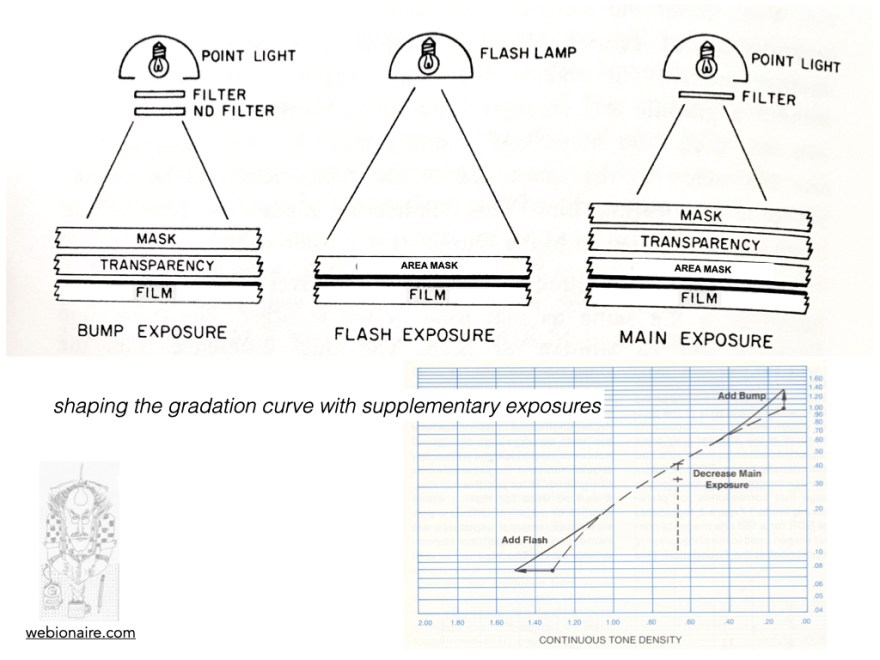
More importantly, how can you use exposure effects in control of the image. How to manage the different points of the curves. Tone-bending, by using effects discovered and refined by early photographers building out the field of light sensitive surfaces.

Flash and Burn characteristics of the enlarger. The slide-set introduces the concepts of controlling some of the HD shape by means of altering single contrast emulsions, such as films. All dye labs had full understanding of these principles. Some of the information carried over into the fixed grade BW darkrooms.

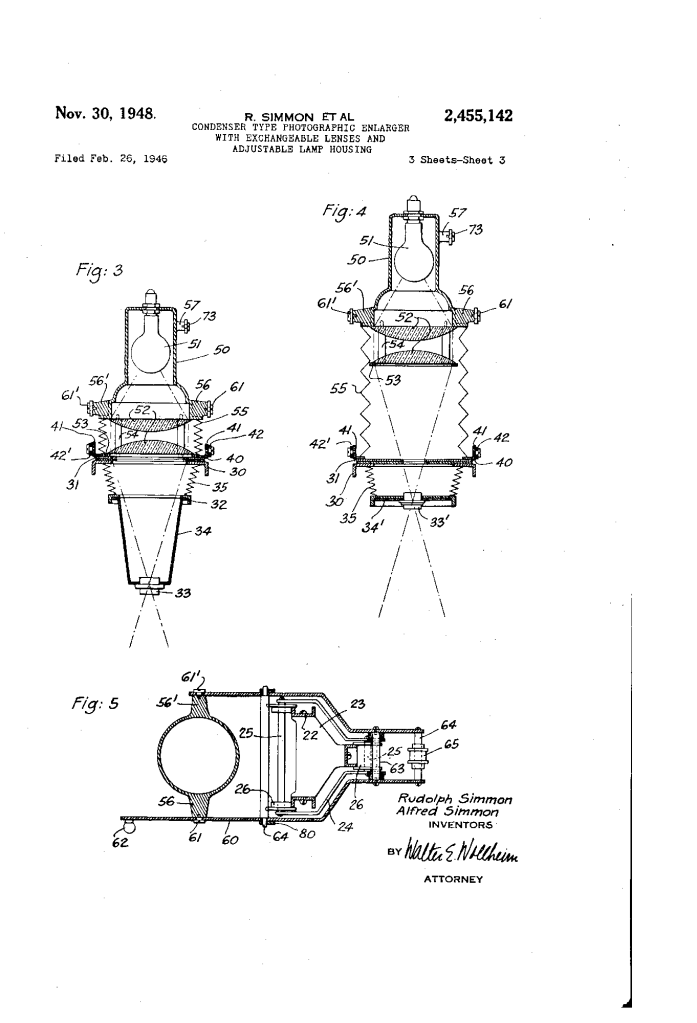
patent simmon
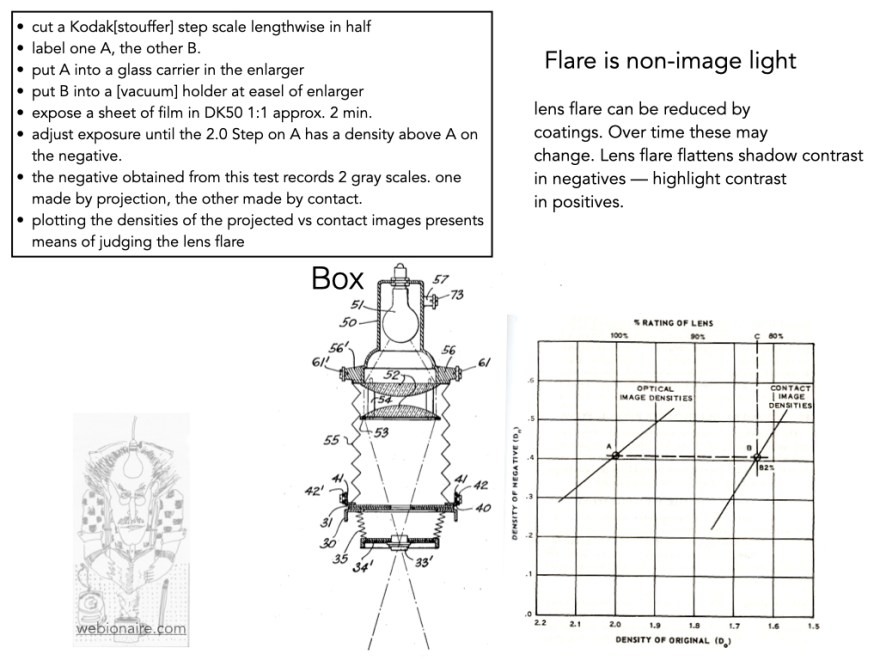
Early darkroom lamphead patent for a condenser enlarger. 1948

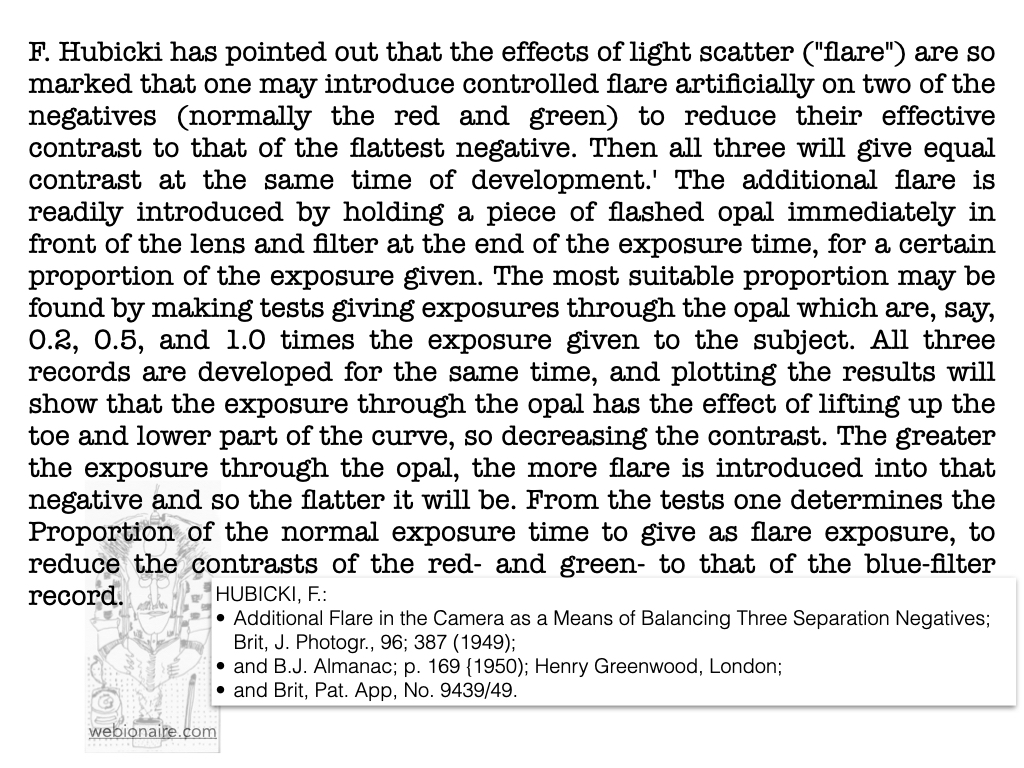
Flare up. The other words, effects found upon deeper reading into the the literature of exposing silver materials. If you were a designer of systems, or an extremely inventive user, these terms, often named after their initial discoverer, will take you along the full path of the characteristic curve; enough so, that you could begin to design exposure making and measuring systems.

Flare: The worst element in photography. The projected light that escapes around the image and causes fog and distortion of the original image. — Bob Pace.

  • MEES. c. E.: The Theory of the Photographic Process, p. 849; Macmillan. New York (1945):
  • and GOETZ, A., BROWN, F. W.: Light Scattering and the Graininess of Photographic Emulsions, J. Soc. Mot. Pict. Engrs., 39; 375 (1942).
  • SMETHURST, P. C.: Scattered Light, Image Gradation, and Surface Treated Lenses; Brit. J. Photogr., 88; 427, 434 (1941).
  • G. Kornfeld, “The Herschel Effect and the Structure and Stability of the Photographic Latent Image*,” J. Opt. Soc. Am. 39, 490-494 (1949).
  • Zachoval, L. A contribution to the theory of some photographic effects. Czech J Phys 8, 214–217 (1958). https://doi.org/10.1007/BF01603694

uses.. filed borders to introduce gate-flare : edge of framing gate induced flare .

Additional References

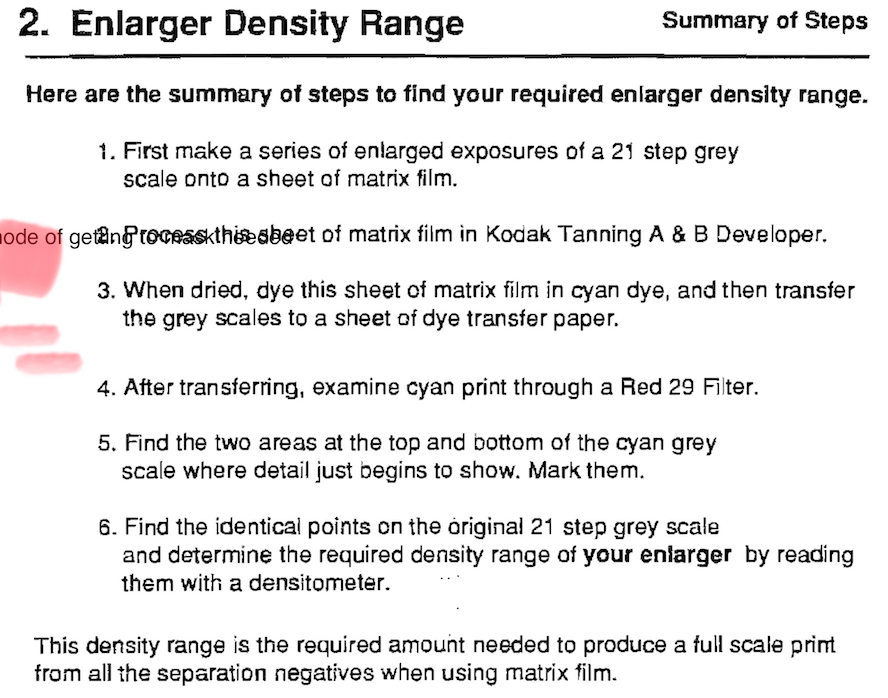
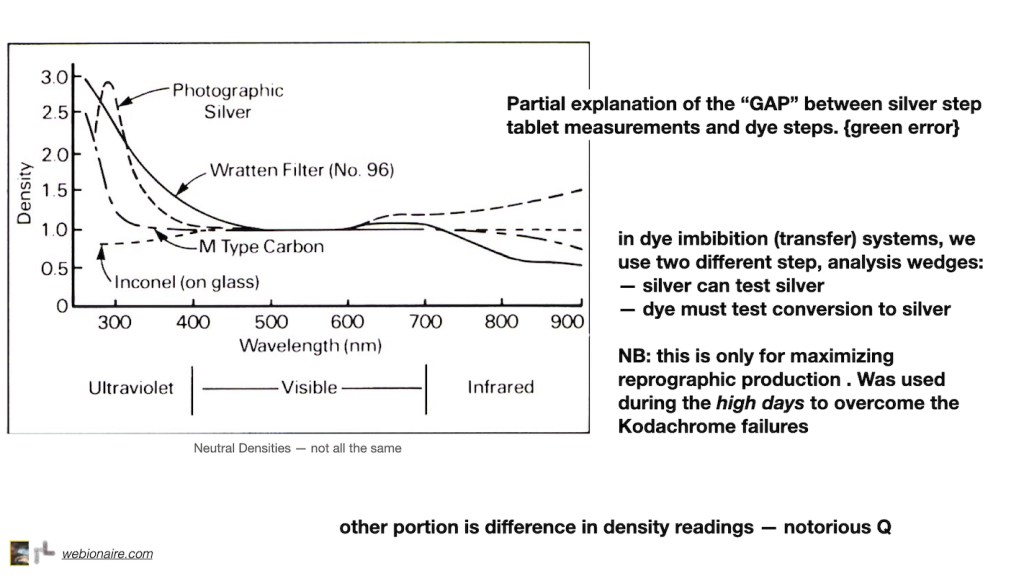
Using means knowing the difference between a silver contact and silver projected image in common darkroom printing. Dye-transfer is BW made complex by the number of steps; permutations seemingly beyond understanding. We learned the difference between silver testing and color, dye testing. The AIM, targets used had effects that could confuse ones initial learning — without luck, or well directed starting information it could seem a fools burden… pushing snowballs up a volcano.

Become alert to difference in response between instrument reading and material action: measurement may not predict fully, accurately. What you measure may not be what you get — refine, or re-define. Dyes aren’t silver; this meant that what we tested changed by stage of the process; was it silver, or dye stage material.

Applications and Implications —

exposing adox lupex : https://www.adox.de/Technical_Informations/TA_LUPEX(EN).pdf

reading adox contrast and understanding: http://www.adox.de/Technical_Informations/MCC_Datasheet.pdf

AN: splasboard processes

zeiss paper: https://lenspire.zeiss.com/photo/app/uploads/2018/12/en_About-the-reduction-of-reflections-of-camera-lenses.pdf

NB: Phantom Markets

The depth of products for photographers, particularly darkoom equipment, declined rapidly in the 90s, the time that most of the current beginners opened their eyes. Providing information about how things were done is more useful if provided with enough background to provide grounding. Rather than tieing their laces together, shut up.

Everyone asks for “it” — upon its production, most have a reason for no longer needing it…

So, the boxes of knowledge weren’t needed.

Amateurs make more requests than most makers can satisfy. As a market declines requests are as likely to be fantasy, role playing more likely. These assumed buyers flee, actually, they never existed. They were suspects, not prospects. No way to close that deal. Most online communities are intended as gossip centers. Sales talk. Buy and sell is the way of exchange. Few members have depth of experience. Most members, most people, even those declaring themself curious, have a narrow decade of knowledge… frequently, craft-skill is more limited than academic transferable awareness; even this is lost after a decade of disuse.

What we have is a gathering of curious, unskilled people passing on hearsay as teaching.

Peak commercial darkroom equipment sales was in 1979. The commercial, custom printers knew this; honest sales reps were quite clear about upcoming deals to be made, going so far as advising other avenues of purchase.

How Groups Grow: dilution or distribution of effort. Online communities cluster in skill pools much as occurred in regional settings . These skill pools are never culture-free clusters.


The AGO Film Processor and B’s Processor are both designed for home film development, but they differ in functionality and design. The AGO offers automated agitation and is compatible with Paterson tanks, while the B’s Processor rotates the entire tank and is known for its compact size and ease of use. Here’s a comprehensive comparison of the Ago Film Processor, B’s, Jobo Silverbase, and Pira Darkroom Helper based on their functionalities and notable features.


Feature Ago Film Processor B’s Film Processor Jobo Silverbase Pira Darkroom Helper
Type Automatic rotary processor Standard processing unit Compact rotary processor Darkroom assistant tool
Compatibility Works with Paterson tanks Various standard tanks Compatible with JOBO 1500 series tanks Designed for darkroom setup
Film Formats 35mm, 120, custom reels 35mm 35mm, 120, 4×5 Various formats
Temperature Control Adjusts development time automatically based on temperature Manual control No water jacket; suitable for room temp Not applicable
Programming Pre-loaded programs; customizable Manual timing Automatic rotation with set speeds Generic darkroom support
Power Source Battery operated AC powered AC powered Not applicable
Cost Approximately $500 USD Varies (generally lower) Approximately $515.90 USD Not applicable
Suitability for B&W Excellent for B&W and color Primarily B&W Designed for B&W film processing Focused on assisting darkroom tasks
User Experience Easy temperature and time adjustment Requires manual intervention User-friendly rotary agitation Supports various darkroom processes

Detailed Insights

Ago Film Processor

  • Technology: It automatically adjusts development times based on temperature fluctuations. It can optimize processing for various color and black-and-white films.
  • User Experience: Battery-operated, allowing flexible usage in small spaces.
  • Pros:
    • Automatically compensates for temperature variations.
    • Includes pre-loaded programs for diverse chemical kits.
    • Efficient for both black-and-white and color processing.

B’s Film Processor

  • Technology: A more traditional processing unit, requiring manual timing adjustments.
  • User Experience: Generally more affordable but less feature-rich.
  • Pros:
    • Cost-effective option for users who do not require advanced features.Around $145
    • Simpler operation for those familiar with manual processing.

Jobo Silverbase

  • Technology: Rotary processor that employs magnetic rotating for even chemical distribution without a water jacket.
  • User Experience: Known for its compact design and efficiency, particularly for black-and-white films.
  • Pros:
    • Compact and user-friendly.
    • Excellent reproducibility of results.
    • Allows use of less developer with one-shot solutions.

Pira.mx Darkroom Helper

  • Estimated cost $250

Basing a product on Jobo or Patterson seems safe. Jobo having vocal suppoters, Patterson being owned by a larger manufacturer with multiple product lines.