Last Dyes

The last dyes are like embers from the fading analog engine. The revivalists are rushing to ride the final fashion like Lauren Lauren’s Leica slung, long lean strappy dangling from her pampered bridal shoulder. Both, she and her camera, accessorizing his success.

Dye transfer prints will decorate many a wall. Some may hang for most of the year.

THE REAL : The show — meaning from the real world. The gallery world seeming more connected to factual effort.

Dye Transfer had an early glow, mystery of process, mystique of object value. The process was time and material consuming, making it in the fuller sense something for advertising, appealing as Veblen Good to the Haute Bourgeoisie.

“I was reading the price list of this lab in Chicago and it advertised ‘from the cheapest to the ultimate print’. The ultimate print was a dye-transfer…. The color saturation and the quality of the ink was overwhelming. I couldn’t wait to see what a plain Eggleston picture would look like with the same process. Every photograph I subsequently printed with the process seemed … better than the previous one.” —William Eggleston in conversation with editor and writer Mark Holborn, 1991

:

CVI, Color Vision Imaging laboratory, Manhattan, 1981. Guy Stricherz (b. 1948) graduated from western Washington University in 1974. He went to New York city in 1977 to work for Frank Tartaro who was one of a dozen masterful printers. Even at that time the process was falling out of use. It had peaked by 1980. Irene Malli (b. 1964) graduated from Cooper Union; after graduation she worked as a printer before answering an ad for CVI in 1989. CVI was moved to Vashon Island from NYC in 2004. Some of their recent clients: Larry Burrows, Bruce Davidson, Thomas Demand, William Eggleston, Mitch Epstein, Ernst Haas, Hiro, Evelyn Hofer, Graziela Iturbide, Zoe Leonard, Arnold Newman, Irving Penn, Christopher Williams.

Frank Tartaro was another user of the idea of “tone zone” masking.


The best memory is based upon your experience. Make your own.

THE IMAGINED: Unfortunately The Last Dyes show brings out the zombie experts of the hobby forums. Killers of a process they view from sideline. The show provides opportunity to talk as tho they had a privileged seat; bring out their old bar counter stories, a chance to repeat their prejudices of process. This is the use for the brag boards.

Question the tale of the salesman. I didn’t call him on his bullshit, so you have been left with his constant crap for a decade. Mea Culpa.

They don’t learn enough because they don’t ask, they aren’t curious. They don’t do enough because they lack courage. They fear failure more than they crave doing.

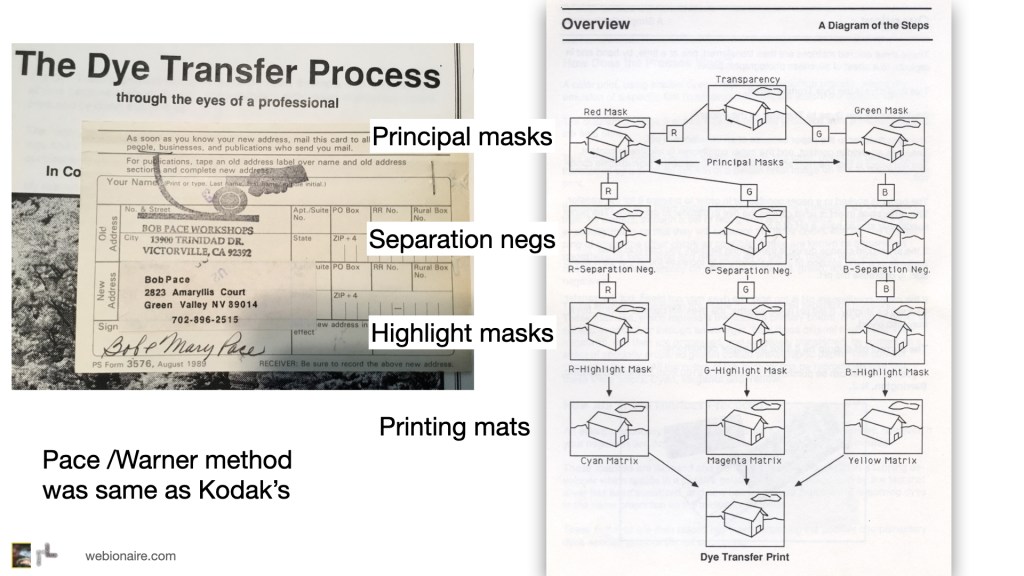
The false information is imprinted onto the naive minds. False tales aren’t questions, even though he is doubted. Why trust any part of his complex tale if the beginning direction is in error. Part of his ongoing commitment to his fantasy story of his skill is due to my being so bored with him at the St. Regis meeting, I fed him his own ignorance agreeing in order to escape. No one used Tanning Bleach in a commercial practice past 1952 — the mats weren’t sharp, nor durable enough for the uses of commercial printing. There was one use of tanning bleach: schools doing Pan Matrix film– this was rare, caused by group darkroom restrictions. AND the Army never made Matrix Film; they did buy it, while after Korean War, the Department of Defense sold the surplus materials. K&L (Len Z.) bought thousands of sheets which gave him a price advantage for several years.

The Army doesn’t make sandbags nor shoelaces. Not even CCA made their materials; they did have a need for large “trans” materials which Kodak refused to make. They couldn’t. They didn’t have the ready knowledge, so CCA tried two different coaters; NG was able to make the materials using a design provided them by Robert M. of Defender.

Lasting Lie Transfers: turning sales speak into history. The story is now being told by people who didn’t even participate until the story was over
eggleston show brings out stale fish stories; stolen valor from the photo fantists

  • “he was a machinist ” — about Eliot Porter; he wasn’t a machinist. His mode of making DTs didn’t require him to have “made his own” transfer equipment. He was a long time woodworker. He discovered the “black box” printing system. His self-made items are all wooden. No metal, no punch-pin system.
  • ” soft image– dye bleed” — the reason Condax was brought into Kodak was because of the improvement of Tanning Development over Bleach Tanning. Two immediate improvements: sharpness of transferred image, and improved color clarity with existing dyes.
  • ” don’t hold highlights well” — hmm, how about all those suds and softgoods ads? Or, Eggleston’s White Ceiling Fan.
dye diffusion effect

a piece of the elaborate custom equipment made by Eliot Porter for his dye transfer lab.


Google has found my post from 2013, titled: The Last Dye Transfers .. coincidence a long time coming

For those considering another possible use of matrix film– think it as a mask. I did. See this patent which I’d discovered around 1961: https://patents.google.com/patent/US2371746
techday: masking 1964

My first dye was made in 1960. It was on Pan Matrix from a color negative. Probably of my dogs. All these are lost to landfill on a farmside hill in Ohio.

A mask is a cover; it holds back light. At first, it was done fully by hand. Masking and retouching have always seemed like two parts of the same concept to me. Dodging is masking that disappears. Retouching a negative holds back something, which is what a mask does. I learned negative retouching from a Paul Outerbridge book. With an endless need for these skills, automatic masking methods found researchers. The “exposure method” of mask making took hold. That is likely the only method you consider.

The first films are long gone. No lab I ever knew kept originals; the client always wanted them returned. Photographers had files of film originals, but they didn’t get the seps; none of the intermediates were maintained more than a year. Perhaps government agencies could manage the volume of film use, but not the commercial, custom labs. Our volumes were too high. We could barely keep supplies in store. What I do have are notebooks; some quite full, and likely complete. Film, processing, curves, all these are what I call upon as reminder of what things were like.


poor Milpool… don’t take his word.

You can count the sheets of film. 2 principal masks — shortened version was a single mask using a magenta filter. I accidentally discovered, using a blank Color Negative ‘base’ acted as a correction mask. I misunderstood readings on what a color negative ‘orange’ mask achieved, thinking it solved problems for all film — believing it a universal filter, I used it on my early Transparency printing. I began making dyes with the Pan Matrix method. I shot color negative, then made mats with PM. These were my early, teenage years. Explaining my shortcut to an accomplished printer, he patiently explained my error, then suggested I substitute a Magenta Mask, as he handed me a Wratten filter, and pamphlet on the procedure.

There were always good people. Maybe because they made a living doing the work. They had little fear of being knocked from their hobby horse.

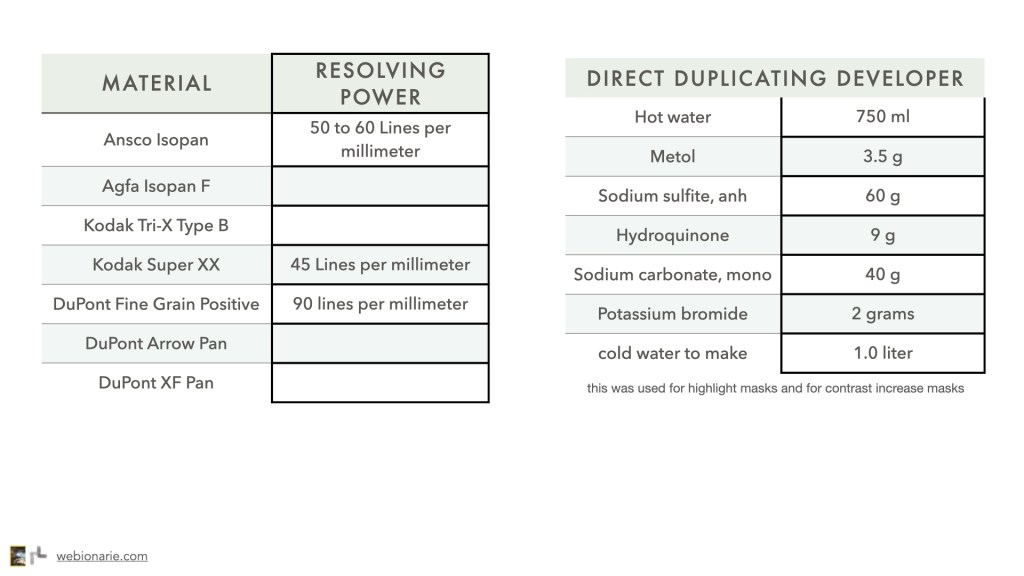
Super-XX was used by generalists, not by specialists. My initial films were many, including Super-XX. Even early in my transparency sep skill, I was disappointed with it. Isopan was superior, as was XF Pan. An early reference took me to Tri-X Type B, a very good separation film; it was also used by Eliot Porter, although he was a Super-XX user. After finding Kodak Separation Film types 1 & 2, my separation methods matured.

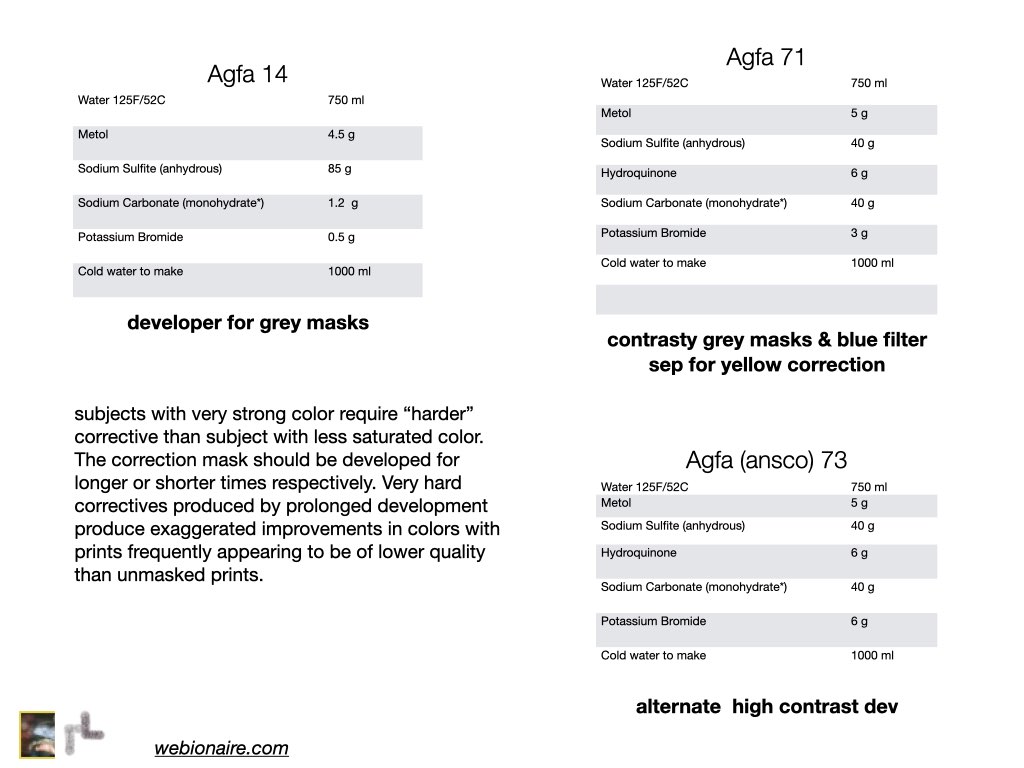
With color negatives of the late 50s, early 60s, contrast and exposure latitude was poor; matching the Matrices was challenging, requiring manipulation of dyes and matrix developer, even beyond what the instruction sheets told. And, after a few years, since I was printing for others, I had masked the negatives. Often for contrast increase, which meant using direct-dupe material. That could also be used for making distinct tone separation masks– all these things, along with having figured out ‘color coupled’ masking, meant I was getting work from labs. None of them realizing they were working with a teen skipping school.

Plastic Defense

sheetwork: scribbles I need to post. These are jots of pieces updated and some sitting as drafts. Time requires ticking of something — these minimum daily/ overnights are tags for those tickings — prompts for more work.

plastic defense: of power of the expert amateut [amat class 1][1st class amateur]

stencil craft.. we inherit digital hobby groups.

[pyro warriors]
catechism of catechol
acolytes of
defending the gospel from ... the under amateur. the un workshoped


make a fool of you
[lots of "repeated opinion" out there.. until it becomes standard knowledge -- a standard loss of direct experience]

know it because you did it. did it to know

following [sk] path realize they [sk] now work digital. dn to inkjetneg for alt printing. became printers calling themselves printmakers.

making a direct route complex-icated.
[even "ordinary" silver gelatin prints are specifically toned - not in some over-the-top artsy/craftsy sense, but in a precisely nuanced manner.] the artsy end of subtle, humble brag from the snob of the back office soft wood store.

--- grandiose declarations.
[150mm f/8 Apo-Germinar W to enlarge 4x5 negatives]

colorado sunset:
fast rising nations have leap-frogged to digital in their medical system. no need for film, not even dentists. colo co split their company prior to shutdown -- digital off to green pasture, WARN notice the coaters..

characterizing film.. 4 films, same developer. what shapes a curve most.

watercolor: hutchings sales;otch.. but exhaustion is lccurring before most tanning.
tanning of hardened gelatin is difficult, why we dont make mats oit of tmax...

Where are the Pyro salesmen now?
-- doing digital. The pyro stopover, for them, ended as they gained skill in digital. So it goes.

Staining developers don't tan enough to be used for differential hardening of gelatin; particularly not modern hardened emulsions that Ilford and Kodak make. If it did, you could make a mat using TMAX. Doesn't work.
[brian shaw and milpool see the error, but can't get beyond]

the citadel, drawbridge of backoffice expert holds that: you can't see it on the internet [like cloth] so i can't point you to an example on the web... while also avoiding[you didn't ask] telling you where ypu couls see it in real world -- doesn't know that either, otherwise answers could be direct, as direct as a contact print.

[pandering to the wileys]

to engage him is nourishing -- light into his lonely ego -- the abuser cannot be over abused. he grew up that way. he was born into anger.
---
the collectionplate holders in the house of born again stainers:
-- freestyle, selling gordon's book, as they sponsor his name upon their banner
-- photographer's formulary -- the many mighty pyro potions including gordon and wimberely. they were the early seller of kits for the curious and the committed.

===
look at prints from original wide scale: clouds blocking sunbeams into rippled water pool in shade
reflection densities from pyro neg
and divided dev neg
onto ilford warmtone in formulary130.. fresh glycin.

4key HL
4deep Shadows.
no toning.

blind test shown to 3 different printers and one master lithography printer[tamarind trained]
none of them could resolutely say which prunt was made by which negative.
the only printmaker did return to the divided dev print wondering how it was made, and if it was typical of darkroom prints.

he took the print as a master reference for a press project he was working.

===
pyro -- joining the choir..
doubley diffuse, or cold light exposure onto brovira, or kodabromide

showing them plots based upon exhaustion and dye products vs silver will be banished with a scoff... tacking into the science if you are 'artsy' and into the 'crafty' if you are too chemical.
how they keep their amateure raft afloat.
[compare curves: fp4+, tmax400, in silver only alongside staining dev.

also, could show tanning only effect... alas, they would not change faith; they have pledged their allegiance. phenidone can't save them.

[conservative means unexamined self]. giving your eyes away.

[2004: Well, thanks to everyone who replied. Probably a little too much detail for me right now, but great none the less.
I've now got hold of some PMK from Silverprint and will try it out soon.
One final question - I usually shoot mf with FP4+, Neopan 400 and recently Efke 25, and develop in Rodinal. Which one of these films is going to benefit most from using PMK?--\\ 10 years later, no answer! opinion]

-- agitation affects stainers more than controlled developer classes; why emulsion cos dropped staining devs from catalog; along with toxic chems in 'kitchen,' dual purpose darkrooms.

[reminder: restrainer post.w]

===
FB4 fonies. show chart, they want art, show art they tack chart. can't show a chart, prefer to reject yours.

NOTES —> Staining: color takes place in the absence of sulphite. [Evans and Hanson] in the absence of sulphite, the colour factor increases greatly. With too high a sulphite concentration, the colour courve falls below that of the silver, whilst the opposite is true with a normal developer.

–>An increase in alkali increase activity of the bath and speed of development, but also increased tendency to oxidize, and hence the fog…. Anti-foggants: development fog can be avoided by adding an organic anti-foggant to the developer.

–> Direct formation of colour images by development — by simple oxidation produces a colour substance in situ. pyrocatechin and pyrogallol in the absence of sulphite produce, in to the silver image, a residual brown organic image which tans the gelatin.[glafkides]

–> 1909 Andre Callier studied the effect of scattered light upon density measurements. Q factors is not a constant for all densities. SEE: Bull and Cartwright, “The measurement of Photographic Density,” J. Sci. Instrum., 77; 444(1937). ALSO: James and Fortmiller, “Dependence of Covering Power and Spectral Absorption of Developed Silver on Temperature and Composition of the Developer,” Phot. Sci. and Eng., 5 297(1961) NOTICE THE temperature part of that article title.

making pyro