The Print… between books and followings: Mortensen or Adams.
William Mortensen (1897 – 1965) was one of the most well known and respected photographers in America in the thirties. Ansel Adams called him ‘the Antichrist’ and wanted him written out of history.
Ansel Easton Adams (February 20, 1902 – April 22, 1984)
The Print… Adams (outlasted ..)
Print Finishing.. Mortensen (came first)
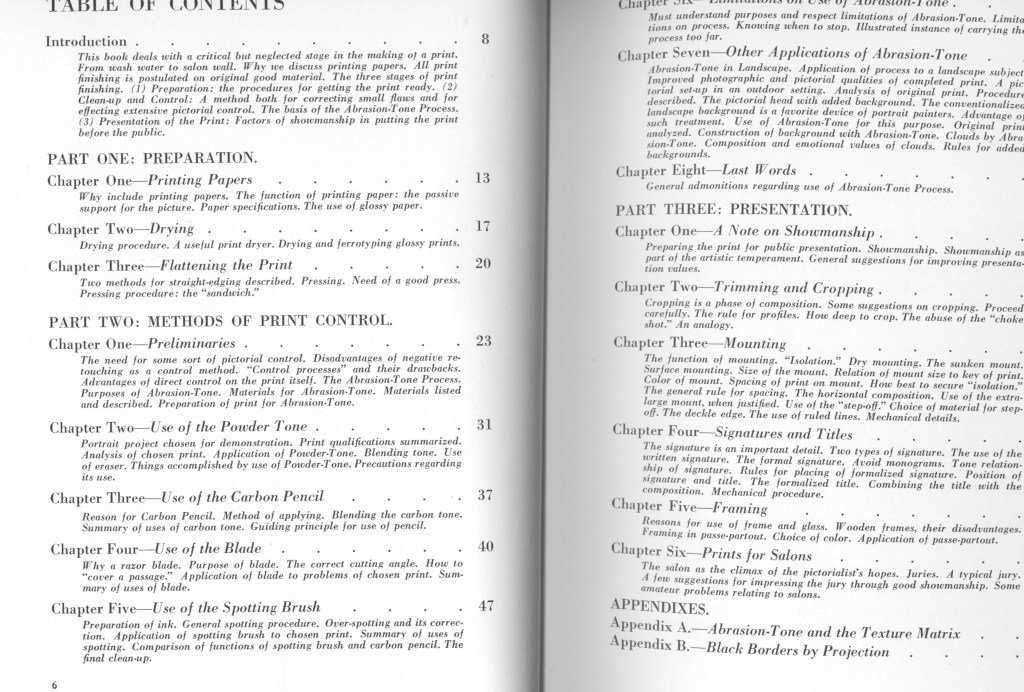
Should you want to make prints, the Mortensen is overlooked; it shouldn’t be.
The contents, shown below, is why. Much more content.
Adams is about curves and chemistry… in search of a print, whereas Mortensen is about how to retouch, to introduce the hand, while also providing specifics about drying, flattening of the print.
Even though he was there before Adams, we all know Ansel Adams.
Mortensen’s method required the hand. It was all about the final print; what could be done by the individual photographer… using haptic tools in addition to the optics.
Not the Zone System. A tone system.
In "Venus and Vulcan" -- a series of 1934 Camera Craft magazine essays -- Mortensen defended Pictorialism against criticism from the f.64 school and other "straight shooters":

Photography, like any other art, is a form of communication. The artist is not blowing bubbles for his own gratification, but is speaking a language, is telling somebody something. Three corollaries are derived from this proposition.

a. As a language, art fails unless it is clear and unequivocal in saying what it means.
b. Ideas may be communicated, not things.
c. Art expresses itself, as all languages do, in terms of symbols [William Mortensen, "Venus and Vulcan 5 - A Manifesto and a Prophecy," Camera Craft 41, n. 6 (July 1934): 310-12. As quoted in A. D. Coleman, "Conspicuous by His Absence: Concerning the Mysterious Disappearance of William Mortensen" in Coleman, Depth of Field (Univ. of New Mexico Press, 1998).]
Mortensen could draw. Had a larger world to draw from than Ansel’s insulated Carmellows. Limited by his piano, limited by playing to predetermined steps; not the human voice, rather the machine one. Chartable. The Adams universe prevailed since it relied less on human spheres. It is something that can be done on the weekends, alone. All that is needed is money and weekends.
Ansel gave us Coffee Cans and Canned Landscapes. Mortensen… another voice from the past, even though it seems possible that his whisper remains stronger than Ansel and the Newhalls wanted
The digital age is the age of retouching, even more than the chemical age.
approximate meaning. finding the way. crossing the divide. making a bridge
Two worlds. Two cultures. Everything changes. Everything stays the same.
Finding meaning and having the means to reveal that, to yourself and maybe others. Both the problem and the driver.
at first an observation. What prompts that. Is it a small nit, or does it take a large shaking abruption. Usually crossing currents provoke the most. Change in flows provide great energy, most is wasted, passes on without utility.
So this provoke began when a technician of graphs asks how else to describe what matters about an emulsion. Actually, he wants to complain about a description of a developer. XY people don’t grok PR people.
amateurs need guides; they await the ice-cream truck.
These are secondary sources; people I didn’t know, nor did I read until this century. I read them now only because I’m studying the failures of the forums. The staggering load carried by weekend workers. Members of bands that none will remember. These sales force folks sell sweets.
they tell you what you tell yourself: it’s the stuff that makes me better. at least, it’s the stuff i can talk about. like gossip by the fish fryer out at manlake lodge.
no girls says the sign . no words say the words
whether they’d like it based upon your likes…all things taste like chicken to a person of consensus taste
like a spoon in the knife drawerthe amateur photographer is, of course, something else by weekday; like cross-dressers, their week sees them one way, their weekend another.
But, then again, my path crossed just now because I was looking for CVI materials. They were found in an archived Picker Newsletter.
Fine Art Photo Supply: FA-1027 is what snapped the string on this topic.
Anthony Giudice sold Fine Art Photo Supply to Photographer’s Formulary for personal reasons.
Fine Art Photo Supply is a new company in Rochester, NY. Much like the old Zone VI Studios, we are a company marketing photographic merchandise and we are photographers ourselves. I have been involved in photography since 1972 (just after I quit my high school basketball team!); and my wife Vicki, who handles the administrative end of the business, has done lots of color commercial photography: 2 books, and over a dozen magazine articles (including 4 covers).
And like most first time, low factor salesmen and entry managers, they move to the extreme. Selling too hard or too soft. They will pass just as all weekenders.
Description is always based upon something else. There is no qualitative, boundless, fully functioning explanation. Not in physics, not in math, certainly not in any developing growing human pursuit including photography, a very self absorbed drawing system.
The color of the silver developed image… what does it mean? We had more options in 1950, but we also had a much more limited vocabulary. Warm. Cold. Developer and paper names didn’t have any basis other than commercial convenience.
How about charts. They always look good. Like something from a math course blackboard.
We call them “characteristic curves” which has to make them readily useable., as well as being beyond just words. Right?
At last. A Table of values. We can put this to use, can’t we?
Yep. If we are using those developers and we have a good working time at 68F, then these provided percent changes to that time should produce the same resulting negative.
This if from 1950. Probably not as useful this year, even with those developers since you won’t be using the lovely films made back then. You can use Ansco 17, particularly if you are doing separations.
of course, just having the words well defined and in a table won’t make them useable, nor used.
this is for an inkjet pigment printer. Note that it does use a pigment — and it seems to get through those tiny jets just fine… this is from a decade ago technology. The dumbwaiters from the forums still think that size defines a colorant.
Purdy pictures certainly seem persuasive. Reading them does require more… picture language is always more demanding.
The colored area is an ICC profile of Dye Transfer colorspace. It is overlaid atop, so you can see how it is contained within, an inkjet pigment printer profile from 2013. A decade ago inkjet printers had wider color range than dye transfer.
Plus, that same inkjet printer calculates out at over 100 years life expectancy before visual difference in color.
Use words that you find useful. Simple enough. The finding is much less certain. Words in all its form make distinctions clear to those experienced in using them. Gaining your own experience; making your own dictionary is just a first necessary step, and the biggest difference between those who ride the hobby horse and those who ride a work horse.
Love is just a word until someone comes along and gives it meaning.
Paulo Coelho
pictures catch the eye; words the mind
words tell; pictures convince
sidebar: ORTHO LITHO. confused online photo sites, like love and online dating. Ortho means the response of the emulsion; litho is jargon for the original use of lithography — a high contrast, usually thin film. Ilford makes Ortho+ sheet film. Arista sells a lith film which seems refactored from the silk-screen industry. This latter, ortho-lith film is frequently what is being referenced by the onliners. Kodak’s Kodalith was the premier version of this film. It also came in types, one was panchromatic, so there used to be Pan-Litho film. So it was.







You must be logged in to post a comment.