Print Finishing.

The Print… between books and followings: Mortensen or Adams.

William Mortensen (1897 – 1965) was one of the most well known and respected photographers in America in the thirties. Ansel Adams called him ‘the Antichrist’ and wanted him written out of history.

Ansel Easton Adams (February 20, 1902 – April 22, 1984) 

The Print… Adams (outlasted ..)

Print Finishing.. Mortensen (came first)

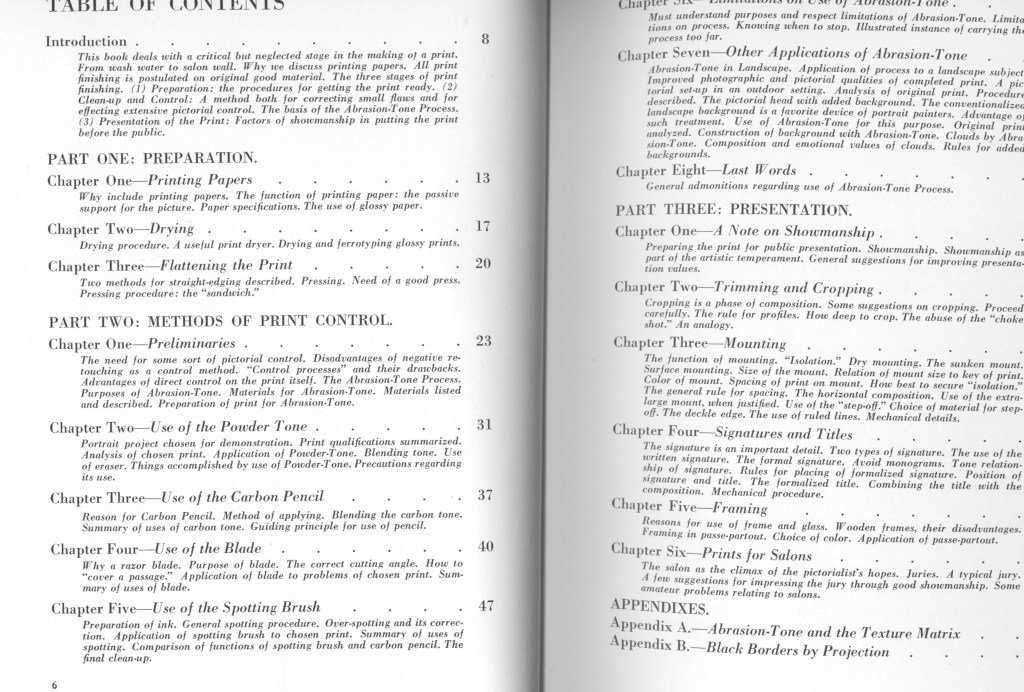
Should you want to make prints, the Mortensen is overlooked; it shouldn’t be.

The contents, shown below, is why. Much more content.

Adams is about curves and chemistry… in search of a print, whereas Mortensen is about how to retouch, to introduce the hand, while also providing specifics about drying, flattening of the print.

Even though he was there before Adams, we all know Ansel Adams.
Mortensen’s method required the hand. It was all about the final print; what could be done by the individual photographer… using haptic tools in addition to the optics.

Not the Zone System. A tone system.

In "Venus and Vulcan" -- a series of 1934 Camera Craft magazine essays -- Mortensen defended Pictorialism against criticism from the f.64 school and other "straight shooters":

Photography, like any other art, is a form of communication. The artist is not blowing bubbles for his own gratification, but is speaking a language, is telling somebody something. Three corollaries are derived from this proposition.

a. As a language, art fails unless it is clear and unequivocal in saying what it means.
b. Ideas may be communicated, not things.
c. Art expresses itself, as all languages do, in terms of symbols [William Mortensen, "Venus and Vulcan 5 - A Manifesto and a Prophecy," Camera Craft 41, n. 6 (July 1934): 310-12. As quoted in A. D. Coleman, "Conspicuous by His Absence: Concerning the Mysterious Disappearance of William Mortensen" in Coleman, Depth of Field (Univ. of New Mexico Press, 1998).]

Mortensen could draw. Had a larger world to draw from than Ansel’s insulated Carmellows. Limited by his piano, limited by playing to predetermined steps; not the human voice, rather the machine one. Chartable. The Adams universe prevailed since it relied less on human spheres. It is something that can be done on the weekends, alone. All that is needed is money and weekends.

Ansel gave us Coffee Cans and Canned Landscapes. Mortensen… another voice from the past, even though it seems possible that his whisper remains stronger than Ansel and the Newhalls wanted

The digital age is the age of retouching, even more than the chemical age.

Imbibition Notes: Matrix Punch

// Kodak directions were complete. More information was made available in the product datasheet than in the instructional guides. Labs always had access to support from the marketing group. If you were big enough, or persistent, you could talk to the research group well into the 70s; then it changed. The product was on the way out — no one wanted to say. Now, I know that the reason my contacts from the 60s called from home was that the labs weren’t supposed to be talking.

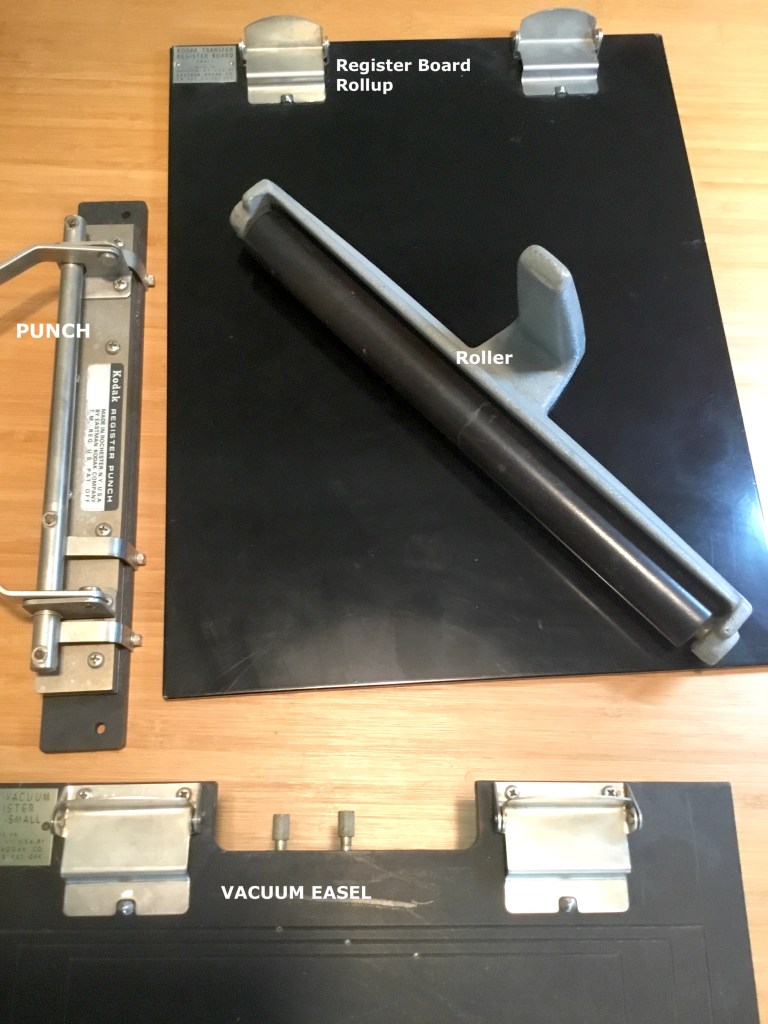
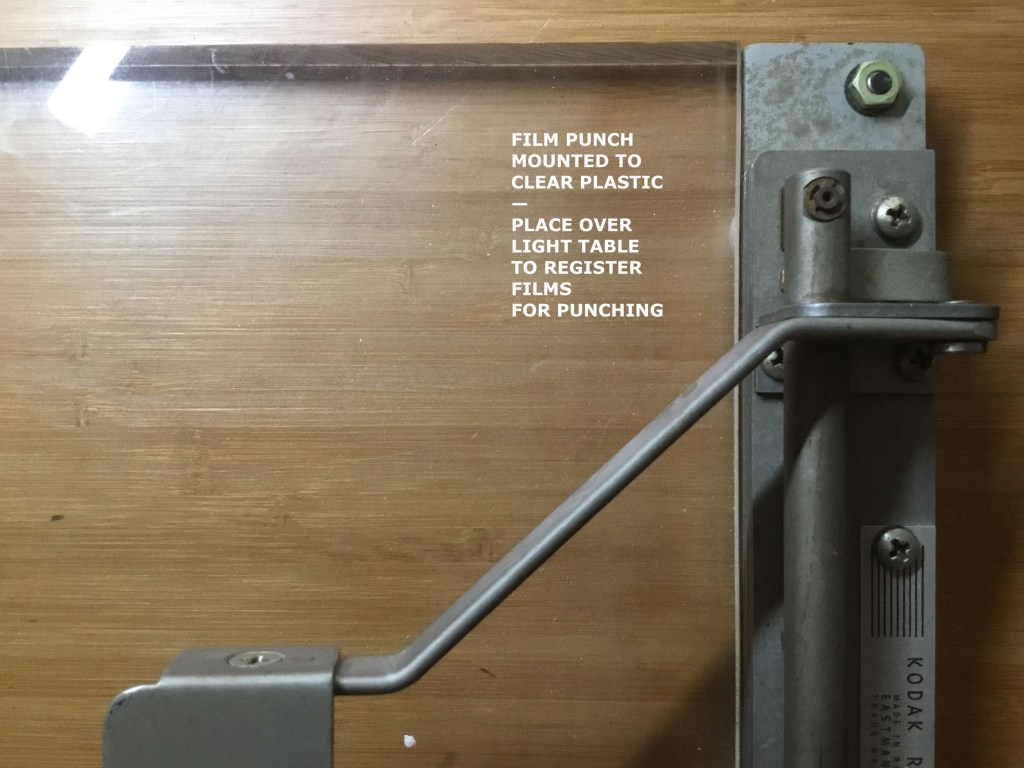
A main Kodak invention for imbibition printing was their film punch. Looks like a very complex paper punch. Not far from wrong, although paper punches aren’t always best for thick sheets of plastic like film.

Pan Matrix sheets came pre-punched to fit the Kodak Transfer table.

An early fight with Kodak was over large rolls of Pan Matrix film. They wouldn’t make it… even though we had many accounts wanting large displays from original color negatives. So, we had to devise the interpositive method — then we had talked to DuPont. And Ansco.

to duplicat today search forregister pins with a #4 x 7/16″ screw stud at McMaster or comparable

Condax’s patent for registration device and method. April 1945, #2455735

It is the Kodak Blanket, the method used from the first decade of Dye Transfer. The early guides (E-80s) showed its use. This was the time of cut-n-but registration — the form inherited from litho-press plate work. The Condax patent references earlier litho patents.

Kodak’s system for making Dye Transfer prints included large pin system. The film used couldn’t take fine punches; not if you were going to put film off and on many times, such as what happens when making real prints. Theoretical prints could be made by punching glass plates, sadly, real glass plates would snap if you punched them.

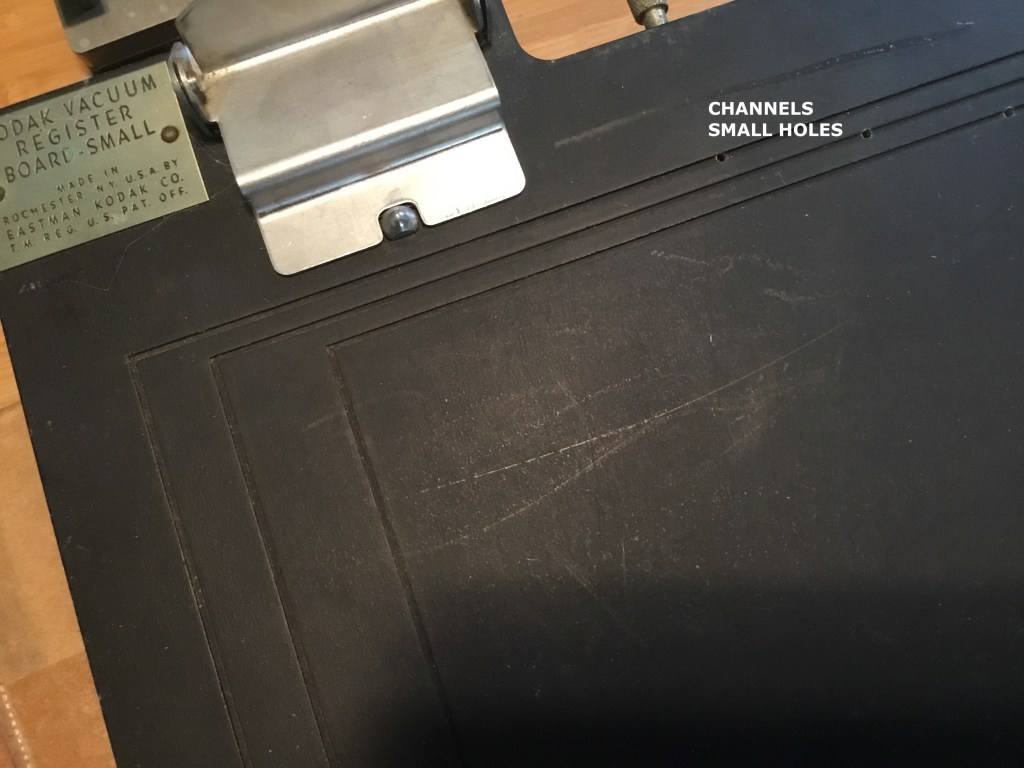
A punch for the film + an easel used during exposure + pinned transfer board + a roller for rollup of the mats onto the blank.

This was a standard set of equipment found in commercial and weekend labs. These items went out of production by 1980. From the mid 60s they were specialty items sold through graphic supply houses, not regular camera stores.

In 1968, Adolph Gasser (big San Francisco store) didn’t know about them, nor dye transfer supplies. I worked with them to make my order; standing with them to make the call back to Rochester. A long time ago. It foreshadowed much of what would come to the very small community of dye transfer printers.

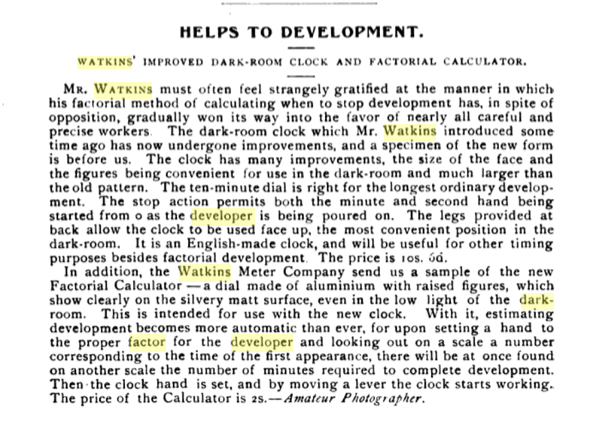
Watkins Factor: developing

Time of first appearance as estimator of developing time for that emulsion in that developer.

In re-working information about Deep/Thick vs Thin emulsions… da-net posers made me do it.

Deeper dive into Time-Temperature of photography.

  • Watkins
  • Sheppard and Meyer
  • Clerc, section 400, the influence of temperature
  • Clerc, section 380 & 381, watkins factors, & combined factors

How Does It Work?

Developing is a process of saturating the emulsion; surrounding the exposed material with fresh developer, then moving exhausted developer. This main process is agitation. The key part of the emulsion is the gelatin. Think of the emulsion as having depth, as well as surface. This emulsion, whether film or paper, has to absorb the fresh developer– this takes time. An induction time. How fast the exposed silver begins developing depends upon the strength (developing power) of the developer. It is affected by temperature, emulsion, etc, but the main factor was the developing agent(s) used.

The watkins method is mainly of use with emulsions suited to development by inspection. It is of great use in making lith negatives, or, somewhat, in making lith-prints. Sadly, in a developer containing two developing agents, the temperature coefficient loses significance when temperature varies much from 20 C.

Developing AgentC
Metol1.25
Paraminophenol1.5
Ferrous oxalate1.7
Pyrogallol1.9
Metol-hydorquinone1.9
Hydroquinone2.2 to 2.8
Catechol2.8

Some developing agents change activity with temperature — hydroquinone loses activity at low temperature. (Jacobsen, p.67)

Temperature coefficients vary slightly with emulsions. Concentration of developer has little effect.

The temperature coefficient of a developer is the increase in speed of development for a 10F increase. A TC of 2 means that a developer works twice as quickly at 75F as it does at 65F — typical Coefficients from the mid-century were: 1.8 for MQ developer(D76), for fine-grain developers (D23), and 2.3 for super-fine grain developer.

Note: pyro and amidol do vary by amount of grains per ounce. Bromide alters the pyro factor.

Compensating Timers

Temperature control is better than a compensating timer. Keeping agitation in line, changes of developer is more important to critical processing than is time-temperature duration. Build tray rockers, insulated, water-jacket trays with lids instead.

But, if you are interested search: Tundra. DLG. ProcessMaster.

[file]