Amidol Tales

The elixir, or the light… or just a developer that stains everything; these days it makes a great hair dye.

A REASON: amidol developer permits ‘water bath’ development better than any other common developer. A water bath is a second tray with only water; this is used during development as a control and evaluation step. Develop in amidol, then put print into the water tray. Examine the print [under safelight] for density & contrast. Return the print to the amidol tray is more density is needed.

Amidol was a developer used by the Cahoona Weston – that alone makes the tripod carrying acolytes tremble. If you don’t have his life, his world, his meaning, at least you can have his method. Big Bad Amidol and Big Bad Camera. I consider this chicken bones; there is no magic in the ash.

The workshop world is filled by takers being taken.
amidolstory.001.png
chinese amidol

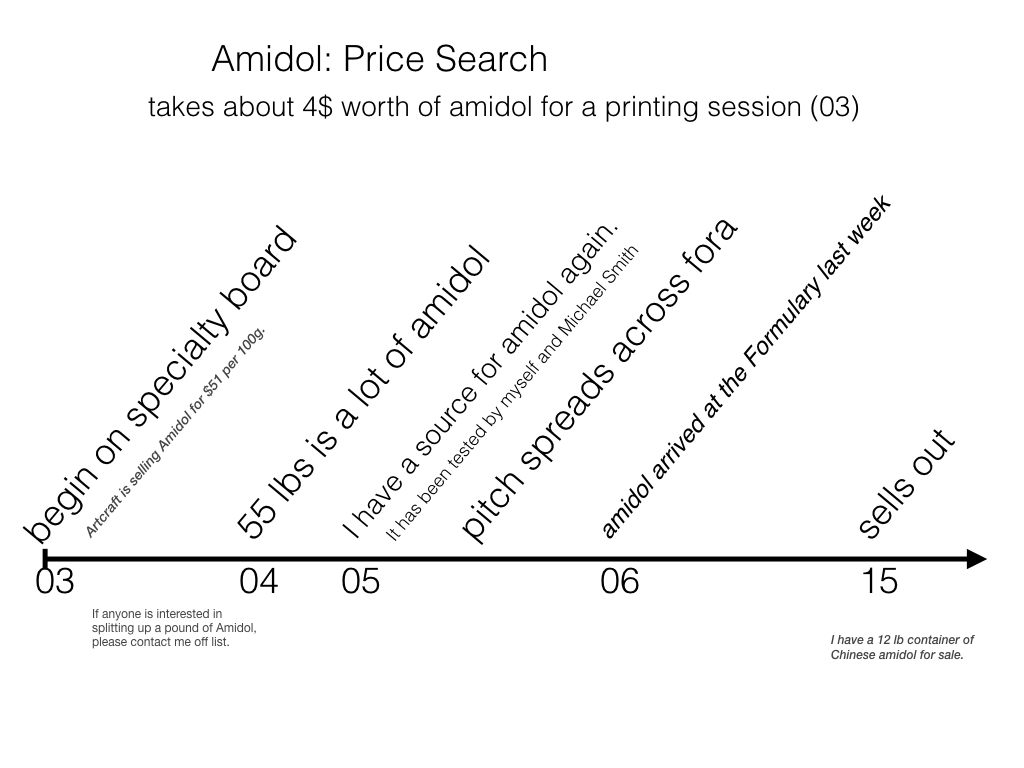
It took 3 years to get the amidol. A lot of hours, effort away from that drive toward meaningful art. It was 9 years later that G. Davis sold off the big barrel. Hope it was worth it. Was he just converting excess to cash, or taking a wiser cash position of a failed dream. Why couldn’t Bud at formulary take it? Probably because they couldn’t sell it either. There is no magic in leftover history, not even the remains of chemical induced zealotry .

Why Oh Why

their motivation wasn’t to save money. that may have been a rational catalyst, but the effort was maintained by some other commitment. Even the commitment to save money was prompted by their need to use the product. What was that need+drive is a much more interesting topic to me

The time and social energy expended had to have some reward, otherwise they are just drained, wasted flow away from an esthetic drive. The simple fact is that the work of Smith and Chamlee is easy bake – the questions they are solving are elementary. Davis has provided a small set of results that edge into beginning terrain, but they quit, having no updates or expansion in years. Perhaps his energy failed him – his techno quest faltered, faith failing him. His sig lines call us toward biblical lands of Matthew and salvation – hard to hold onto a barrel of hair dye if Jesus is calling the faithful and you’re left behind.

take aways:

  • No silver bullet. No magic christian.
  • In search of price. Searching for the silver bullet.
  • Silver users in search of the perfected cheap bullet.
  • After the magic bullet instead of the magic.
  • buying their magic instead of making it.

References & Notes:

amidol supply:

people:

webionaire links AMIDOL CHLORIDE PAPER

[1 of 3: Nov 6, 17]

Word Turns

Aesthetics should not attempt to turn art into a word game. Too often the critical conversation sounds like a pitch to an investor made by a shady pitchman.

Artists have tried to claim that sound, but after they’re done they have only added pages to the brochure.

how many prints could a printshop make, if a printshop made dyes

Some notes —
in a box: 25 sheets (back in origin time, film came 10 sheets to a box. like now, again. We are back to the fifties.)
1 sheet was for standard tests. QC thingys
3 sheets per print
means 8 prints per box — but we don’t have an answer to our riddle.

Prints On Paper

as supplied, Kodak provided mordanted paper to make  10×12, 11×14, 20×24, 40 inch rolls.
the size frequently used by agencies was 11×14
the 10×12 was what I had students use. For my work, I used the 11×14 and 40 inch roll paper.

Cutting Roll Paper
I cut the roll paper into sheet sizes for prints. The problem with this was the cut edges meant dust. At that time the paper dust seemed the big problem, now, knowing better about the mordant, I wouldn’t do it. I’m lucky, good ventilation and meticulous work mode means I’ve had no side effects from the dust. At the time, I was just reducing the amount of dust introduced into the workroom, and chemistry (paper conditioner).
When I cut the paper I’d use a fresh, new razor blade, each time. Before cutting, I put a covering sheet of tissue over the cutting area. This tissue sheet was about 2 inches wide. It came in rolls of several hundred inches. This tissue sheet was held down using flat stainless rulers — two of them spaced about and inch apart. One, the left one, was what I cut along. Simpler to do than to describe. All of the tissue was scrapped with each cut. This meant a lot of waste, but it made for very clean print process… and that was my intent.

An Answer?

So, how many prints did those beloved custom shops make… making a guess based upon what I’ve gleaned from a couple of conversations — between the demise of Kodak Matrix in 1994 and 2007 the Net Name printer went through most of his paper, with  about a third of his film still stored. Five years later (’12) He had 5 boxes of film to sell. He had used it once the year prior (’11). That guess — one or two images a month! Not much of a living, even at high setup, first print and such fees. No wonder digital is where he went.

How Many
back of napkin

napkin: bought around 30 boxes — used 25 of them — makes it about 16 prints a year. Sounds like a hobby not a career. Good thing the magazines paid for words of wisdom

Production Printing- Dye Transfer

What would a production printer produce? Assuming that you work at a place with consisten daily output for clients that were demaninding, both in terms of quality, but also in terms of commitment to quantity– agencies would order 2 or three prints– not much. Not much as compared to architects or industry or …
I regularly made 20 or 25 prints for an order. So how could we do that, day in and out for multiple clients? We had print rooms setup so that we had 2 roller positions. Automatic tray rockers, and heated transfer blocks.
A general flow: Starting dry.. paper and matrix-set are dry. They have to be placed into holding/ conditioning baths. After about 6 minutes you can begin the process of dying and rolling. This is all about rhythm and directed attention — and practice. At the end of 20 minutes you have a print. Plus 5 mins and your second print is lifted, while your third has one roll down… and so it goes..
This results in a system that produces 6 prints an hour. Since we have to replenish dyes, along with other maintenance chores the real production is about 5 prints per room each hour. This productivity requires near ideal mat-sets, which is why so much attention is given their perfection. Attention including means of testing their match without resorting to production rolling. These separation of functions meant the production area had 3 separate functional spaces. Negatives; matrices; prints
Now, maybe, you understand that odd “5” print staircase .. 5 prints, 15 prints, 25 prints, as price points.

Footnote: