
pulling a camera film into the darkroom to become a lab-film….. masks are aids to separations.
Ask yourself: What are you separating, and what are you doing with those separations?
[ see: https://webionaire.com/2023/03/15/nutshell-masking/ ]
Don’t fall for the “curve” bull; most film can be useful as a lab film. Always was. For most of the life of photography, film has been meant for use in a camera. Specialized process, specific to color printing, called upon the skills of emulsion makers to ease the task of color production.
It isn’t unusual to make masks of differing density ranges to modify different portions of the original’s curve. The lab film list from 1970 era would have been:
- Kodak Pan Masking Film 4570, which had no anti-halation backing, making it near perfect for unsharp masks
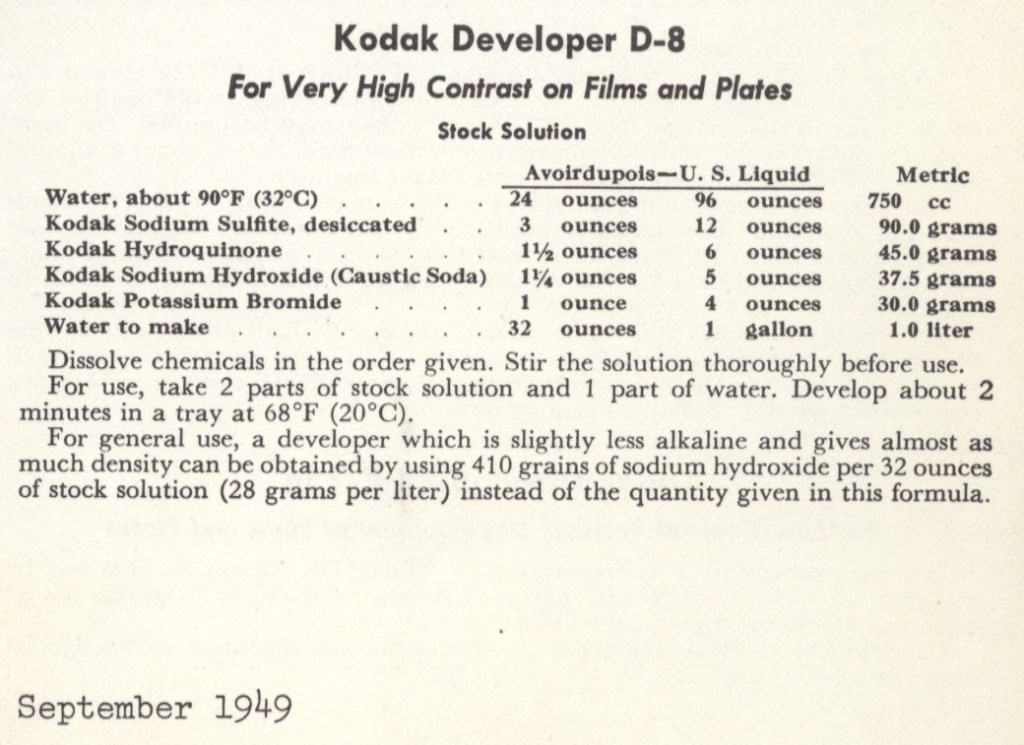
- Kodalith Pan Film 2568 which had a very steep curve. This was controlled using the “Ds” D-19, D-11,D-8 (not Ilford ID-11)
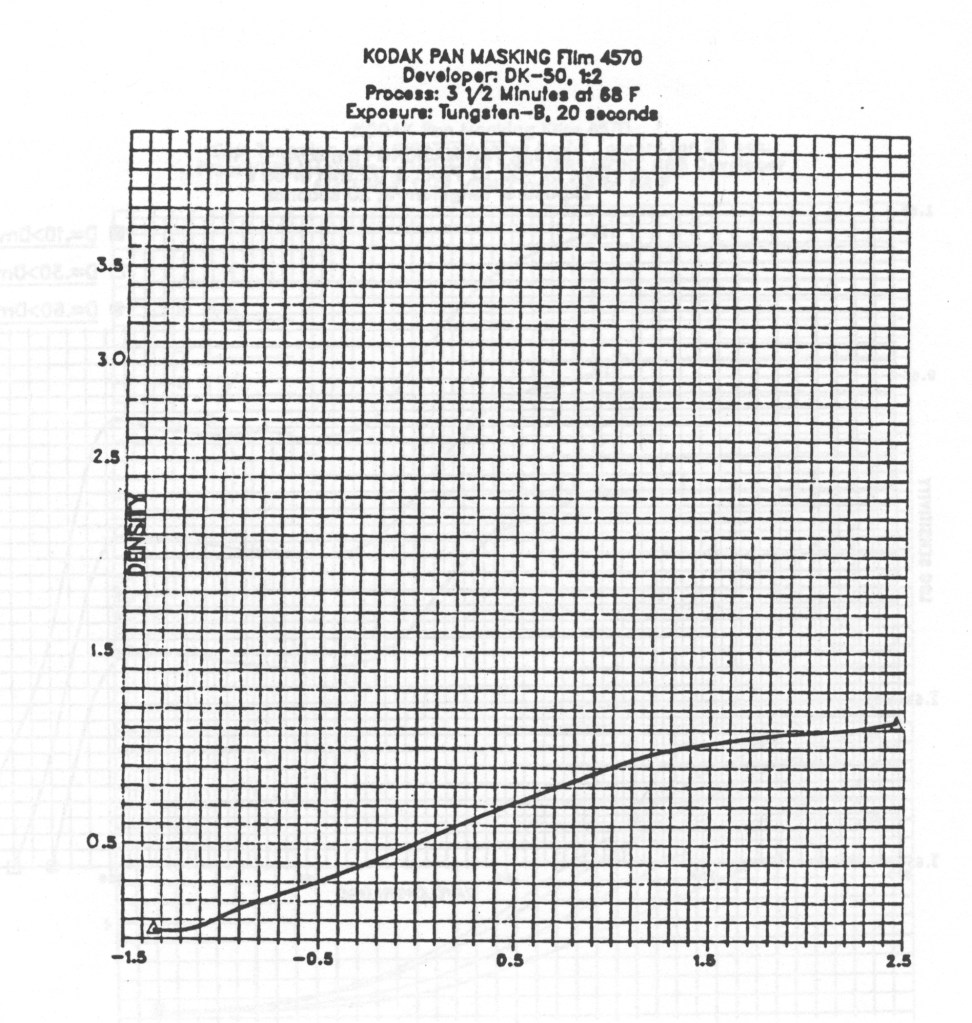
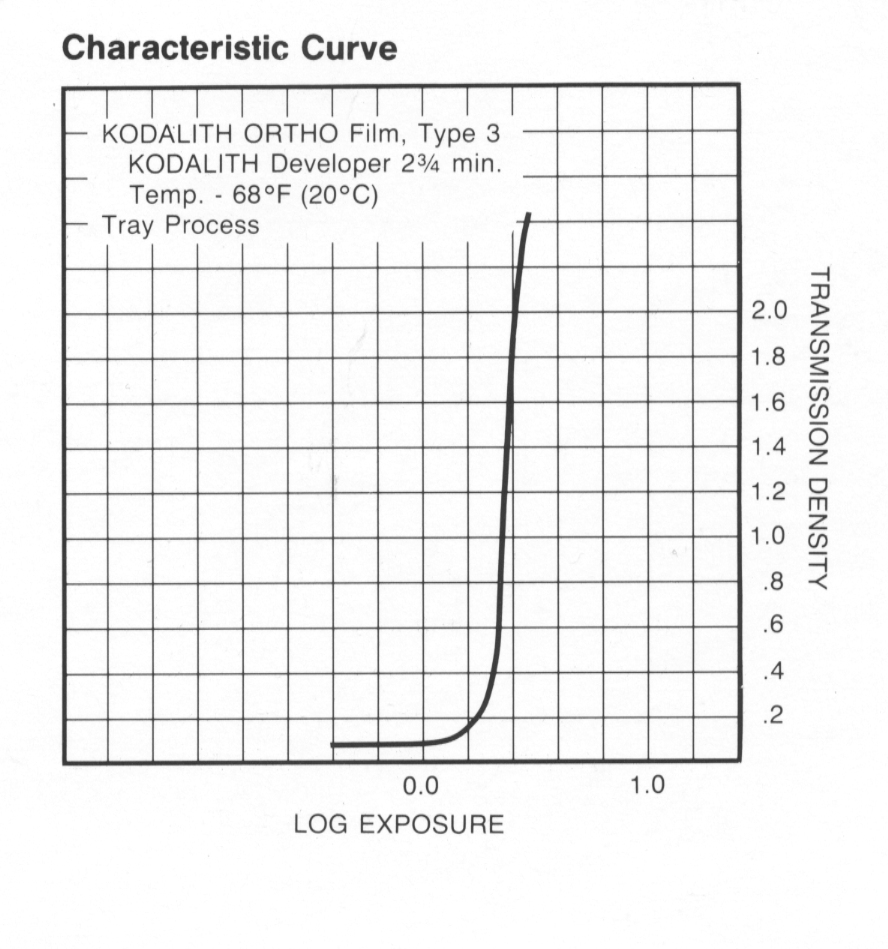
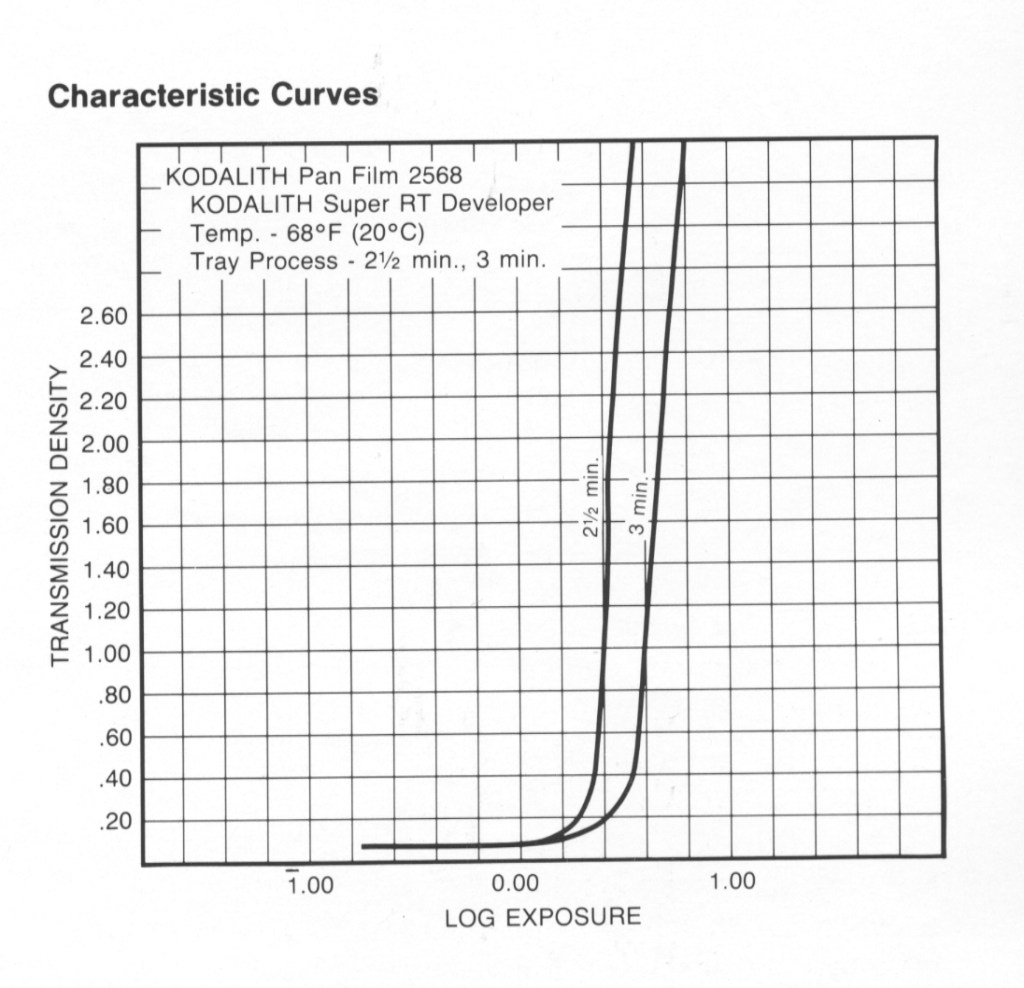
The following is updated from an Ilford Cibachrome datasheet, which anyone using the product should have noticed.
The difference between those who ride and those who shovel.
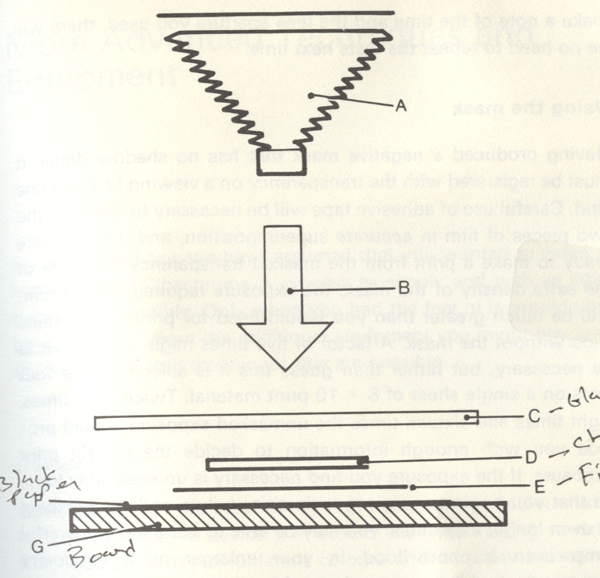
The exposure layout, using enlarger as light source.
A: Light (Enlarger set to height for projecting a 35mm to 8×10 size). Lens at f/16. First trial exposure for 10 seconds.
C: Glass to hold the Original in close contact with the un-exposed PanF (mask to be)
D: the Original (chrome) facing emulsion down (away from light)
E: is the PanF film — emulsion side up.
F: BLACK backing paper – reduces flare
G: baseboard. I use smooth black-rubber sheet from electronics supply houses.
3M silver tape aids in placement of “curly” PanF film. Small spots work well.
Developer: Ilford PQ Universal [1:20] 68F, 3 minutes tray agitation (constant)
Alternate: DK-50 [1:4] instead of the PQ Universal.
If the development time is too short, or if the film has a warmtone tint, add Benzotriazole (BZT) solution to the developer (either PQ or DK) . An initial point: 10ml of 1% BZT to 300ml of working developer (tray)
BZT solution must be mixed at125F, otherwise the powder won’t dissolve. You can also buy prepared anti-fogs from Bellini, or Moersch.
According to Kodak’s “Processing Chemicals and Formulas for Black and White Photography”, publication J-1 1973, Kodak Developer D-19 is designed as a higher contrast developer for continuous tone films. It provides short development times. While primarily aimed at scientific applications, it has utility where high contrast is desired.
It is not as active as D-8’s extremely high contrast or D-11’s very high contrast. Both of those are designed to fully utilize the line reproduction possibilities of lith films. Kodak says D-19 produces, “brilliant negatives with short development times. It has good keeping properties and high capacity. D-19 is recommended especially for continuous-tone work that requires higher-than-normal contrast.”
Technote:
Because benzotriazole is only slightly soluble in water or developer solution, the most convenient method for adding it to freshly prepared developer solutions is to use a stock solution of Anti-Fog, No. 1 in ethylene glycol.
To prepare a stock solution, you will need:
- 700.0 ml of ethylene glycol (high purity)
- 166.7 gm of Anti-Fog,
No.1 (benzotriazole) in powder form*
*Do not use the tablet form. Each tablet contains only 0.03 gram of benzotriazole.
For this solution alone, over 5,500 tablets (110 50-tablet bottles) would be needed.
Warm the ethylene glycol to 120F (49C). Add the Anti-Fog, No.1 and stir until completely dissolved. Cool to 75F (24C). Add ethylene glycol to make a total volume of 1 litre and stir until the solution is uniform. If the stock solution is stored in a stoppered brown bottle, it may be kept indefinitely.
For each gram of Anti-Fog, No. 1 required, use 6 ml of the prepared stock solution.
Masking Principles:
- Hunt, The Reproduction of Colour, Ch. 7, 10.
- Jenkins. Colour Separation Negatives,
- Masking Colour Transparencies, Graphic Arts Leaflet No, GA-9, Kodak Ltd., 1961
- Masking for the Kodak Dye Transfer Process, Eastman Kodak Co., 1948
- Theory and General Photographic Technique of Masking, Graphic Arts Leaflet No. GA-7, Kodak Ltd., 1962
To obtain maximum contrast with any film, use a contrast developer: the Kodak sequence of D’s:
D-8, D-11, D-19 decreasing in contrast. D-19 is also a rapid developer suited to replenishment and tank (5G) processing.

According to Kodak's "Processing Chemicals and Formulas for Black and White Photography", publication J-1 1973, Kodak Developer D-19 is designed as a higher contrast developer for continuous tone films. It provides short development times. While primarily aimed at scientific applications, it has utility where high contrast is desired.

It is not as active as D-8's extremely high contrast or D-11's very high contrast. Both of those are designed to fully utilize the line reproduction possibilities of lith films. Kodak says D-19 produces, "brilliant negatives with short development times. It has good keeping properties and high capacity. D-19 is recommended especially for continuous-tone work that requires higher-than-normal contrast."
UPDATED: Kodapak isn’t Duratrans, Fujiflex
Kodakpak was a Kodak product used by many labs for making masks; it was the “gap” between films which was responsible for making “unsharp” masks. It was clear; came in 11×14 (6sheet pack) sizes of .003, .005, .0075 mm thickness. A frosted version came in 8×10 packs which was used in some circumstances. Sharpness was controlled by physical separation, distance between emulsions and movement, or angle of exposure using a point light system — this was the major difference between many labs. How they made their diffusion step.(USM).
Whar was an Opal mask became a framework of all masking.
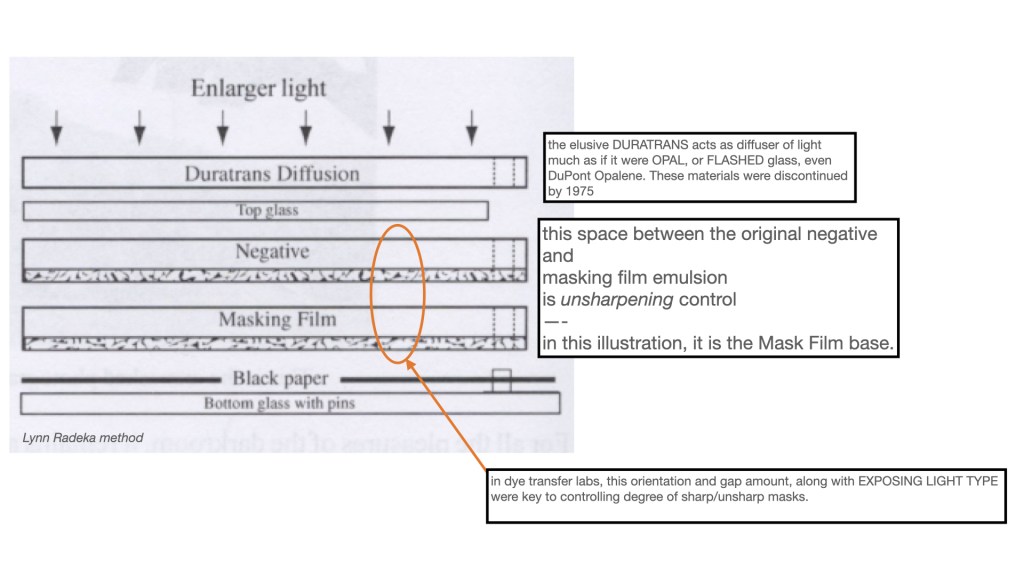
The respondent (Fatih Ayoglu) misunderstood “Duratrans,” Kodak’s display material. He then proceeded to provide his configuration of making masks. His teacher (Drew Wiley) has him following an odd path for making “standard light” by having him raise the color temperature of tungsten to daylight, then inserting a blank C-41 film base to achieve balance.
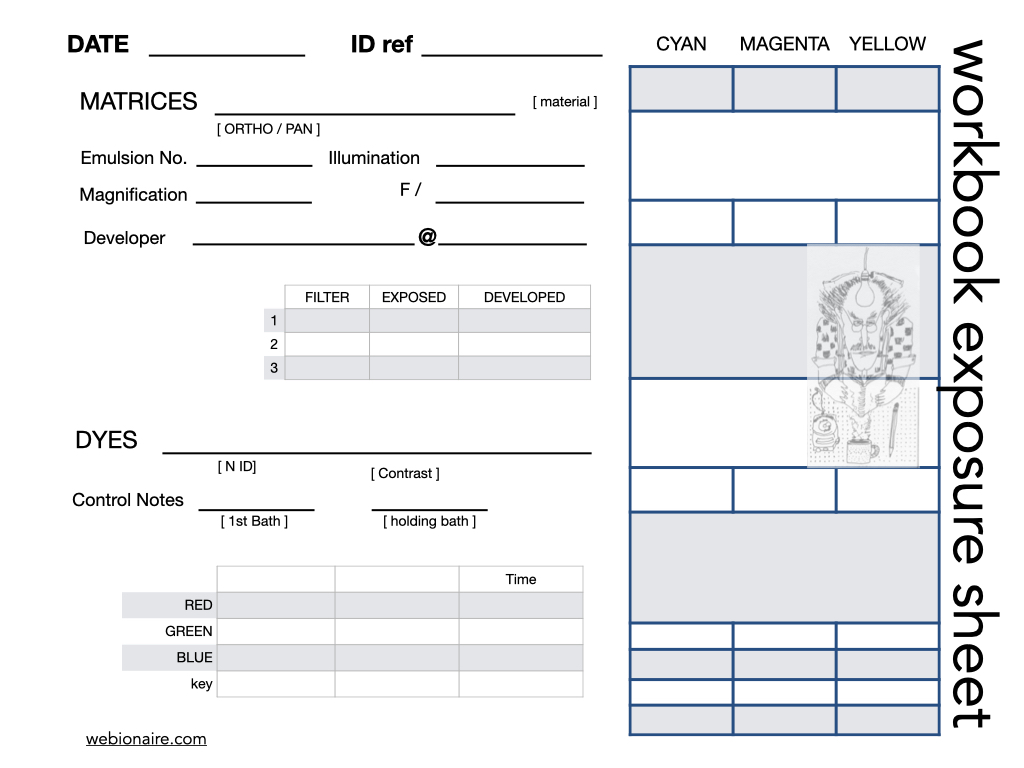
Extra credit material… a matrix / dye worksheet.

PAN MASKING FILM REFS
- Kodak Three Point Transparency Guide Q-6C
- E-48
- E-66 Printing Color Negatives Kodak Color Data Book E-66..E-66 1st Ed 1958 [mine]
- E-80
- Q2
- Q7A, Q7B, Q11D, Q11F, Q11G



You must be logged in to post a comment.