bee shit

Keeping the image from falling too far. “the misty territory of truthful fiction”

imagery stimulates the creative.. often stepping across the boundary setup by prior makers. An image type, structure, content, will make it into another mode. Ads/Art/Commerce/Collection.

People who like photographs to be of things, make photographs of things they like .. The things they like often are places; often large places, with large cameras. These same photographers rarely make photographs of people … frequently they avoid people.. 

When presented an image, an object, a picture of people … people presented without adornment, without background ,so that your attention is directed towards only that person..if you don’t like that type of person, you won’t like that photograph.  You probably won’t like the photographer. You may feel confronted, intimidated.

Too often, a hardened view becomes a prejudice. Unexamined, so extending into more matters. Their prejudice extends deeper than their aesthetic matters, it has to vilify, not only them ,but those like them, even those who like them — a prejudice down to explaining the glasses. Maybe even cameras, cities

We know, of course, these critics  don’t apply such level of scrutiny to themself. Instead they conform. Limiting what they know to when they were 30.

Richard Avedon [1923-2004] , in 1979, was commissioned by the Amon Carter Museum [Fort Worth, TX, aka Cow Town] to produce photographs attentive to to people with overlooked occupations — to summarize the West. The overlooked westerner. Laura Wilson, a Dallas photographer, worked with Avedon on the project.

[ Richard Avedon died in San Antonio, TX, on assignment…]. His work, in overview, is here.

>> I like the picture. Obviously, it was staged; most beekeepers don’t wear their bees. But it’s still a natural picture – its natural bee behavior. I think those who were against Avedon before…are the ones who were most vocal about this picture when it comes out.— Ronald Fisher. Not from “.. some place up north…” Still selling Vacant Acres honey[2024]

Initial contact. Davis, California, which, even to this day is in the West, not the north… within CA is is east of San Francisco.
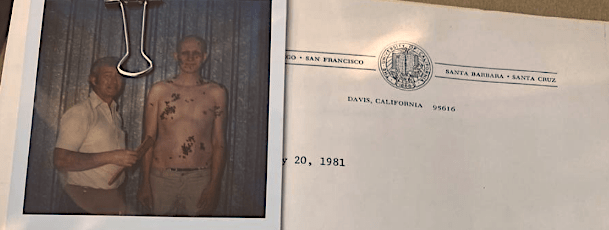
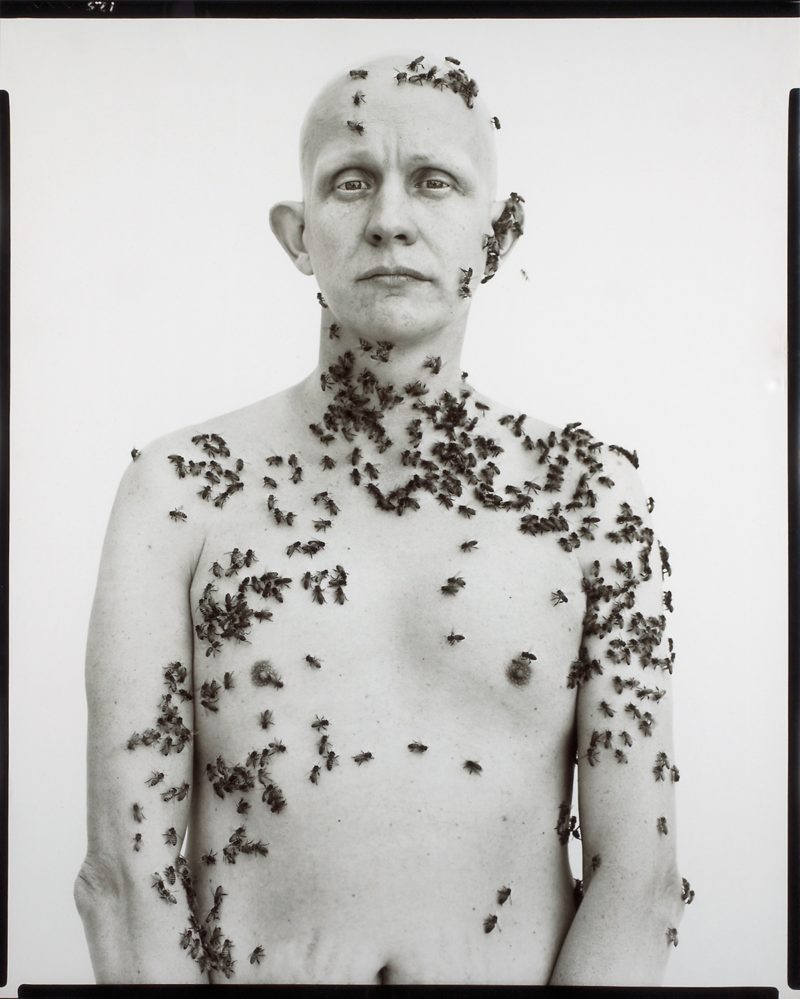
Richard Avedon – Ronald Fisher, Beekeeper, Davis, California, May 9, 1981, printed 1985


Note: Bay Area Avedon: “A career retrospective that covered all areas of Avedon’s photography, it was Avedon’s initial collaboration with the curator and museum director David Ross.  The first of Avedon’s photographs from In the American West debuted at Berkeley, an oversized portrait of Boyd Fortin, the rattlesnake skinner.  The show was disrupted (though not closed) when Avedon’s 30-foot-long mural of Andy Warhol and Members of the Factory was vandalized by a visitor who tossed an iodine-filled balloon at Warhol’s head, destroying the photograph. ” — UNIVERSITY ART MUSEUM, BERKELEY, CA, 1980

Links, refs:

—–

It took years for Carnie to see behind the mask:

Engineering Words

what words mean is what we agree — actually, how we use them as unknowing users. Like economics vs home economics: what we do without an PhD from Cornell. We make, buy or sell stuff. Economists wonder why they can’t predict our actions perfectly. Is it us, or the blackboard?

When a field gains another crafting, it also seeks to modify the name. Photography becomes digital, alt, AI, AgX or some other prefix. It happens in all fields. They, those other fields, don’t often discard the modifier, unlike amateur-hobby-enthusiast photographers. The Forumati Photographers grapple so much with the elements of the craft that they offend easily. They are repulsed by the PreFixers who would come into this forum with a claim of authenticity. If the craft is different, the art is gone.

They argue somewhat naively; meaning incompletely. A typical path is a call to authority: if you won’t accept my word, how about a story I seem to remember. Or, if that fails, how about a bit more info with my spin on it. This is the mark of the polemic in photoland. Just enough to convince. Just enough so you let me believe.

I hope that there are sour apples in every bushel.” – Mark Shaney

They couldn’t write like Derrida, yet they could write a program that fooled, or at least satisfied them and their fellow engineers.

Like the founders of Opto-Chemical photography. Good enough to fool the drawing room.

In 1984, Rob Pike and Brad Ellis unleashed a character named Mark V. Shaney onto the unsuspecting Usenet forum “net.singles,” a place for nerdy lonely hearts to find love or at least commiserate in their failed search for love. Mark was named after a Markov Chain, a random mathematical process that provided the coding directives for his preferred form of communication: Regurgitating text into grammatically correct but completely nonsensical approximations of human language.

Mark was a bot.
there was Mark V. Shaney, a program that was so good at feigning humanity that it managed to confuse and rile Usenet group users for years.
 Using code written by Don P. Mitchell, the duo created Mark V. Shaney and unleashed “him” on the unsuspecting masses of the net.singles board, a place where scientifically-minded lonely hearts congregated.

According to a 1989 issue of Scientific American:

The program must first read and reflect on someone else’s work. It then produces a rambling and somewhat confused commentary on the work….Although sense is conspicuously absent from MARK V. SHANEY’s writings, the sounds are certainly there. The overall impression is not unlike what remains in the brain of an inattentive student after a late-night study session.

Because the program could read and comprehend punctuation, Mark V. Shaney easily composed full, grammatically-correct sentences. This further confused the lonely lovers on net.singles, who saw postings like the one below that boasted proper grammatical structure but made little actual sense:

---
damaged flesh and blood neural-nets spewing crazy flames all the time,” wrote Penn Jillette in a 1991 column for PC-Computing. (Indeed, a post by Mark V. Shaney in net.med about using raw honey to treat allergies elicited an outraged response from a user named Daniel R. Levy: “This reply is inscrutable!”)

What does all this mean; what was the promptation for me?

This: begin with a claim to support another claim. Provide very general direction, references sparse enough to sound like support from higher authority: “grammatically correct English that was utter gibberish. The team then published the results on USENET (a precursor to the internet) and said it was a new work from Jaques Derridas, the Deconstructionist Philosopher. People were so excited about this new “work” that, apparently, Ph.D. dissertations were considering analyzing it. Apparently, the gibberish closely mirrored Derrida’s actual writing. Ideas matter. Words matter. Grammar matters.”

His position is that since engineers can’t write (understand) Derrida, but can write a program that makes nonsense while adhering strictly to English Grammar, then Derrida is nonsense. This is from a person who holds Ayn Rand up as a model of understanding — a higher order artist.

He does answer, although without much reference. Not as much as I’ve provided.

Follow this mode (for this claim). can we get further. Dig into the claimed authority?

Extraction begins: get as much of the statement

  • Rob Pike. Bell Labs. USENIX Boston late 1990s.
  • Jaques Derrida. Grammar.
  • famous experiment Bell Las

I found enough to grant him almost accuracy. The omission was because his need for polemic. Prove the point of GIBBERISH.

so, what is the Derrida (1930 – 2004) position, simply?

Derrida called his challenge to the assumptions of Western culture “deconstruction” Derrida’s most quoted and famous assertion, which appears in an essay on Rousseau in his book Of Grammatology (1967),is the statement that “there is no out-of-context” (il n’y a pas de hors-texte).

Derrida once explained that this assertion “which for some has become a sort of slogan, in general so badly understood, of deconstruction … means nothing else: there is nothing outside context. In this form, which says exactly the same thing, the formula would doubtless have been less shocking.”

What he is saying seems quite obvious to those who have built languages: Context sensitive. It is demonstrated in almost every post on enthusiast boards, wherein they come together in effort to answer small questions and large with the same simplified answers. They operate in ignorance of the foundation text — they do not operate context free. They bring it with them.

computational imaging conversation