Cutoff Filter

cutting off light. cutting off learning. cutting off experience.

Photography is an experimental studio art — with experiment meaning experience. Art is philosophy — as photographers gain experience they make it and themselves meaningful. We walk around becoming more and more an artist. Maybe our photography, that physical stuff, never catches up to us. Most photographers stop themselves rather than being stopped. I find them, the stalled ones, gather together saying they want to help others. They offer advice which, on face, seems sound, it is often repeated. It is rarely based upon direct experience. It is often wrong — in application and theory.

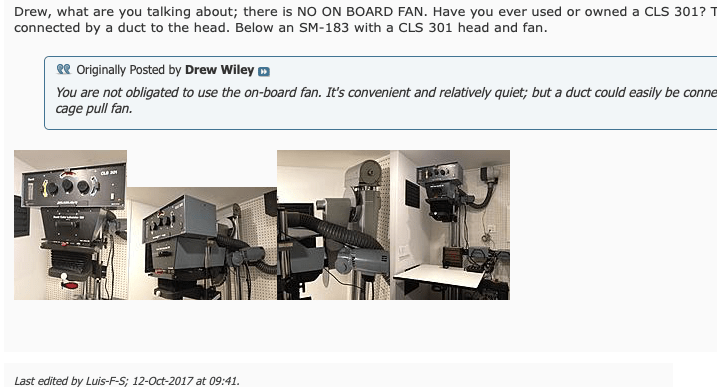
In the color darkroom — the age of enlargers. When enlargers were called that. No need to give them a new coat calling them “optical” — they were enlargers, the key to the photo-lab, the darkroom was built to house them. They used hot-lights — light bulbs.

Enlarger Lamps

ESJ 3350K … PH140 3000K — two common lamps with their respective color temperature. These are both small bulbs used in small, but common darkroom enlargers. A chart of color temperature may help in understanding why we need IR cutoffs in a hot enlarger.

Chopping the IR off the enlarger light path means the emulsion will have less spurious response to the image being projected (enlarged). Infrared isn’t “heat” — there is a thermodynamic element to it, however, in main the photographic emulsion will respond differently with and without an IR filter in place and filtering the projection light.

For those of you making color separations or color internegatives this will be noticed, it is measurable, for blue and cyan. The horizon colors.

This came up because an on-liner had a problem with color balance — it seemed nothing could be done; that the balance was illogical, showing sporadic response. Many of the often outspoken experts said it must be the failure of the poster — their skills weren’t good for the task. Not the task of doing, not even the task of diagnostic. Several days. Several efforts. The likely answer was pointed out by someone who has little experience printing; this according to themself — having only begun printing in the past three years. They are correct in the diagnosis of the problem while the other, over 10 thousand posters haven’t yet agreed. Experiment can’t convince them. Display can’t convince them.

They can’t see what they didn’t expect.

They have so little experience that they don’t understand, can’t accept yours.

They may be well intentioned — attempting to maintain knowledge from a field of past knowledge, but they are keeping alight a flame they never lit. They never were on that road, the path they say they’re maintaining. The field of casual knowledge wasn’t enough to work in a professional lab then, it certainly isn’t enough to sustain the field now. Experience doesn’t come in teacups


Refs:

https://physics.stackexchange.com/questions/80983/how-does-infrared-relate-to-heat#:~:text=There%20is%20no%20special%20link,radiate%20at%20a%20higher%20frequency.

Lost Highlights

highlights can be washed away or crushed in assembly — huh? Okay, they can, but not if you are making dye transfers correctly.

Dye transfer was used by commercial photographers doing flatware, silk goods, diamonds, crystal — it seemed good enough for those highlight intensive products photos used for point of purchase along with sample books.

Dye transfer was used by portrait photographers selling upscale bridal portraits for their wedding — the 20×24 for the family to remember the bride in her white wedding gown. Another highlight intensive requirement.

Further examples seem unnecessary. The large-format dye transfer expert isn’t experienced. Sadly, those involved in that conversation don’t know enough to know — maybe they just don’t care, since they’ve nothing else to do. It is after all, only chat among the idle — an endgame move of resignation.

Why do so many believe the persistent posters?

The difference between a carbon print and a dye transfer is extreme. That they are assembly processes using gelatin as the image carrier, and that the image is a result of differential hardening of gelatin is what they share. Exposure method is a major factor in how highlights are maintained or lost.

In pigment processes exposure is from the top of the emulsion/coating. In dye transfer (imbibition ) exposure is through the base; this means the gelatin is hardened from the support upward. The highlight is thin but it is close to the support. In carbon the highlight tends to wash off, since it is being dissolved away. The pigment will actually collapse. The dye transfer mat has a relief image but it is durable. In imbibition printing the final image is assembled in thin layers; in gum/carbon it is stacked up in thicker reliefs. This can, likely will, result in some undercut of fine color details which occur alongside larger detail areas. In an effort to reduce this problem, screened negatives are being used by some carbon printers.

Dye transfer has additional controls to manage highlights which provide even more advantage over carbon printing. Carbon’s advantage is the tissue is easier to make than matrix film. Carbon rules because it can; it’s’ disadvantages have been made a part of the aesthetic feature: lots of “dimensional” texture.

Sparks Fly

when amateur experts collide. If nobody is right… let’s have a fight.

Power Struggles

Does the answer matter as much as winning, dominating among, what are essentially bullies in boast mode. Aging forums traverse a standard decay. It takes very little to cause the inmates to stomp and shout. So, what happened?

technology designed to serve industry across many nations with differing standards of safety.

Professional labs often operated all day, every day. One workstation was used by different operators on different shifts.

Design standards matured. Knowledge among users of different products was passed to all the involved vendors.

Salesmen talk. Hard to keep secrets that are for sale to anyone at a trade show or a reception room.

Could it get you there? The knowledge thread. Only if you already knew the answer; you’d do fine picking through the several pages collected over many years. And read German. The fact is, most of the knowledgeable from the chemical era began retiring in the 80s. Those most successful labs were being sold by the late 80s. It was clear that growth was over. By 1990 anyone with an accountant knew: the best is done. And asking: what comes next, if they were too young or too poor to stop, to make the next step.

Enlargers are elegant solutions to a simple need. Make this bigger. Make a projection. A light and a lens is all that’s needed.

Mechanical engineering improved over several decades to hold and position the film to be enlarged. How to do this cheaply yet durably. Divide the market into the casual and the commercial. From the 50s onward safety standards matured, so did manufacturing experience and supporting industry with more and more solutions.

The hobbiest’s casual darkroom is likely a converted space, perhaps a shared space. The car, the bar, the enlarger, that spare freezer, all stuck away. And subject to accidents. Water makes a great conductor.

hard to get agreement among them, when they don’t even keep agreement with themself. over time they switch opinion — seems to be based upon who they agree with not that it matters. none of them are the ones who have to fix the broken, possibly dangerous, device.

Lonely, a bully, and a know-it-all meet online to answer questions of the naive. Bullfrogs at a roadside puddle.

Resources

http://www.luigipasto.com/pages/resources/

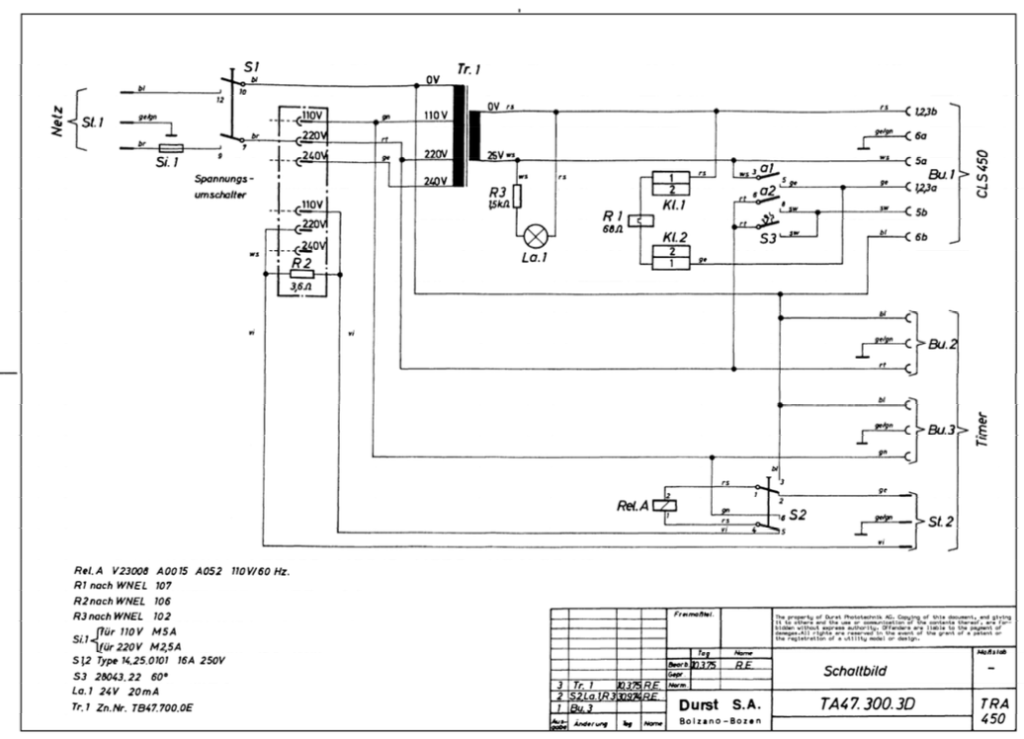
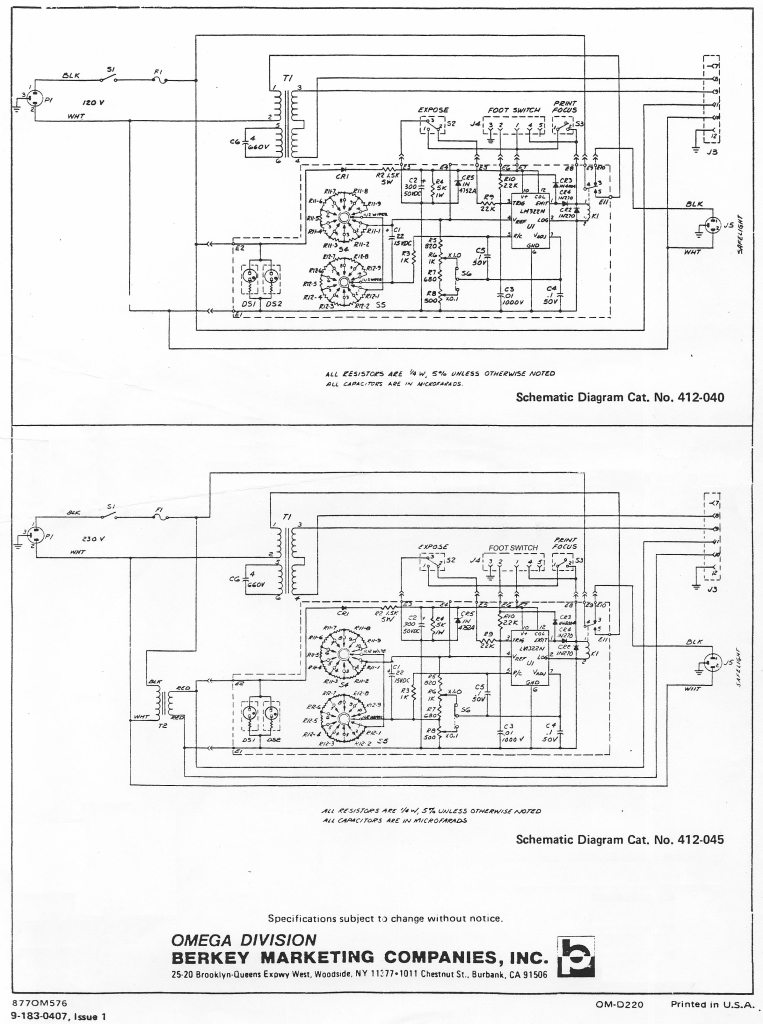
http://www.jollinger.com/photo/enlargers/chromegatrol_repair.html

http://durst.loremi.com/


http://www.jollinger.com/photo/enlargers/other/Changes_to_My_Chromegatrol.pdf

Amateurs need to explain, more to themselves than to others, why they ended where they did. It can’t be because of their lack, it must be something you’ve done.

“Galdston was surprised that Evans made better pictures than he did, even though Evans didn’t know much about f-stops and shutter speeds.”

The difference between Iago Galdston and Walker Evans is obvious.