2001: Dye Transfer has become a lost process. Something talked about, mostly by those who never made one.
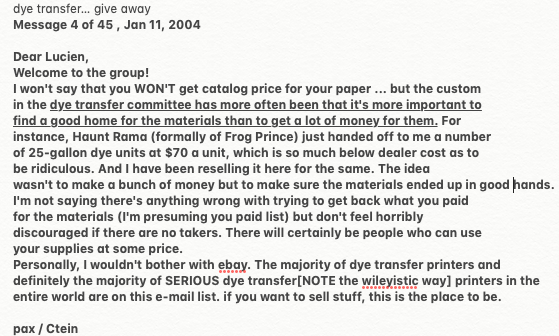
>> Apr 19, 2001 –Anyone out there interested in a Durst 8×10 with all the extra’s for Dye Transfer? Carriers, Condit stuff, vacuum easel, 403 color head and more. >> Jan 16, 2002 All my stuff has been sitting … anyone want anything? Rollers, granite tables, trays ??? 2 rolls 10 feet by 40 inch Kodak F paper. about 100 sheets Surface F 20×24 about 18 gallons Cyan, Magenta, Yellow dyes. All for free, just make it easy for me to ship. I’d like to able to drop at Mail Boxes Etc. and have you pay for shipping.
Then, there are those that make the dime they need. Selling to cover their mistakes, missteps. Greed is never a gift.
>> ctein “comment about giving “the custom in the dye transfer…
away… then, he sells… and, at last, he must give away. A needy greedy cycle. From the Herdy Gerdy Man
advice he didn’t take until many years after he couldn’t sell it.
advice, like old equipment, isn’t worth as much as the seller thinks
I keep pretty good track of who is doing DT, because I still get inquiries.
[ctein ] 2023…
[2023] From the large membership group, some collected remarks concerning volume of work, as well as film+developers in use for mask & separations.
[J1] 10-15 for clients. Delta 100.
[A2] 8 to 10, for myself. using expired Pan Masking. LPD4 in D-8, and Kodalith A&B. DK-50 1:3 3min at 78F rotary processor.
[R3] T-Max 100 & HC-110.
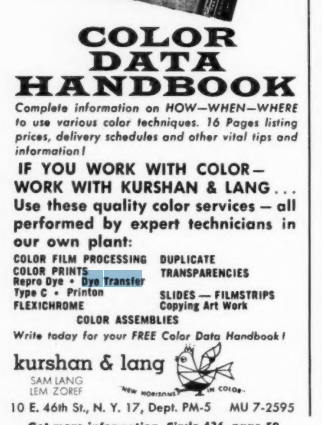
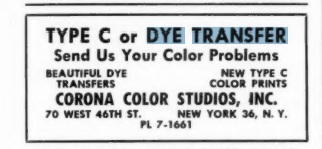
Meanwhile, back in the fifties: ads for labs, and a new film, a new style of emulsion. All these are gone; Kodak won, for awhile. And along came Fuji, who seemed, for awhile, to be the winner. An along came the worldwide HealtQuake. Fuji has moved to that great big ocean. Kodak coats 35mm for the masses, returning to their origin story. We push film; you push buttons.
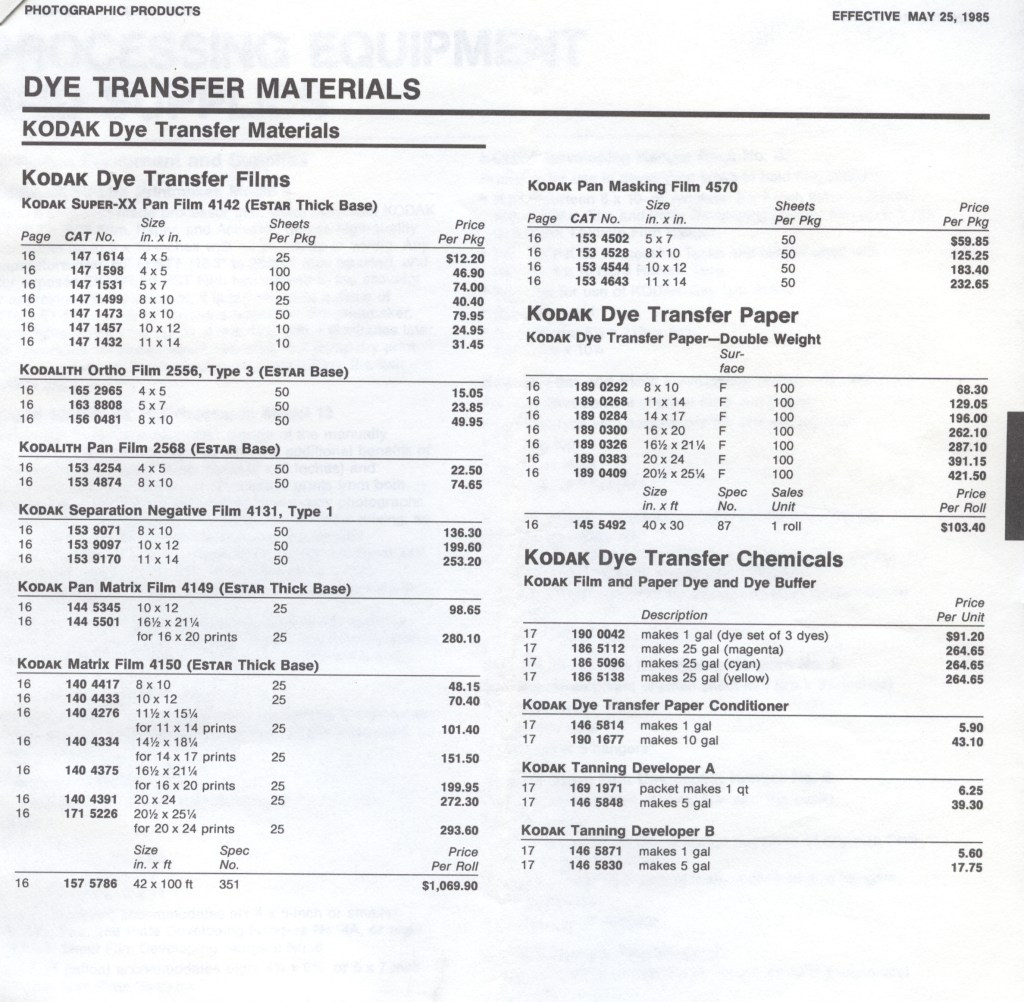
Dye Transfer Materials price list.
A group can’t live if it can’t get passed its origins. That is why OIC began. They are the largest group engaged in making DT/IP prints.
[there will be more posted. this post will grow]
\\ updated post on dye transfer paper[apr 2024] summary: don’t buy paper unless you have all other items, even chems. If you must make conditioner, why not also make mordant, which means you can use fixed out BW paper from Foma, Ilford, or … old eBay.
.. and the great misdirections.. Where do I buy _X__ is one frequent question on photo forums. Forums are built around buy/sell, how/tell. since you don’t correct him, it means you don’t know.
NB: realize Maxima was never intended for the retail, general darkroom user of RA materials, so was handled diectly by Fuji USA diect to the user. It also was serviced by distributors to those with resale association agreements; typical of professional labs. There was an person on LFPF cutting Maxima for anyone interested. She also offered a complete dye transfer lab, including starting supplies at no cost — no takers after a year. Showing how strong the market was among these longtime hobbyists.
[**/Wiley/ Mr. Bill /mshchem /— ** ]
forums come together to express opinions; additionally, posters attempt to out talk each other, like perennial freshmen.

mr. bill, another back officer, explains why it is difficult[thinking that manufacturers don't sell direct]. They do.
 Drew Wiley hasn't achieved success, even with his consummate back office communication skills. after all, he talked with some of the wealthiest salesmen in the world. he even worked at a Pella store selling door knobs to billionaires.
— the answer is in there … just lost in Wiley telling everyone his story. Koraks, a mod, never picks a review point , yet continues to make his repeat point. To get a group past freshman status requires someone to direct the group. In open-classrooms such as medicine, and law, this is achieved by use of extreme interrogation by seasoned upper class-men. These schools aren’t hobby shops. Getting the conversation moving… keeping the plate juggled, means getting the conversation to more points, or away from points making it all pointless. since you don’t correct him, it means you don’t know.
[ the answer for USA: maxima is sold direct. it can also be walked thru for some mini-lab sellers. Minimum order is one roll.
it is up to that seller to decide if you can become a customer of theirs.
these are not the  B&H, Freestyle stores. Unique can get Maxima. You can also buy directly from Fujifilm USA. Just make polite, reasoned access. Simple to do.
The direct answer, a name and phone number, was provided by Jen, on Large Format Forum. She posted it overnight after Gregory Davis posted a contact name at Pakor, the equipment supplier known to photography labs since 1984. Gregory Davis had a fight with D.Wiley over color retouching. Mr. Davis, has removed his posts from LFF (and Photrio). So it goes... You keep a Wiley, you lose the Gregory's and Jen's.
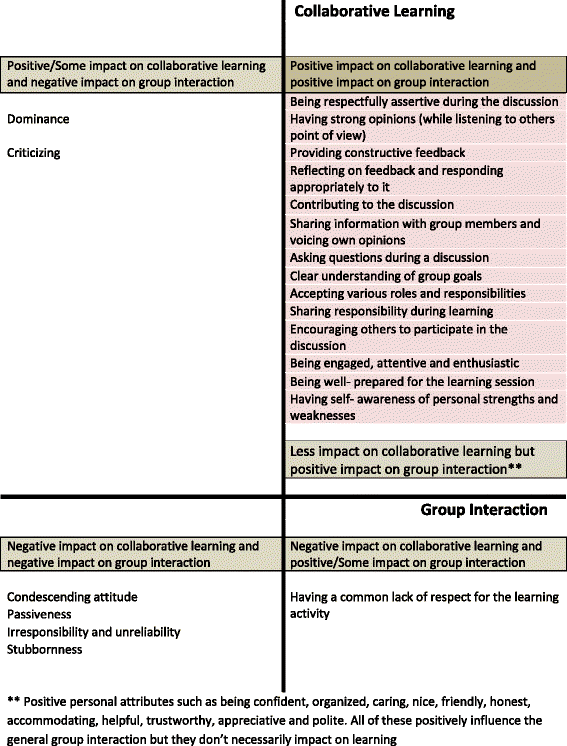
https://bmcmededuc.biomedcentral.com/articles/10.1186/s12909-016-0730-1/figures/1 ‘Students and tutors identified a range of behaviours that influenced collaborative learning. The main themes that emerged included: respectfulness; dominance, strong opinions and openness; constructiveness of feedback; active listening and contribution; goal orientation; acceptance of roles and responsibilities; engagement and enthusiasm; preparedness; self- awareness and positive personal attributes. An important finding was that some of these student behaviours were found to have a differential impact on group interaction compared with collaborative learning. This information could be used to promote higher quality learning in small groups.’
[ they have fresh, broadening explanations that they lose within a fortnight]
Material #
DESCRIPTION
UNITS/CASE
MIN.UNITS/ORDER
4/1/2019 SUGGESTED RETAIL PRICE
600020562
CLP CA PROL MAX GLOSSY 16 x 275 (40.6×83.8)
1
1
$375.30
600020550
CLP CA PROL MAX GLOSSY 20 x 275 (50.8×83.8)
1
1
$469.13
600020549
CLP CA PROL MAX GLOSSY 24 x 164 (61.0×50)
1
1
$335.72
600020548
CLP CA PROL MAX GLOSSY 30 x 164 (76.2×50)
1
1
$419.66
600020547
CLP CA PROL MAX GLOSSY 30 x 164 (76.2×50) EM OUT
1
1
$419.66
600020561
CLP CA PROL MAX GLOSSY 50 x 164 (127.0×50)
1
1
$699.43
600020553
CLP CA PROL MAX MATTE 16 x 275 (40.6×83.8)
1
1
$375.30
600020552
CLP CA PROL MAX MATTE 20 x 275 (50.8×83.8)
1
1
$469.13
600020554
CLP CA PROL MAX MATTE 24 x 164 (61.0×50)
1
1
$335.72
600020551
CLP CA PROL MAX MATTE 30 x 164 (76.2×50)
1
1
$419.66
600020530
CLP CA PROL MAX MATTE 30 x 164 (76.2×50) EM OUT
1
1
$419.66
600020529
CLP CA PROL MAX MATTE 50 x 164 (127.0×50)
1
1
$699.43
fuji maxima … just a phone call and an email
Maxima Labs… this list is shrinking as those using Polies close their RA4 polies out. Polies had the highest dpi, using the newest engineering.The 50×100 inch Polielettronica LaserLab HD C-Printer, excels with a 610 dpi resolution (6100 dpi “apparent” resolution) and 48-bit color.
[ Measurements always go in the same order. The first number is always the length, the second one is the width, and the third one is the height…. \note to: the long winded forumat iley ]
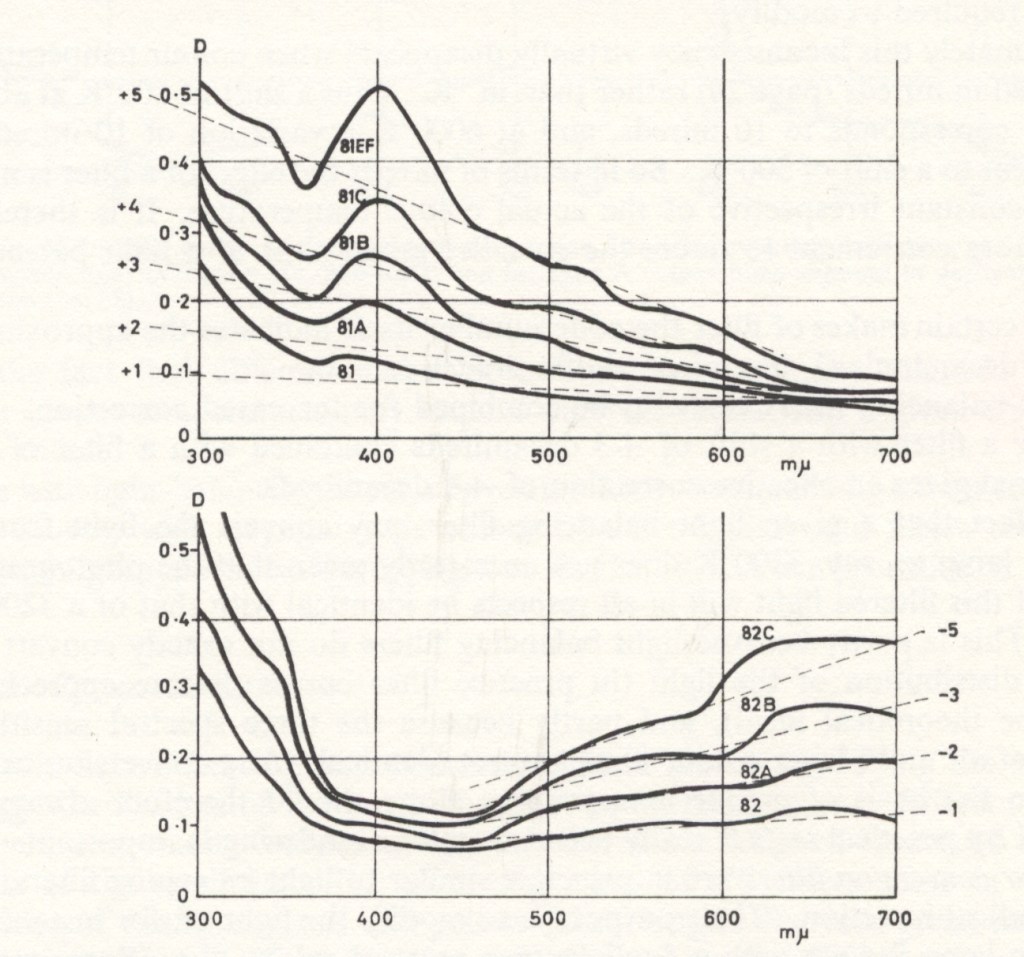
a brownish or amber series of filters to reduce ‘effective’ color temperature. Gevaert CTO, various R ranges, and Wratten 81.
bluish Wratten 82, Gevaert CTB, and B filters increase color temperature.
These plots are of absorption, not transmission.
--- riddle me this
if you want to change color of shadows (landscape photo) using a filter on the lens, does it also affect the brighter sunlit portions?
understand why CT filters are correcting a scene. architecture photographers had to understand this for most work done after 1970. we had rolls of neutral density material in addition to tungsten, or daylight correctors -- this, along with multiple emulsions designed for different tungstens lights meant we achieved long scale balance. Also, labs could push or pull because of modified chemistries. That is all gone. Well, not gone, it has migrated. Evolved. It has followed the natural path of all industry.
-- another riddler
long straight line film wasn't the best design of contrast masking film. standard camera films were used to make masks when sharp division of subjects could produce 'halo' against a clear background on the 'chrome. separation neg Type I was favored by labs in NYC.
-- the curves are meant to sum to a desired line. the original isn't linear, and often its layers aren't parallel. Masks "move" lines by adding density.
experience with actual, true, real, pro-level [I’m snarking] images teaches the answers. anyone who believes Wiley isn't believable... they don't have depth.
--- third riddleabout points of control.
2 point control is what much of the photolab is about. exposure sets shadow, development sets highlight.
to make a color *interneg without adjusting the development means you have single point control. exposure, with a standard high being maintained by your c-41 lab. this means you are making multiple rounders to get masking/color correct. okay, lets say that is locked.
we have to mask the 'chrome to bring it to too high an initial [c-41 standard] point. this likely means we need to make a post mask as well.
the internegative is an intermediate, a conversion step between 'chrome and paper.[ E-6 to RA-4]
complex... has anyone said that's what they do [in photrio/lff land][N]
*The color negative film is balanced to daylight; my enlarger lights are tungsten balanced. I use a tungsten to daylight conversion filter. I also may make masks. I always used modified C-41 processing.
...continuing with the riddle of control points:
3 point aim was the height of the better labs. a very few, ~3[?] achieved 5 point control for clients. those cases involved making split-masks and colored masks -- this meant dyeing the silver mask.
in this digital age, simplified skillsets involve matching 16 aim points, while achieving control of 1024 is a practical matter for commercial printers. film makers go even greater lengths to satisfy an image aware consumer.
-- subpoint: Keyed Process. Emulsion makers design for full step process. The color negative is designed for a color positive. Kodak Portra films were designed for printing onto Kodak Professional Portra and Supra Papers.
The Top Knot is: you lose the people with direct answers and experience, keeping those who don’t know, but keep the arguments alive. Perhaps that is the path to commercial success. Perhaps take a look at the payment status of the deflectors.
Equipment does matter! — sometimes it does; sometimes it doesn’t. For most people, even photographers, photographic equipment gets in their way, Even if their way is the standardized imagery of the Kodakery.
Equipment Poor
is the phrase once used as epithet about those professionals who bought more equipment than they ever used; buying so much they rotated credit cards. They were made poor by their falling for the pitch of the Camera Monthlies sold at the camera counter. Salesmen could be relied upon to inform their customers about improvements to their vision that lay in their future — oh, and we have layaway.
Lollipops also fell into the trap of buying for something sometime in the future. These people were the ones caught off-guard when the tide changed.
Lollipops were the single person lab barely able to support themself. They may have had aspirations of becoming a mom-n-pop. Lollipops eventually realize they’re just a hobbyist on the brink of becoming a hobo. For most, the only professional thing they did was get a re-sale license
— ANSWERING every question the same. applying one answer for every situation. see it in one case, not the other. variable in the Sinar, not in the souping. BL mode. Cost of souping, not knowing that the person used the burst system to save more than direct cost, and that in that approach they hired an assistant, gaining even more work relief: they could answer phones and other small tasks. [ link site ]
two pathways taken. The first is more popular than the second. Note the view counts.
One sells — they are trying to make a living off of the adventure of photography
the other is the much harder, less certain way. Sometimes it works.







You must be logged in to post a comment.