
when trivia becomes the reason for the gathering. Weekenders, devoted members of the Snobby Hobby discuss work turning to the meaningless, quickly.
It may not mean anything, yet it fills the time of those without much effort.
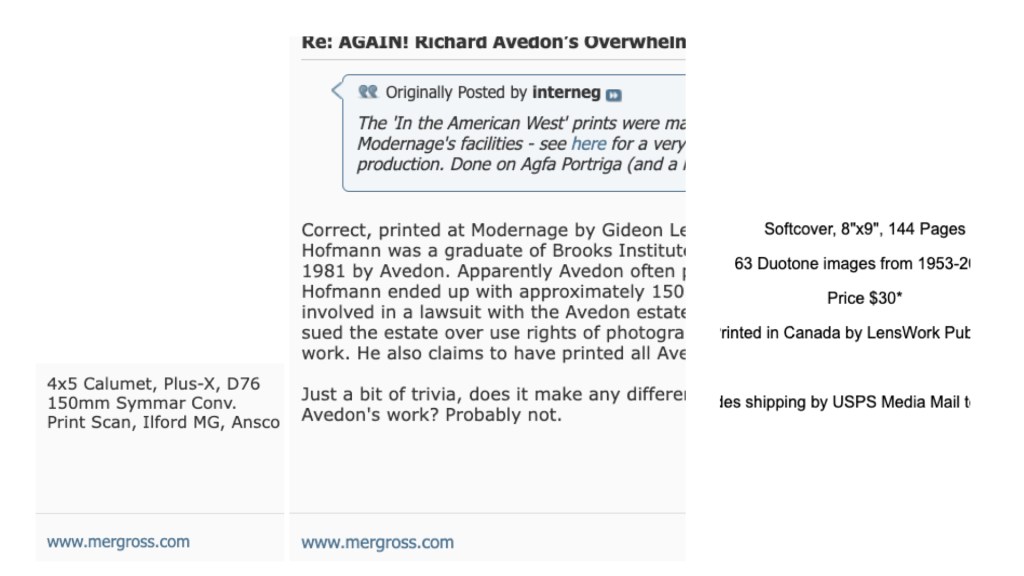
Let’s get to the work… they can’t. What they can say about their work is how it was done. Even after decades, the conversation is at how-to.

speaking from rumor. once heard becomes the word.
The why-for of considering their campfire stories. Do they propose a mode of looking without understanding who, what it excludes. What, the how and the who they condone (or condemn) matters, perhaps, even more as the world of profession recedes into the past. There are amateurs and then again others. The nature of a field mixed without common ground is my interest.
Richard Avedon
Baldwin and Avedon. Nothing Personal [ https://www.newyorker.com/magazine/2017/11/13/richard-avedon-and-james-baldwins-joint-examination-of-american-identity ] was my preferred book. Baldwin’s writing was my prompt. Many years later, I see Avedon as a masterful photographer. A maker of cliches rather than a perpetuator of them. His story is that of many commercial photographers, although he was able to move from the commerce to collection with help from the Amon Carter.
Philip Gefter’s book, “What Becomes a Legend Most,” argues for Avedon’s place as one of the 20th century’s most consequential photographers.
Laura Wilson documented the project’s gestation and birth in her book “Avedon at Work: In the American West.” Published in 2003. She learned the most necessary “craft” of photography — dealing with the world. The following video at the Amon Carter hits several key points in her method.
Modernage
Founded by Ralph Baum in the 1950′s, New York’s Modernage Photographics pioneered many of the most advanced darkroom techniques in the last half of the 20th Century. A master photographer and technician, Baum was to champion the notion that the art of the photographic print was equally important to the creation of the photographic negative that served as its inspiration. Name Drop: Josef Cernovics; Michael J. Masucci
1985 Amon Carter shows Avedon In the American West
Deborah Bright (spe exposure) publishes Mother Nature and Marlboro Men… about landscape photography and western spaces

You must be logged in to post a comment.