Daisuke Yokota

Born: 1983- //  Yokota is part of a 
generation of young artists using photography in subversive 
new ways. His approach combines multiple rephotographing 
and printing, applying acid or flame to the end results, and 
making one-off prints and books from unexpected materials 
in staged public performances. Yokota is working out of, and 
pushing forward, a Japanese tradition of photobook-making 
that harks back to the visceral experimentation of the Provoke 
generation 

I don’t make work to express my feelings, it’s more like burning them

the Zine form: “A self published limited edition zine, the publication marks one of Yokota’s earliest printed works. Experimental and distinct to his book-making process, SITE is a series of images which displays the artist’s photographic approach in exploring both memory and time. With SITE, Yokota chose to experiment with both photoshop and digital forms of image distortion.” https://www.shashasha.co/en/book/site

“His practice consists in constantly revisiting his own archive of personal photographs by adding layers of accidents, in order to metaphorically signify the superimposition of states of consciousness and memories. Of- ten referring to the principles of echo and reverb, Yokota also establishes links between visual and musical fields. One could say that he captures ‘noise’ in the broadest sens of the word.

Daisuke Yokota is the author of numerous critically-acclaimed artist’s books, either handmade and self-published or realized with various publishers.” https://jeankentagauthier.com/en/artistes/presentation/5/daisuke-yokota

DAISUKE YOKOTA — For Color Photographs, I worked with layered sheets of unused, large-format color film, experimenting with the development before scanning them. Generally, photography exists to record reality. The present development of technology ignores the material. Originally, needless to say, film negatives generated the image, and there was paper to stabilize it. In short, photography is a combination of images without the mass and the matter [film and paper]. For
Color Photographs, I focused on this material side. https://purple.fr/magazine/ss-2016-issue-25/daisuke-yokota/

note the foils included… how they overlay.

finally, flashback, only because it makes those of the hobby board wonder…

very clear explanation that leaves those expecting their method to be the only method, mis-interpreting the steps

the first group of amateur, the most common type, understand only what they know how to do.
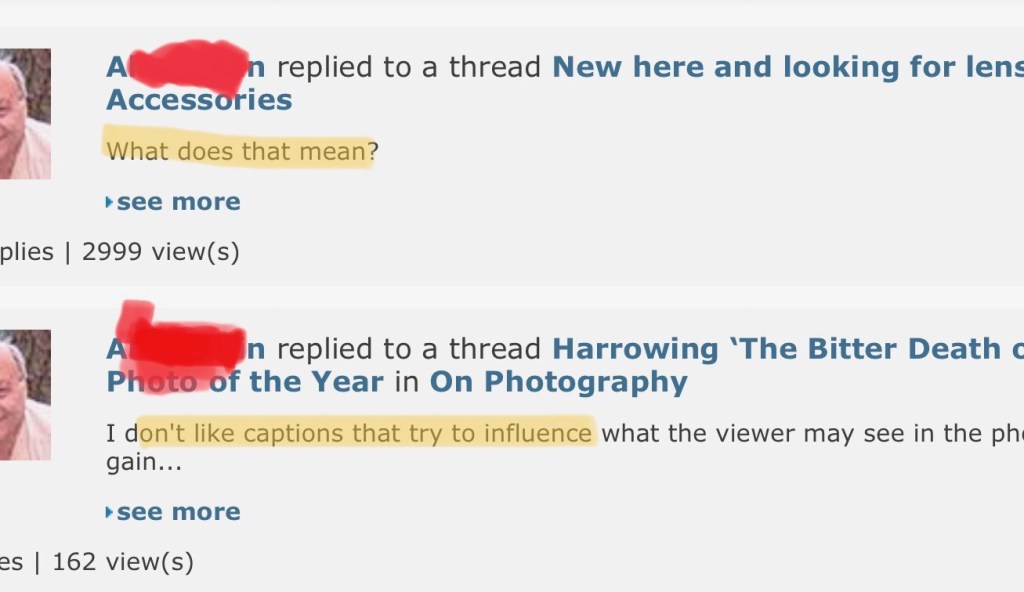
Captions.

Words are limited, so are photographs. Words have possible definition; photographs don’t.

Amateurs can be spotted by what they try to eliminate. And how.

It is common that they will present pictures with captions. Their captions include technical specifics. The craft, the method used, the specifics of technology are key to their working – to their exchange of common ground. The amateur, enthusiast community is built around the camera counter. What to buy, how much to pay, these are the components of their world. They are consumers attempting to claim makership.

They celebrate their GAS and joke about their wife finding out. Her ignorance is assumed. She is too busy buying makeup to notice my charges.

[posts are in recent to prior order. they are consecutive in time, but different threads.

“don’t like captions that try to influence” ?too arty for his socialization.

“what does that mean” — needed more caption.

Captions, writing on photographs are welcome elements of photography since its inception. But, that of course is among those “arsty” types who are trying to influence my opinion. Do you wonder what network he watches?

Acceptable, even necessary caption examples: “Great shot, very pleasing.” + “Intrepid 4×5 MK4
SuperAngulon 90mmf8” ” “I wouldn’t want it any brighter.” + “Fuji HR-U  D76 1:6 12 minutes”

These are the words of the enthusiast. Somehow they do tell me what to think; what is acceptable; how little thought it takes.

For me, I wish the captions and conversations where brighter. Or at least had even a hint at meaning beyond place and placement.

Darkroom Privileges

taking pride, and gaining privilege.

Working in the darkroom was necessary for most photographers in the 20th century. There were some who used it as relaxation; a place apart from others. It served as backdrop to many photographer’s conversation. Craft remain the common conversation topic; often the only thing photographers speak about, can speak about, or will permit as point of conversation is craft.

They don’t, oddly, engage in big definition of what they mean by ‘craft.’ — That being obvious. A big silent gestured “you know” being enough.

Honor, prestige for something in your life. Most people are printers, not printmakers. They do think they are the grand ones; those who have mastered the work. What they, the weekenders, committed workshopaholics don’t understand, or won’t say, is they are not the Sammallahti’s of the world. They make prints; this doesn’t make them printmakers. Not even the Sammallahti’s are printmakers.

Pentti Sammallahti (born 1950 in Helsinki)

“For [Sammallahti] making prints is part of his art. The frog peers from a silver-gelatine image taken from a black-and-white negative, one of his preferred techniques, but he experiments ceaselessly.”

  • The Russian Way.
  • Pentti Sammallahti.  Photographs by Pentti Sammallahti. Text by jukka Mallinen and Taneli Eskola. Musta taide/Finnfoto, Helsinki, 1996. 
  • Pentti Sammallahti. Photographs by Pentti Sammallahti. Blue Sky Gallery, Portland, 2001.
  • Pentti Sammallahti. Photographs by Pentti Sammallahti. Nazraeli Press, Tucson, 2002.
  • Archipelago. Finnish Landscapes. Photographs by Pentti Sammallahti. Helsinki, 2004.  
  • Photo Poche 103: Pentti Sammallahti  Photographs by Pentti Sammalahti. With an introduction by Gerard Mace. Actes SUD, Paris, 2005
  • Ici Au Loin. Photographs by Pentti Sammallahti. Actes Sud, 2012.
  • Here Far Away. Photographs by Pentti Sammallahti. Dewi Lewis Publishing, Manchester, 2012.
  • Des Oiseaux. Photographs by Pentti Sammallahti. Text by Guilhem Lesaffre. Editions Xavier Barral, Paris, 2018
  • Me Kaksi.  Photographs by Pentti Sammallahti. Atelier EXB, 2021.

Craft is certainly a part of any doing, making; it isn’t the only thing, just an early, and frequent thing. A point of conversation.


Art or Craft
easy to tell
when you look at a photograph, do you ask what lens was used?
-- you’re “craft”
If those are the key questions you ask after years, then you aren’t in the conversation about art.

craft is conservative
the hobby world is like the big store Hobby Lobby
conservative imagers

skill badges around the making of items for gift and sale

reduced range of variance (happens in all learning - *shops)

even across medium : watercolor, photography; the image modeled to judge ‘art level’ is siilar or same. rules applied to guide the selection of subject, topic treatment set out the parameters of skill exercised.
the feedback : learn do see is the same
the training corpus guides them.

craft poles
Arbus --- Porter
Arbus -- Adams

style, demeanor
mode of action, interaction within the world outside the frame
experience of world produces actions within the frame.

worst of singers makes a mannerism of song

art isn’t an exhibition of craft
I don’t shoot film because it is harder, slower, better, longer lasting... none of those things. I shoot film because I like the cameras and understand the process to a great depth with many thousand hours acquiring.
I prefer digital because of the greater flexibility, responsiveness and likely future growth. It also is much more amenable to direct, same process alterations.

photography, by 1890, had demonstrated that difficulty of task wasn’t the catalyst of art./

Art isn’t a craft fair, no matter what the camera salesman says.

craft online
not locate silver mine, or build corona discharge multi-slot coater

but log into a forum of unknowns and ask if they know what you don’t
ask where to buy something.

craft sets your limits; delimits your imitation range
craft can’t be hired?