
telling tales: to children about the evil rich chinese who fails because…
Have you heard the story about the rich Chinese who bought Technicolor, but couldn’t get it to work. If you haven’t heard it, good , it isn’t true. It’s based upon a prejudice told by a person Who is neither wealthy nor able.
A tale told often by the fool on the forum.
from an idler responding with waves and wishes; his comment, repeated many times has never been correct, and is never corrected. This lack of caring about accuracy is easy to pass off as knowledge among those asking questions about setting their camera ISO, or failing to know that pushing and pulling are terms from developing (movie lines introduced the terms). Even the long time keepers of those places seem to fail at understanding the exposure relationship differences between Negative and Slide processes. Furthering demonstrating the lack of experience based knowledge, consider that almost anyone with a drawer filled with negatives would realize that a sheet of 8×10 paper is covered by 4 (4x5s), or 1 roll of 120, or 135.
[The remaining Technicolor cameras, along with huge quantities of the remaining dyes, were allegedly sold to a Chinese entrepreneur, who thought there was a market for it in relation to the colorful big budget Bollywood films of India. But that would require rekindling an entire lost culture and industry of specialized craft at great expense, which proved unrealistic.]
Before providing a boast post, check– then, please proceed to boast of your skills.
[& if you don’t have a library, check online — avoid the forums]
Maybe this will help:
Technicolor:
The British line was shut down in 1978 and sold to Beijing Film and Video Lab which shipped the equipment to China. A great many films from China and Hong Kong were made in the Technicolor dye transfer process,[**] including Zhang Yimou’s Ju Dou (1990) and even one American film, Space Avenger (1989), directed by Richard W. Haines. The Beijing line was shut down in 1993.
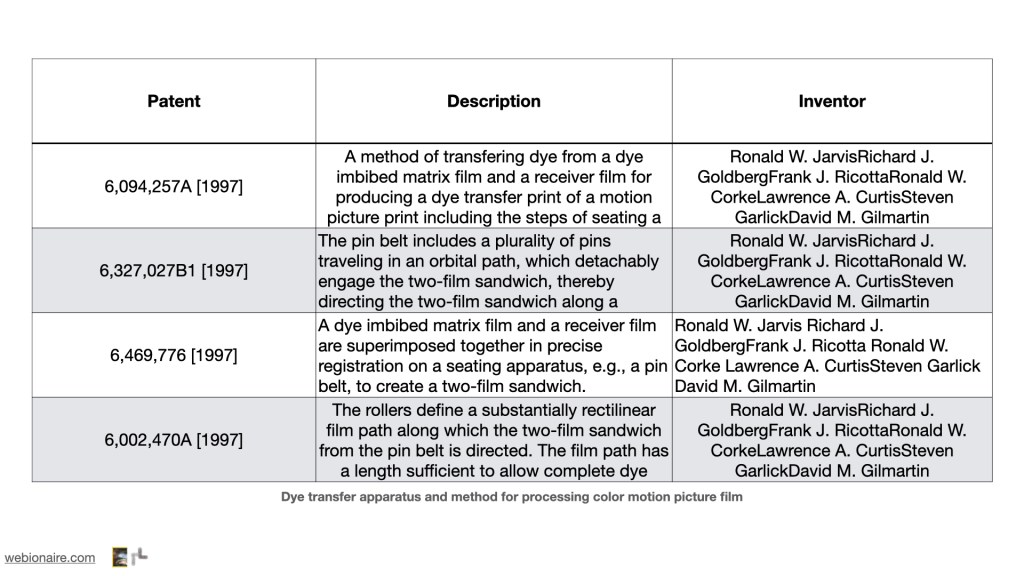
The “revived” Technicolor Dye Transfer process had several patents:


You must be logged in to post a comment.