Phonio

telling tales: to children about the evil rich chinese who fails because…

Have you heard the story about the rich Chinese who bought Technicolor, but couldn’t get it to work. If you haven’t heard it, good , it isn’t true. It’s based upon a prejudice told by a person Who is neither wealthy nor able.

A tale told often by the fool on the forum.

from an idler responding with waves and wishes; his comment, repeated many times has never been correct, and is never corrected. This lack of caring about accuracy is easy to pass off as knowledge among those asking questions about setting their camera ISO, or failing to know that pushing and pulling are terms from developing (movie lines introduced the terms). Even the long time keepers of those places seem to fail at understanding the exposure relationship differences between Negative and Slide processes. Furthering demonstrating the lack of experience based knowledge, consider that almost anyone with a drawer filled with negatives would realize that a sheet of 8×10 paper is covered by 4 (4x5s), or 1 roll of 120, or 135.

[The remaining Technicolor cameras, along with huge quantities of the remaining dyes, were allegedly sold to a Chinese entrepreneur, who thought there was a market for it in relation to the colorful big budget Bollywood films of India. But that would require rekindling an entire lost culture and industry of specialized craft at great expense, which proved unrealistic.]

Before providing a boast post, check– then, please proceed to boast of your skills.

[& if you don’t have a library, check online — avoid the forums]

Maybe this will help:

Technicolor:
The British line was shut down in 1978 and sold to Beijing Film and Video Lab which shipped the equipment to China. A great many films from China and Hong Kong were made in the Technicolor dye transfer process,[**] including Zhang Yimou’s Ju Dou (1990) and even one American film, Space Avenger (1989), directed by Richard W. Haines. The Beijing line was shut down in 1993.


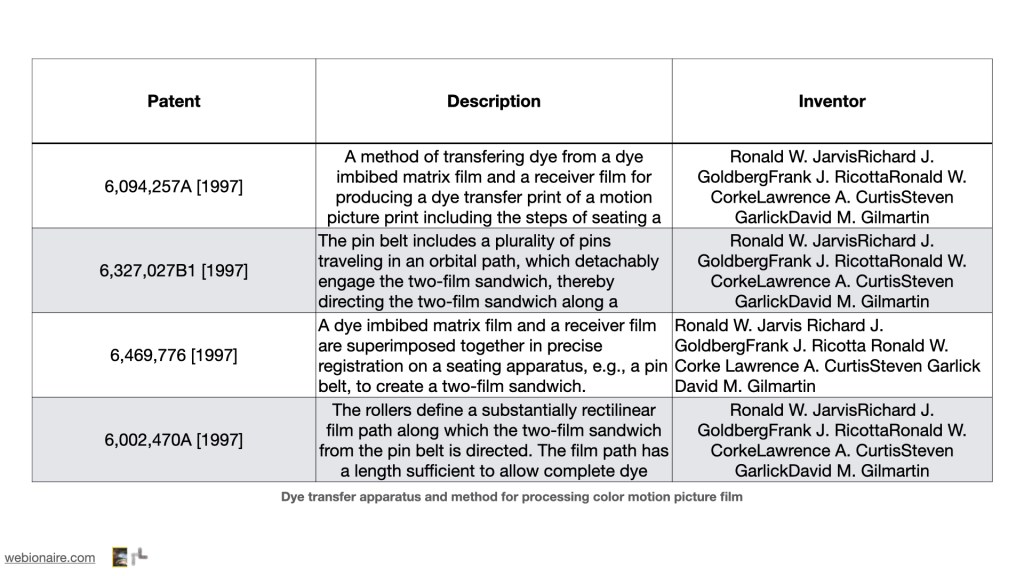
The “revived” Technicolor Dye Transfer process had several patents:
What is “Old Brown”

from days of Harvey’s [CHQ] and Edwal developers. It is seasoned developer, developers before greater knowledge of buffering the emulsion byproducts of developing. Fresh developer (777) was mixed in clear glass bottles; into this was put the butts and tails of the roll of film. After enough time, this clear became cloudy. This aged film was put into “old brown” jugs. Old brown was used as starter for “clear”

in paper terms, it doesn’t mean exhausted hydroquinone, it means chemicals from the paper emulsion intermixing with developer chems. In early days, when lith was a commercial, highly controlled procedure for making controlled dots, this could be a ‘bang’ paper such as Broivira 6. Current use of “old brown” can mean the seasoned [weaker] developer used in solarization, more likely OB means seasoned LITH developer.

These high contrast papers had cadmium, and rhodium chloride essential for high-contrast long storage paper. a darkroom would have grade 5, or 6 in stock, but likely use infrequently. These paper found their way into splashboard processes such as solarization, and lith, with lith meaning using exhausted developer from the lithographic side of the shop. These prints took on coarse clumped particles of warmtone hues, unlike lith-proof paper which remained true bowntone when processed in lith developer.

Like many specialties, photography borrows terms from existing fields. We also adapt concepts: old brown is similar to Solera:
[ Solera is a process for aging liquids such as wine, beer, vinegar, by fractional blending in such a way that the finished product is a mixture of ages, with the average age gradually increasing as the process continues over many years. The purpose of this labor-intensive process is the maintenance of a reliable style and quality of the beverage over time.Solera means “on the ground” –wikipedia]

song somewhere between singers

those well known. those somewhat, somewhere known.

Neither are they the authors. They didn’t originate the sound, the system, nor the platforms of engagement. They each share the same virtual space.

I know little of either of these two. The one, Miley Cyrus, I have heard of without ever hearing. A Youtube search for the song brought both these videos. After listening to several versions, the Miley Cyrus is a return listen. She remains on my Yawn list, but this video tempted me enough to seek other versions of her. So much for success. So much for my ability to pick a path to the top.

The cover singers are competent; even providing a believable reason for making the music. The difference is that difference raised often between those with ability, access, and ‘other.’

Covid lockdowns lowered the bar, increased access to music. Musicians played over the same channels; apparently, for the same rewards. Getting to play music for others. Most of the well known met my criteria for acceptance of their success.

The stage is only so big. Only some will ever stand in a stadium and fill it. I wish when they did, they did it with their music rather than their costume.

between singers is song.