
gallery notes from 70s. origin story of photography entering the world of walls for the people.
San Francisco early years of photography into art gallery. the wall and the bins were filled with unknowns, and early risers. Todd Walker was making a transition and name. His work was an early pathway into the alt-photo world. When alt meant “not Kodak” and a precedent to Post-Industrial photography.
Focus Gallery was founded by Helen Head Johnson (1916-1989) in 1966 on Union Street in San Francisco. She had worked for the de Young Museum as public relations director. She decided to open a “people’s gallery.” Over the nineteen year span of Focus Gallery, she presented over 300 exhibitions, showing work of more than 500 photographers. She closed the gallery in 1985.
Grapestake gallery was functioning in the period 1970-1986.
I remember the bins for photographs. Bins had prices. Prints were in plastic, much like a record store.
Helen Johnston left her private photography collection to the de Saisset Museum, the Oakland Museum of California, and the San Francisco Museum of Modern Art.
The show prior to Todd Walker’s was Eikoh Hosoe’s.
1969, Aug :” enclosed is check for sale of portfolio at $9.00 less gallery commission of one third… Glad you are not dependent on our sales to keep the wolf from the door! I always say.. can promise no sales.. but certainly can promise exposure.
Sept 1969, from Todd: “Thank you for the check and most especially for the invitation to show in your gallery. Do you have a drawing or measurements of the gallery space so I can plan the number of prints and how they might fit?”
1969, Nov 14: “dates for exhibition would be Feb 3-28. We instal over the weekend…. the other show will be by Tom Baird…we could use about 40 to 45 prints….. Am wondering what you plan to show? Would it be the same show as was “Camera Work?”
Dec 1969, from Todd: “I would also like to print the announcment and will get it to you two weeks ahead of time. I think the show should just be called Photographs by Todd Walker.
FG: [announcement photos] if you have both abstract and representational probably representational would be better.. … printing enough copies of the announcement to send us copies for our mailing list of about 400 mostly poster sources and regular customers?
Jan 6, 1970: Received of Todd Walker. three portfolios and a sample to sell for $30 less gallery commission of one third and 450 announcements. [HJ]
[HJ] We don’t have them (openings). However if there are photographers that you would want to see and might not have a chance to see them otherwise we could arrange one.
Feb, 1970: [HJ] … and I’m so glad we have the explanation for the techniques. There has already been much favorable commen on it. … Could you send us about two more press pictures? The one most representative of the show… The landscape is just too dark for newspaper reproduction and besides I’m afraid they would think it was not really representative of your show.
June 1970: [HJ] … I hear so many wonderful reports of what you are doing.. how exciting is your present work. We were fortunate to have had it at Focus. .. enlcosed is a check for the sale of the 16 print portfolio (30) less gallery commission and thank you!
Aug, 1970: [HJ] Enclosed is check for sale of one of your portfolios … Your show at Focus was one of the best we ever had..
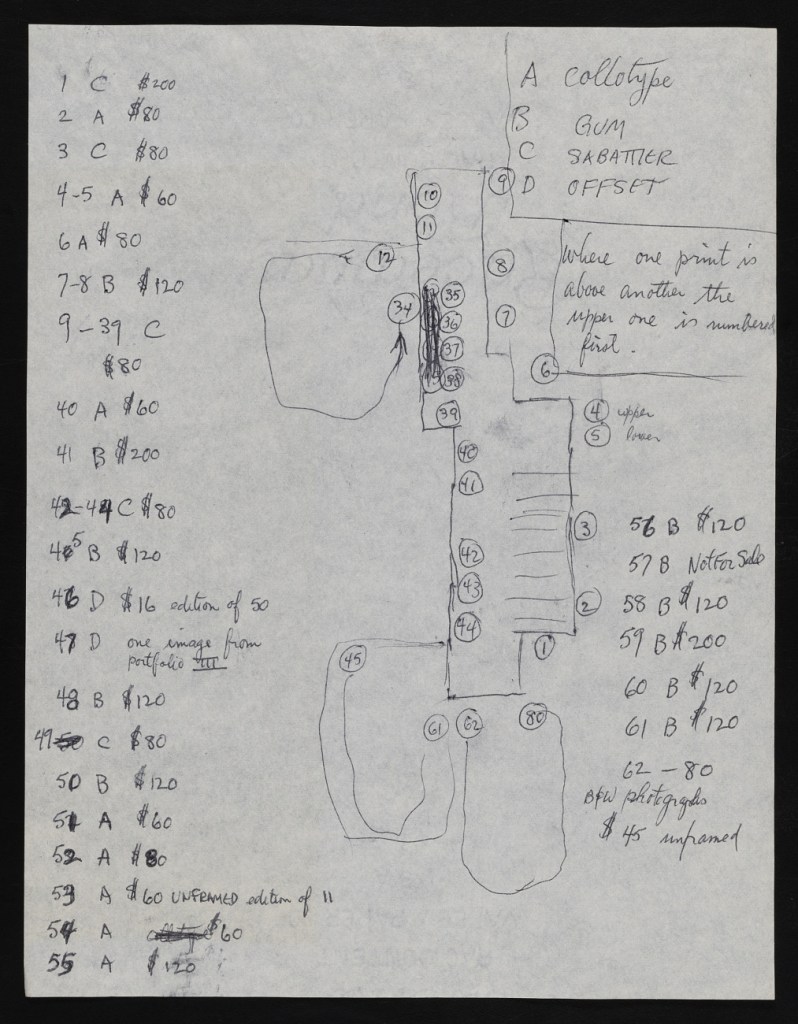
Arts coverage in the 70s was printed in Travel sections of papers. It fell into foundation journalism, being somewhat enlarged form of a Press Release. Some reviews were only that, a re-write for space.
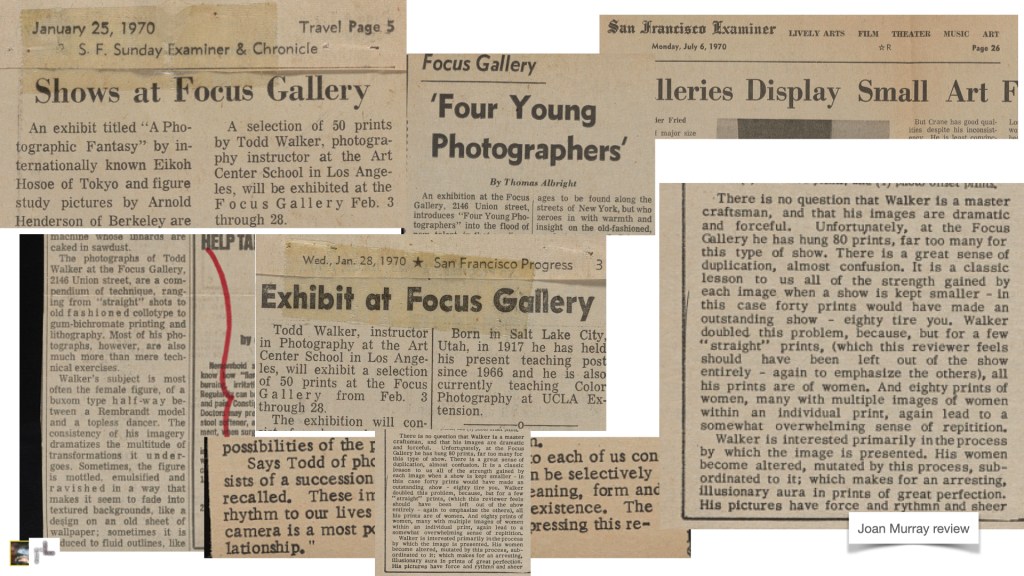
Todd Walker: “Reality to each of us consists of a succession of images which can be selectively recalled. These images provide the meaning, form and rhythm to our lives as they relate us to existence The camera is a most powerful means of expressing this relationship.”
Joan Murray (reviewing): ” Unfortunately, at the Focus Gallery he has hung 80 prints, far too many for this type of show. There is a great sense of duplication, almost confusion. It is a classic lesson to us all of the strength gained by each image when a show is kept smaller. … Walker is interested primarily in the process by which the image is presented. His women become altered, mutated by this process, subordinated to it; which makes for an arresting, illusionary aura in prints of great perfection.”

You must be logged in to post a comment.