
What Fujifilm knows. Two interesting patents about color print/ display materials. Also contain light sources used during testing of the new material.
People. Patents. Products. Find the people behind the knowledge and you will learn what the product solves. Meindert Slagt has few patents. This one lists several people with multiple patents. Jun Matsumoto came about in reviewing other patents of the holders. He is a key researcher for Fujifilm. Finding the addresses of each of these researchers locates their research building.
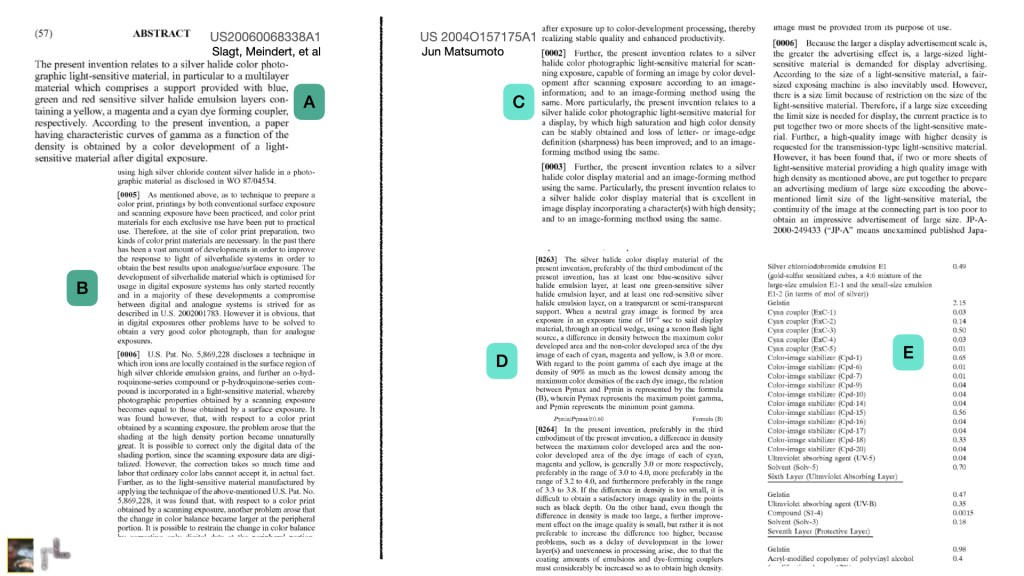
The need to provide a different print material, one designed to solve the problems of prior silver/color printing in being used in a digital /scan printing system.
- A: “light-sensitive material after digital exposure.”
- B: “it is obvious, that in digital exposures other problems have to be solved to obtain a very good color photograph.”
- C: “a high-quality image with higher desnity is requested for the transmission-type light-sensitive material.”
- D: “if the difference in density is too small, it is difficult to obtain satisfactory image quality in the points such as black depth…” difference too higher, problems such as delay of development in lower layer(s)…
- E: a snippet describing a single layer (the Fifth) of the display material. This is the Red-Sensitive layer. Notice that there are 5 Cyan couplers indicate, and eleven “color-image stabilizers.” Describing all the chemistry would take months.
>> https://patents.google.com/patent/US20060068338A1/en ” as to technique to prepare a color print, printings by both conventional surface exposure and scanning exposure have been practiced, and color print materials for each exclusive use have been put to practical use. Therefore, at the site of color print preparation, two kinds of color print materials are necessary. In the past there has been a vast amount of developments in order to improve the response to light of silver halide systems in order to obtain the best results upon analogue/surface exposure. ” Inventor Meindert Slagt Akira Kase Peter Franciscus Van Asten Yasuo Iwasa
>> https://patents.google.com/patent/US20040157175A1/en “As a method to expose a light-sensitive material according to digitized image information, an image-forming method in which scanning exposure is carried out using a light source of high light intensity such as a laser or LED, has been rapidly gaining popularity. Resulting from the recent popularization of laser printers and digital prints, the above-said image-forming method has been common. Accordingly, there has been a continual need for a light-sensitive material having characteristics suitable for laser exposure and digital exposure. As print for a display advertisement, higher image density is requested, because a vivid image must be provided from its purpose of use.” Jun Matsumoto Shinichi Nakahira Hidekazu Sakai
—- plus, updated posts: this on portra


You must be logged in to post a comment.