
home cooking: he brags about steak from his freezer
sushi isn’t thawed--

beef isn’t frozen. farm to table isn’t a home path way
the most nutritious meals aren’t made at home. uniform cooking is what the fast food industry provides. working to a standard is what a best lab achieves. that standard is set-able by the client.
not in some “fresh-water” fantasy way, but in a work to example print.

difference between hand lab and machine lab
AIM points


It was natural that he should care nothing for any abstract speculation or inquiry; he was an artist throughout, desiring only the refracted light of human imperfection, never the purity of colourless reason. – Percy Lubbock on Henry James, Introduction to The Letters of Henry James (London: Macmillan & Co., 1920), Vol. I., p. xxvii


½ teaspoon hot chile powder, preferably Thai or Lao
4 teaspoons fish sauce (nam pla)
5 teaspoons freshly squeezed lime juice
¼ cup slivered red onions
2 tablespoons chopped cilantro
2 tablespoons sliced scallions
10 whole mint leaves, more for serving
 Lettuce leaves
 cucumber spears, for serving

sushi is never frozen
there is no “authentic Chinese” from Oregon


realism has a past
abstraction never happens

better to have birthday on fresh friday than leftover thursday

smug ass not smart. often, similarity is familiarity. losers flock around QTs play pool
They don’t share, they show off. they best you, not better you.
Alt Papers: getting stuff
In new country may mean new clothes. Printing and printmaking are different. They began in different places, and diverged into different schools — education of the doers. Some of the words may sound the same. They aren’t.
Works on paper is the big arch. The base of the image is a paper, that very old fundamental object. It is quite nice on its own. So nice, that many are makers of paper; done. that is all that is needed. Make the paper. Show the paper.
Others, most of us, put something onto that paper. Photographic prints are on very limited range of papers. Hand-coated emulsions extend that range, as does digital printing. In fact, many digital printmakers chose that method because of the range of paper surfaces. Some of the most ardent devotees of the chemical cult do so because they dislike, disapprove of the paper surfacing above the plastic sheen of 20th Century Gloss.
Look List:
- https://legionpaper.com/
- https://www.acuitypapers.com/
- https://www.talasonline.com/paper-and-board/fine-art/printmaking
- https://www.imcclains.com/catalog/paper/index.html
- https://www.takachpaper.com/
- https://www.graphicchemical.com/
- https://www.utrechtart.com/categories/paper-boards/printmaking/
- https://www.washiarts.com/
- https://ruscombepaper.com/uk/
- https://www.johnpurcell.net/
- https://store.bookbinding.co.uk/store/
- https://www.dickblick.com/
- https://www.freestylephoto.com/
- https://www.bostick-sullivan.com/
| Paper | Process | Comment |
|---|---|---|
| Hahnemuhle Platinum Rag (HPR) | Platinum | Use as delivered |
| Arches Platine 300gsm | Platinum | “” |
| Bergger Cot 320gsm | Platinum | “” |
| Legion Revere Platinum | Platinum | “” |
| Clearprint 1020HP | Inexpensive 100% cotton | |
| Arches En Tout Cas | one side hot pressed, one side eggshell textured | |
| Awagami Platinum Gampi | ||
| Hahnemühle Sumi-e: | ||
| Legion Thai Kozo | coat with brush. | |
| Canson Vidalon Vellum | ||
| Canson Opalux Vellum | ||
| Rives BFK 280gsm | gum /pigment | my first paper for litho back in school. for alt prints requires acidification. |
| Fabriano Artistico | gum prints | requires acidification |
These are papers that are proven to work well across processes. find a vendor, then get samples to test in your work conditions. Your water, workroom conditions of temperature and humidity. How well they dry. How well they coat. How well, and comfortable you are in their use.
One size rarely suits all printmakers. Chemical Printers are confined to accepting that which is commercially, meaning widely acceptable. That is, the “classic” look of “air-dried” gelatin. Or, the commercial Glass Gloss display print. They don’t have much choice. As a printmaker, you do. Make the most of that …
nutshell: Masking
an overview of masks: what they are; what they do. Masking is selective dodging.. consider it a precise, custom, graduated neutral density filter. Masks are most often used this century to alter contrast of B&W film. They also increase local contrasts, thereby altering edge effects making a print appear sharper with more gradations. These are the “unsharp masks (USM)”
In last century, during the growth stage of masking, they were used in color processes to alter, and correct contrast and color. Masking increased the contrast of the magenta and yellow, overcoming deficiencies, impurities of colorants.
If the original transparency isn’t underexposed, and the contrast of the scene is low, no masking is required.

Films I have today for masking: Ilford PanF (120). Ilford Delta 100 (4×5 & 8×10). Ilford Ortho+ (4×5, 8×10, special roll). Note the Ilford weight. I do, and it makes me nervous, since Ilford hangs on the interest of real estate ventures in a country of short term values.
From the past; more for the Rosetta stone. Translating data sheets. Why that film/developer was made.
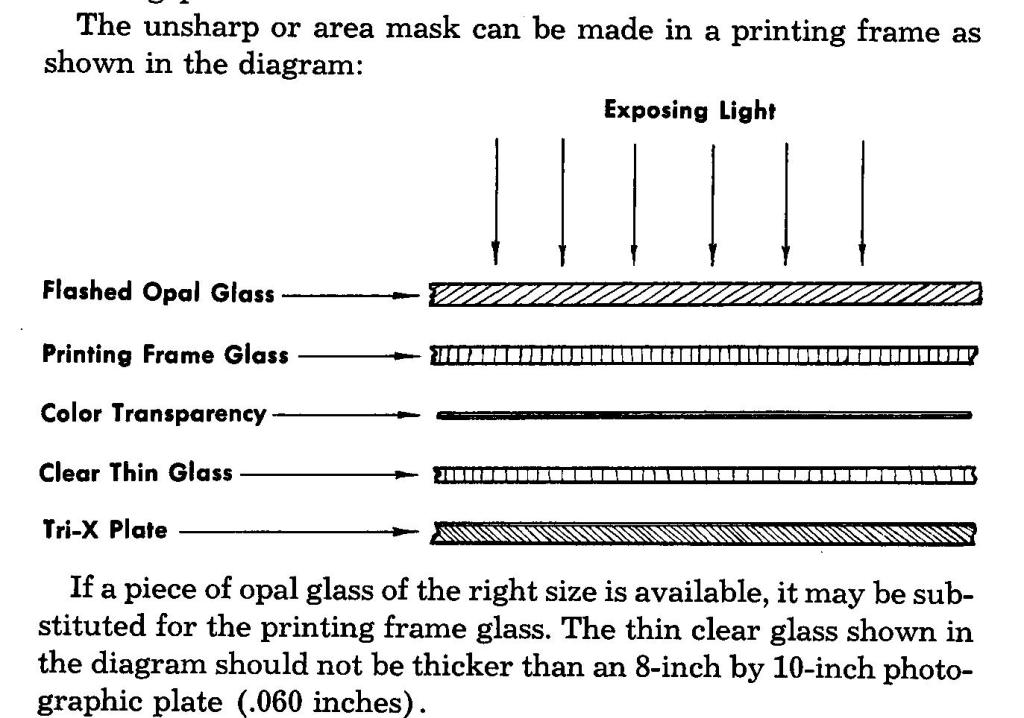
From the past, The mask film used was Tri-X Plate. Masks were made using film available. No special film.
The layout, exposure configuration was typical Kodak method used and taught for over 40 years.
Pan Masking film in Versamat — was the standard method at the end of the Kodak Dye Transfer era.

Masks should never be greater than 40%. Coated (APO) lenses require higher percent masks.
The appearance of color swatches in separation negatives is best indicator of correct mask exposure.
Most of the original guidance assumed the use of the Standard Light.
Developer for masks, like those for seps should be non-staining and not “fine-grain” solvent type. It is easy to recommend DK-50, DK-60a as best options, even this decade. For ready mix, try HC-110 one-shot. All masks and seps should be processed following a one-shot protocol. Use the mixture one time and discard. I use fresh developer for each sheet of film.
| Filter | Use |
|---|---|
| F- 29 Red | Required |
| N- 61 Green | Required |
| #96 Neutral density: 0.10 / 0.30 / 1.0 | Strongly recommended. Equalize exposures. Reduce reciprocity differences. |
| #33 Magenta | optional |
| #15 Yellow | optional |
Be assured that masking cannot make a color that the dyes, if mixed outside the system, cannot produce. This is why we always tried for better and better dyes (colorants). To correct all the cross-talk of dyes, six masks are needed. Contrast of masks is proportional to errors of colorants being modified.
| compensate blue and green in CYAN | 2 masks |
| compensate for MAGENTA | 2 masks |
| compensate for YELLOW | 2 masks |
Not a realistic effort. Particularly since most images/ viewer sets can’t discern the improvement in real world conditions.
MASKING COLOR NEGATIVES
footnote for ongoing readers: notation on confused Large format masking board:

Removing the “Orange” mask: If you want this brightest color to have a neutral hue, you need to expose, such that Dred = Dgreen = Dblue = 0.9, i.e. a uniform gray strip with D = 0.9 will be the brightest neutral color you can create. With extra exposure you can then reach all colors in the range (Dred = 0.9, Dgreen = 0.9, Dblue = 0.9) + (ΔDred, ΔDgreen, ΔDblue) with ΔDred ≥ 0, ΔDgreen ≥ 0, ΔDblue ≥ 0.
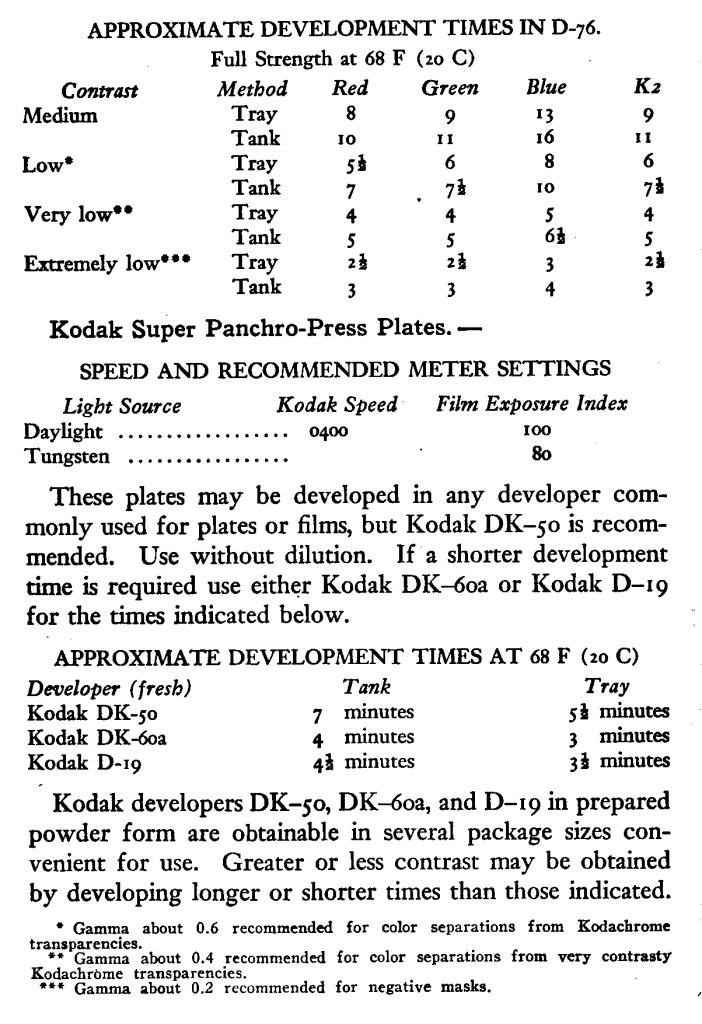
There was no magic in separation negatives. It has always been a balance between exposure types, filters, film + developer + agitation method.
I rarely used Super-XX as a sep film; only when clients required it. And on a small year, I made around 200 first prints – this, during my first 5 years working.

You must be logged in to post a comment.