
answering a question they don’t have experience in
cause they need to be heard


parked car ... don’t need more information, they need more courage-- the power to try again.

they always tell you what to wear to the dance .. they think you like the same music

always telling you what to wear, no matter how you dance

assume they know how to dance and aren’t merely jumping around showing off — remembering someone else’s memory

mark of an amateur : they cant tell good advice from bad, they are too filled with fear. biggest fear is of making a mistake. art is about moving without enough knowledge  -- that's what you are making


----
making a list
key concept(s)
-- assembly process
pigment in colloid
wash-off processing
exposure hardens colloid to retain pigment
-- more exposure = more density, depth of layer

how to make your list
work from both ends
-- have a goal
-- know where you're starting
have distinct pages for each step so drill down isn't blocking your guide list.
don't get yourself lost with stacks of pages, references.
take each into notebook. stickies help
Asking Directions in a Stalled Car
asking directions in a stalled car
stalling for time. taking 9 years to start your journey. You may not have serious intention. Certainly little motivation.
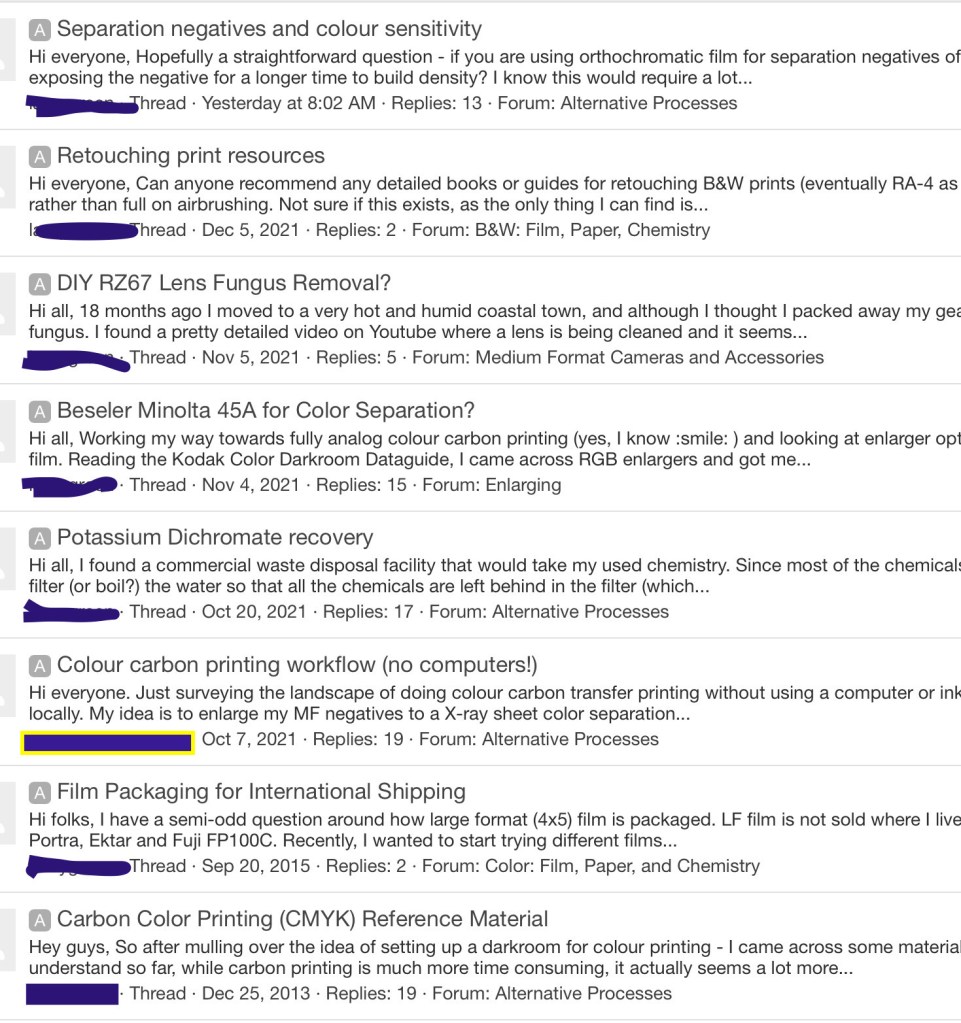
the questions asked. trying to make color prints in carbon. what was simple has become almost impossible.
why does it take someone so long to get to the first actual steps?
This person has asked similar questions in three different forums to same result.
is it just a point of conversation — like picking the best developer — always looking but not expecting a final answer —
How can someone spend years learning how to make a print? How many times, how many people do they have to ask before taking action? I don’t know. Most people rarely arrive at the peak — probably good, otherwise the path would be too worn to travel, the top too crowded to enjoy.
Asking other people questions — better if they had asked themselves more questions.
Taking themself step by step into the past.
So, how does someone get out of an endless cycle — Try something — anything. That is the natural order of studio arts. Make a mark. Examine it. Make another.
After collecting stacks of references, organize them. Make a try to build your own guidebook. That’s how I learned to print dye transfer. I read a couple of pamphlets and the inserts put into the product boxes. They were written by people making the process clear enough to be learned by an interested amateur. Professional labs learned from each other. Later, Kodak hired professional tech writers — the literature became less useful. Professionals milking the assignment a word at a time; an article extended to three months instead of one.
Make an outline. Discover the mystery with a reference about the end, the goal. Answering honestly, where are you starting. What will you need. That is the rub: how do you know if you don’t already know? Go back further in literature. Skip the boards and recent books. Write your outline based upon the past. Fill it in with material from the present.
Getting There:
- it is an assembly process
- it is assembled layer by layer — cyan, magenta, yellow
- each of these layers is made separately — made by separation
- it is a negative positive process — a negative makes a positive. (positive makes a negative)
- it is a contact speed process — means the negative will be in contact with the final emulsion — they are same size
- you may have to make an enlarged negative
- in this century you will have to make your own “tissue” — you will worry about this far too much
- in this century you can buy some large film — it is becoming more expensive and less common. Some emulsion runs are made every few years –large sheet film is a specialty item. [Ilford Orhto+ and Bergger Printfilm] 2022
- Write a rosetta
- Write a dictionary – terms with sources
- don’t buy equipment unless you have tried with what you have —
- know what you know before asking the forum
set yourself word and picture goals. refer back to them often. make measurement of your progress.. if you skip a measurement, demand more of yourself. if the process of learning takes longer than giving birth — give up, you are probably infertile.
amateurs can do early, or they will never do
the Dye Guy
If you are of the internet age, of those who know more about dye transfer as a mystic process from a distant age. As a process steeped in, and dripping with the badge of chemical craft — meticulous step by step make no error darkroom work, then you probably know few names of its thousands of practitioners.
You know those who have been proclaimed by the forums as keepers of the skill. They aren’t the folks I knew. Of course I knew of Eliot Porter, but then I also knew of his assistants as well as some of the printers who worked at the labs who printed for him.
The photographer most people know is William Eggleston. A man of many printers.
The person most of you from the pop-photo, camera store, workshop trained photographers have heard of is Ctein. He isn’t the person I think of as the main dye guy. To me, he is a tech writer who was given work by Frank McLaughlin of Kodak.
I have mixed feelings about this post. Ctein can’t do any harm — neither can he do any good — not for you, not if you are trying to learn about making prints. The information of doing that exists in better, more usable form in several books and places. The process as it is done in this century is fading again. The last orthomatrix film coating was in 2018. That was done by a coater that no longer has the equipment used for that type coating.
What bothers me is the sense of privilege along with the power given to someone who spent so much time staking claim to a skill so widely held — an ability to make prints many times more often, to even higher demands with a seemingly endless array of problems. A commercial lab doesn’t often reject possible clients. Our success was based upon solving a clients problem, not by setting out the reason we wouldn’t take their job. “we’d have to change a printer”
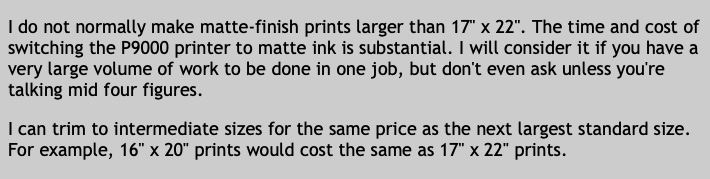
limitations … perhaps after years doing dyes didn’t provide enough profit to afford two printers in his second stage..

he doesn’t have to tell his story; others will repeat it. By association they gain favor.
“I know great people, must mean I’m a great person.”
So, what’s my problem. None. I understand all of this — I even understand that you will not change your viewpoint. You shouldn’t.
Too bad you never met the real dye guys. Too bad you never became one.

You must be logged in to post a comment.