Azo Zombie?

azo.jpg

Kodak Azo was discontinued in 2005. It was in production longer than Kodak Dye Transfer products. Monochrome outlived color. Just a tiny part of the tale.

Texture Sheen Tint Contrast

Azo came in most surfaces and weights; it was used widely because it was cheap and constant across so many types of surface. Deckle edged postcards, cheap studio proofs, or retouching prints for advertising agency work — all could be done on Azo.

Amidol was also easy to buy during that day. Drugstores sold it in glass tubes, ready for processing film or paper. Only Kodak’s Vitava Opal came in more configurations.

When a favorite paper drops dead what are members of the Silver Circle to do? Make it themself or sponsor someone else to make some.

Smith & Chamlee, of the workshop world, chose the latter. Other workers gladly coat small runs learned while workshopping their craft sense at places like George Eastman, and Photographers Formulary. Chloride papers are easy enough to coat, but clearly this is small scale demand, which isn’t a problem for people who hold to their belief that the longer something takes to do the better it is. Self coaters are the slow dry painters of photography.

Lodima Dreams

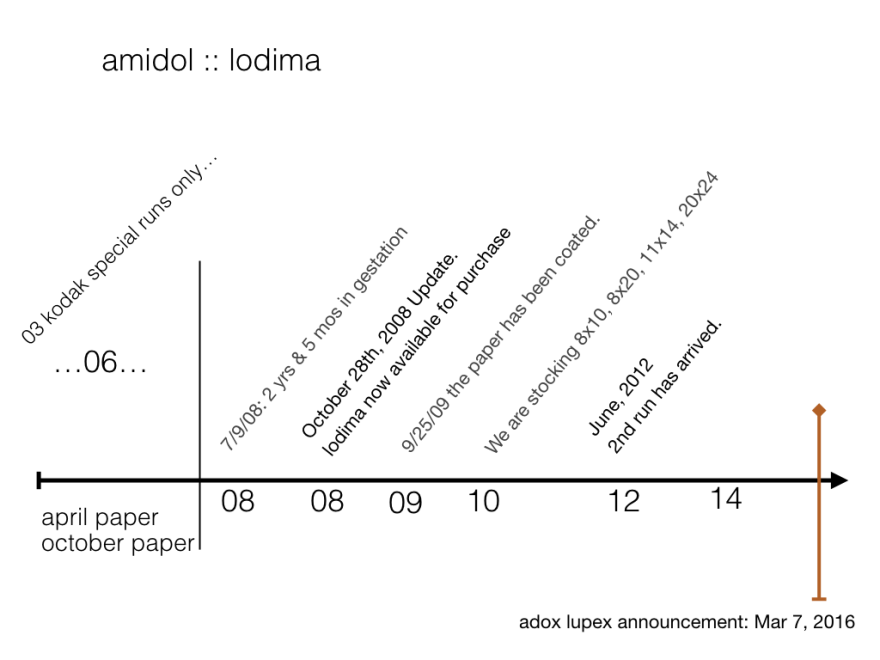
A new company and identity was introduced in response to the Kodak discontinuation of Azo. Photographers Michal Smith (MAS) and Paula Chamlee bought much of the Azo stock, going so far as being the last Kodak dealer for its sale. As demand dropped for all photo papers, Kodak, in trouble, dropped its black and white darkroom papers. Smith and Chamlee sought a producer of a replacement paper suited to contact printing – their preferred mode of print production.

Constructing the details of these progressions hasn’t been straightforward. I’ve collected posts from multiple web sources – some of which had to be retrieved from archived crawls. The posts on Photrio (nee Apug) and Large Format (LFPF) remain available (10/17).
elementsOfPrintingLodima.002
lodima timeline


Azo paper goes well in amidol developer; so much so that several onliners preach that you can only achieve nirvana when both are present. I’m a heathen. Amidol is nice, but not exclusively so, but then, azo (chloride) paper isn’t perfection in silver. They are just what they are: one way across the field.

Kodak, in their azo publication, indicated developing in Dektol 1:2 for 1 minute; that would have been the conventional processing for azo the last 20 years of its production and use. Graded paper can be “contrast” adjusted using divided, 2 tray, developing. Amidol is so active that a water bath suffices as the ‘other’ developer. I prefer using dektol 1:1 and an accelerator as the second tray.

current chloride papersI use amidol and have used lodima paper although my current contact paper is Adox Lupex – has been since April, 2016. Lodima, the paper and the company, don’t provide me any advantage over Lupex. In my procedures Lupex even liths. It also handles wet life better than lodima. Lodima comes in more grades, but Smith Chamlee cannot keep it stocked in grade and size offered on their price list which seems to be updated irregularly. In short, as business, Lodima paper is the sideline of Smith Chamlee workshopping business.

Michael Smith draws much fire from online fora – LFPF as example. That would usually earn him points on my card, however, what I see his success, his contribution to my community of photographers to be is: publishing. I’ve met him twice in 30 years, and only corresponded with him twice – once when I ordered paper he didn’t have; the other time was a request for confirmation about work he may have made. The business conversation went better.

Smith Chamlee have survived the years since Asilomar ’75 by selling simple solutions to the easily influenced junior photographers. He is a businessman who has succeeded by turning his life into a tax deduction. His contribution to artists is as a book publisher, and paper vendor to a few of the lesser imagists of the past 20 years.


webionaire links AMIDOL CHLORIDE PAPER

[2 of 3: Nov 7, 17]

Amidol Tales

The elixir, or the light… or just a developer that stains everything; these days it makes a great hair dye.

A REASON: amidol developer permits ‘water bath’ development better than any other common developer. A water bath is a second tray with only water; this is used during development as a control and evaluation step. Develop in amidol, then put print into the water tray. Examine the print [under safelight] for density & contrast. Return the print to the amidol tray is more density is needed.

Amidol was a developer used by the Cahoona Weston – that alone makes the tripod carrying acolytes tremble. If you don’t have his life, his world, his meaning, at least you can have his method. Big Bad Amidol and Big Bad Camera. I consider this chicken bones; there is no magic in the ash.

The workshop world is filled by takers being taken.

amidolstory.001.png
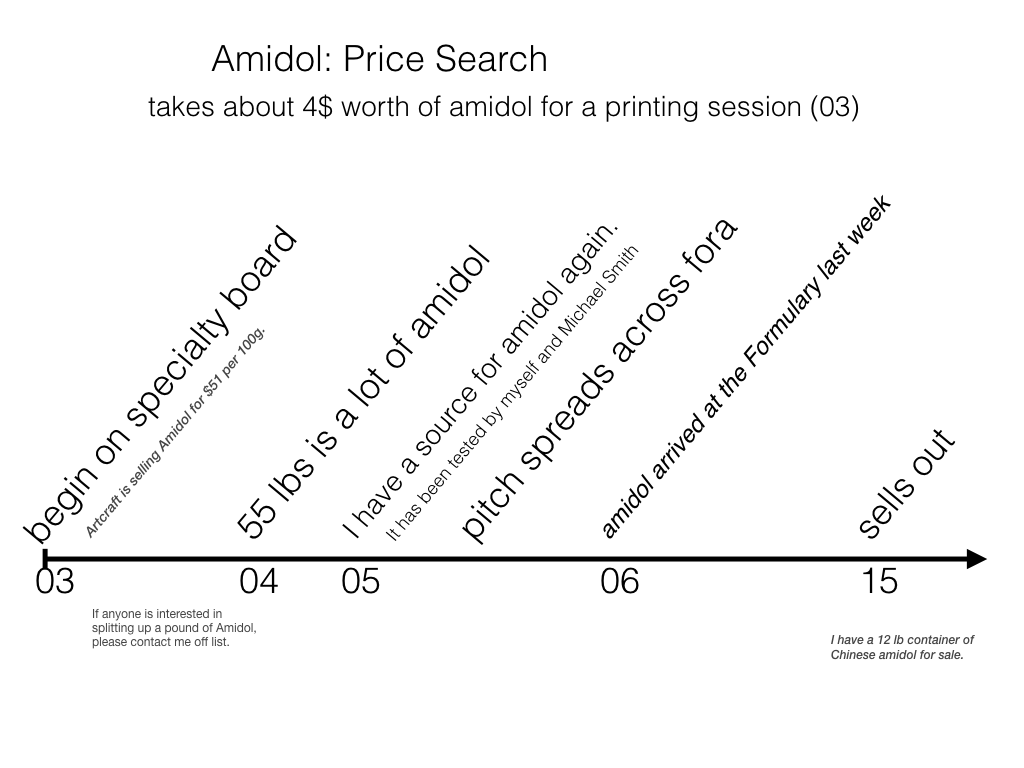
chinese amidol

It took 3 years to get the amidol. A lot of hours, effort away from that drive toward meaningful art. It was 9 years later that G. Davis sold off the big barrel. Hope it was worth it. Was he just converting excess to cash, or taking a wiser cash position of a failed dream. Why couldn’t Bud at formulary take it? Probably because they couldn’t sell it either. There is no magic in leftover history, not even the remains of chemical induced zealotry .

Why Oh Why

their motivation wasn’t to save money. that may have been a rational catalyst, but the effort was maintained by some other commitment. Even the commitment to save money was prompted by their need to use the product. What was that need+drive is a much more interesting topic to me

The time and social energy expended had to have some reward, otherwise they are just drained, wasted flow away from an esthetic drive. The simple fact is that the work of Smith and Chamlee is easy bake – the questions they are solving are elementary. Davis has provided a small set of results that edge into beginning terrain, but they quit, having no updates or expansion in years. Perhaps his energy failed him – his techno quest faltered, faith failing him. His sig lines call us toward biblical lands of Matthew and salvation – hard to hold onto a barrel of hair dye if Jesus is calling the faithful and you’re left behind.

take aways:

  • No silver bullet. No magic christian.
  • In search of price. Searching for the silver bullet.
  • Silver users in search of the perfected cheap bullet.
  • After the magic bullet instead of the magic.
  • buying their magic instead of making it.

References & Notes:

amidol supply:

people:

webionaire links AMIDOL CHLORIDE PAPER

[1 of 3: Nov 6, 17]

Pipeline to Prints: Darkroom

Don’t Let the Camera Block You

Photographic process pipeline – the way you get from camera to complete, can be simple or complex, of course, one persons complex can be another’s simple. I prefer to use the simplest approach to get somewhere. Sometimes that means letting the physical process of making a picture take me where it will. In such cases, I trust emulsions: film and paper.

labNotesFlow.001.png
making a photograph

Simple Approach

Reduce the number of technical choices by using one camera, one film, one developer. This is always a wise way of working. Most early practitioners don’t take this path, instead they believe that the picture they are after but aren’t getting is because they don’t have the right camera, or chemistry. They give up by adding things rather than ideas or pictures to their studio.

The simple approach means the direct approach – getting to a picture with the fewest side matters. Don’t let the Tech Blindfold you.

My approach is given in the above schematic. It depicts the camera steps – getting the negative; and the printing steps.

By way of specifying what I use for emulsion photography:

labNotesFil.001
my film + developer choices [2012]

Choices in film have dwindled over my time. So has developer ranges. This doesn’t mean that we have less quality available now than when I began. In fact two of my current developers, D-76 & Rodinal were in my cupboards decades ago. When young, I stumbled about trying to achieve unknown what by switching film + chemical combinations. That was time wasted, unless learning that it was a waste of time searching for pictures in the darkroom.

The new developer, DDX, is from Ilford/Harman, and it isn’t really new. I use it with Ilford films, SFX and Delta 3200 because it provides clean grain and short developing time with very good shadow detail. (makes it seem full ‘box speed’) In the chart I have listed the films in ascending EI, as I use them – acros (100)  > SFX (200) > Tri-X (400), Delta 3200 (800).

None of these films are color, although I use acros and tri-x as 2 color separation negative films.

These combinations give me a full choice of grain: grain as transformer or as transferer. Is it there, or isn’t it. Acros in D-76 at 1+1 provides me a negative with grain so fine it is difficult to see using a Peak magnifier (Koana system.)

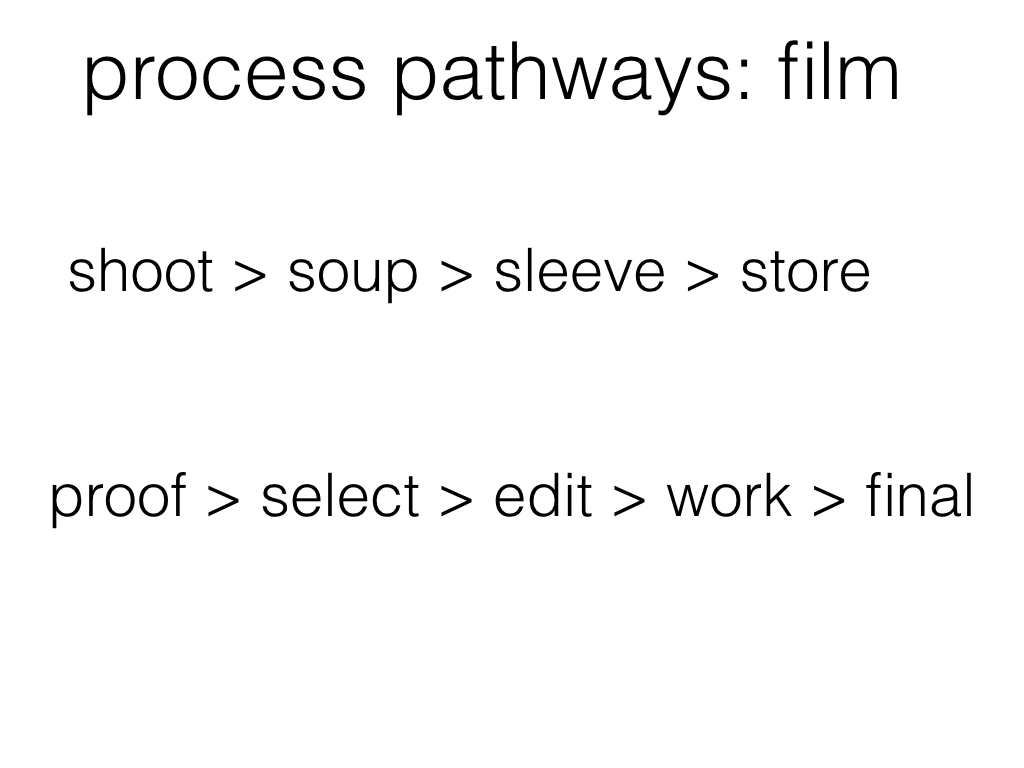
I shoot, soup, sleeve, then store the negatives. My negatives are stored in clear sleeves and put into binders or boxes depending upon size of film. I make contact prints of all negatives. These contact prints (index) are what I use for first pass selection of what pictures I will use.

next: prints
continued…