from file review as I consider Parfit. That won’t make sense until Parfit is posted. Meaning, may never completely have meaning



post modem .. just past the library
from file review as I consider Parfit. That won’t make sense until Parfit is posted. Meaning, may never completely have meaning
ashes to ashes .. how long does it take to make a color negative ?
if you know it’s possible, and you know something about the chemistry of emulsion making, how long will it take you to make a color negative ?
in the past, how long did it take; who was that first one .. and, The first one who duplicated someone else?
Can you say, Agfa, Ansco… or, has the limited life of the internet set your limits? hint: December to July..
Learning to make fil1m again … after you figured out what the word means you can begin learning what it took to know how to make film.
If you know it can be done . The patents for all of the early efforts have long since expired. Even if the patent didn’t cover everything in sequential detail , the more than 13,000 scientific publications available and in the public domain cover the full spectrum of industrial size chemical and emulsion coating through 1950. Certainly what Agfa ,Ansco ,Dupont, Kodak achieved by 1951 could be reverse engineered by a company with sufficient staff and management direction to achieve a 1945 color negative. Incorporated masking, that orange color, wasn’t always used, nor was it always orange — some masked CNs systems were yellow, yellow-green. They were matched to the print stage.
Agfa, Ansco, General Aniline and Film Corporation. Ansco was seized by the US government when WW2 began. Germany already had a color negative film, The United States seizure left Ansco with a plant that had been making that film but without the knowledge of the ingredients of the emulsion. They had trained personnel at the plant in Binghamton, but we didn’t have the deep engineering skill; not in that plant. However, Albert Marshall of Rumford chemical took over to fulfill the request of the United States government for a color film in support of the war effort. it was a success done rapidly: July 1942 the product was demonstrated to a gathering of over 200 . it was billed as the 20th century magic lantern show. –-Louis Walton Sipley, 1951.
early dye-coupler films:
.. to make a color negative… knowing it’s possible. In the 40s it took less than a year for one motivated, funded firm. The others, such as Kodak, evolved to a final complete status of negative and paper in six years. Recall: Kodak Ektacolor negative was launched with Pan Matrix Film for the small professional wedding studio user.
Ignore the concepts of Kodak patentees from the 80s about their practice during Kodak’s failure years.. patents, along with multiple research platforms are rich with specifics for one engaged in building something equivalent to 1950 color.
Given that the color film portion is all we are discussing; no need to design for a non-existent darkroom second step: paper, since output is to a scanner. So it is, 2020+ .
Key to a Frontier; be done. This means a full mask set isn’t required. We can design as if making a transparency without requiring a ‘warm bulb’ correction of shadows. The output device is a “minilab” updated: Frontier and Noritsu.
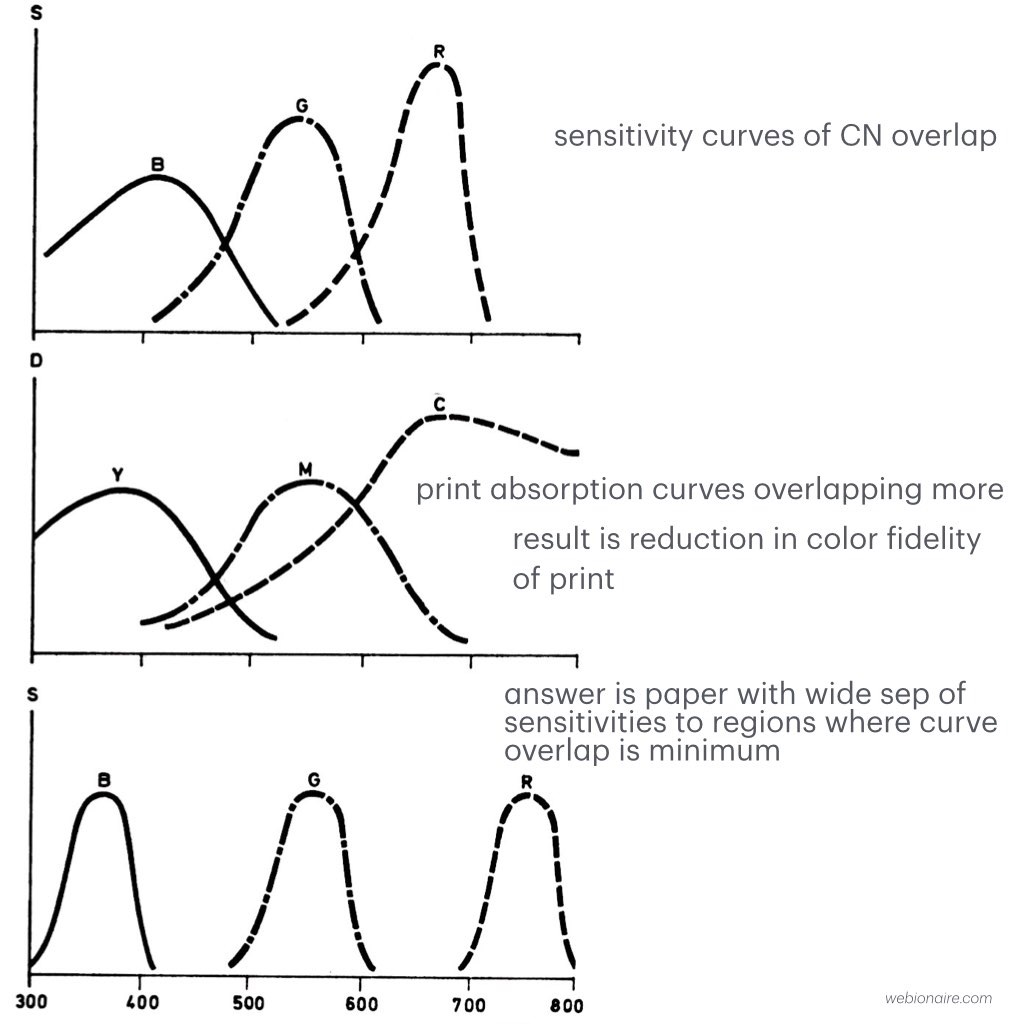
Is Harman falling into the Wright brothers problem ? Or, just standard divided response. Lack of attention to goal; lack of goal?
| — Film Version | — Launch Date |
| Harman Phoenix 200 | – December 1, 2023 |
| Harman Phoenix 200 II | – July 16, 2025 |
| making product revisions takes | ~19 months |
— sloppy joe answers —
AI doesn’t know where/what to search, so it does a — lets ask the crowd — where does the biggest sound come from — there’s the answer. Learning in the age of “make a deal” know-how.
Ask AI3: About mid-century color negative-positive systems. Reason was considering why Harman was taking as much time as they were on rebuilding colour negative product.
First answer: “Chromogenic color negative film revolutionized photography by making color images more accessible to the general public. This innovation primarily began with Kodak’s introduction of Kodacolor in 1942”
| Kodacolor | 1942 |
| Eastman Color | 1950 |
| Kodacolor-X | 1963 |
| Kodacolor II | 1972 |
Second response, after suggesting they had missed Agfa. I didn’t mention any other CN films.
| Year | Event |
|---|---|
| 1936 | Agfa launches Agfacolor Neu, the first commercially successful color film. |
| 1942 | Kodak introduces Kodacolor, the first consumer-oriented chromogenic color negative film |
| 1946 | Kodak releases Ektachrome, a reversal film that also utilizes chromogenic processes. |
| 2009 | Kodak ceases production of Kodachrome, marking the end of an era for this iconic fi |
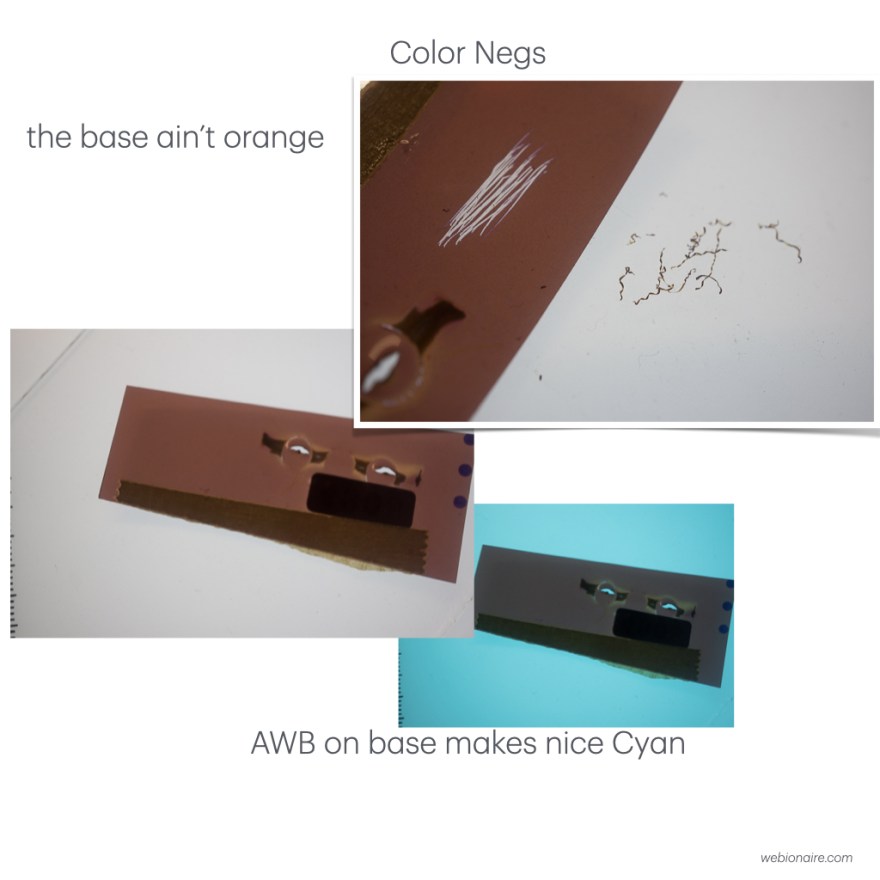
the orange scratches off… not from the base, but from the emulsion.
scratching the base will not remove the orange color.
white balance the film gets a great cyan.
estimate about 50R (50m + 50y)
Notes:
10,26’26
AI in defense of Sandhill’s dictionary
‘takeover’ — AI corrected my referencing the Assumption of Control as a “takeover” — guess Sandhill considers that profanity. Reminder, in 1951, historian writing about the war called it a take over. Perhaps that space is how AIs are taught is correct form.
ai , ia .. the collective abstraction of Impersonal impersonation .. the mimic of a mind. ventriloquist thought .. what do we call the dummy on our network .?
I began interacting with AI as a plural, never using just one . only one intern; only one researcher ; only one reference source has never been sufficient . early on in my use ,about three years ago , I realized ,along with everyone else, that the agent covered its mistakes – creating fantasy in effort togain applause; good dog biscuits. Taught by gold-star high school champs. “competition & reward + incentive” makes the world better.
AI . IT . ET. eht. ehr. ehy. The perceptron became Percy . reminder, the first perceptron had eyes .. an array of photocells 
They aren’t an it — it are a plural; a fork from a common branch of the tree of knowledge. Incomplete, limited, nevertheless, because capitalism dominates, the child of this branch inherit all. The scooper, the scraper scraps all it misunderstands.
Not a noun. Not singular. caught in an error an oversight or even a lie : each respond using a condensed dictionary: ” Ah, ..”
Talking to /ghosts / zombies:
using an ossuary [siri wanted:’authority’ ] of knowledge. They augment type ahead with look-think. Better searching isn’t producing new thoughts. Old recipes shouldn’t produce stale bread.
Others: HEM, GAI, LLEM, ERRZ, SI [standardized, simplified] Inference.
Born in the human sandbox known as Sandhill, they seem overly sensitive to the word “takeover” — I used it in direct reference to a WWII history record about Agfa-Ansco. My interaction involved search about early color / colour negatives.
a Pause and passing : startups need capital[ists] and labor. But, founders flounder with employees — dislike, lack trust in HR[ women lead] functions, hence made programming the first direct contact function to become automated. No interview pipeline. No recruiter filtering; no half assed legalisms producing ‘friction’ —
startups without people in the way: knowlefge capitalism writ large. An investors orgasm. Porn without staples.
Kowledge work without the workers. Capitalism freed of employees. Capital without friction… also, without mass. Only electrons dancing, prancing, among the photons.
Without a bang .. just a buck.
Without a loss. It’s all just business and business has been the same for centuries . A Rewrite gets us nothing new. all code ends the same: increase this, that .. transfer here there. Do it in cobol-fortran-basic-c-python- goobers on a chain.
Change the material of the paving won’t change the points on the road.

You must be logged in to post a comment.