If You Knew Dye Transfer

How many times must a process die before you learn why? The insistence is common, consistent, durable — it lasts longer than the process itself. People of the Net hold the belief that dye transfer would be resurected, successfully, if peopls could see how fantastic it was, particularly in this age of terrible stuff.

You have to see it to believe it… You have to believe it to see it. Is that true in the case of dye transfers?

The role played by product names in art appreciation is high at the sales table, and among the foremost forums.

“Not to find one's way around a city does not mean much. But to lose one's way in a city, as one loses one's way in a forest, requires some schooling. Street names must speak to the urban wanderer like the snapping of dry twigs, and little streets in the heart of the city must reflect the times of day, for him, as clearly as a mountain valley. This art I acquired rather late in life; it fulfilled a dream, of which the first traces were labyrinths on the blotting papers in my school notebooks.”
— Walter Benjamin

understand the magic

Dyes were seen and made by hundreds in the era of Photograph as Object suited to gallery and museum. The growth years of photography in art schools — 1975 – 1995.

Even still, it failed, being superseded by other processes. Direct to print processes such as Type Rs (Cibas, too) for Slide to print. And, Type Cs (chromogenics, RA-4s)for Negative to print. This later printing mode strikes hardest, since Kodak Pan Matrix film was introduced with Kodak masked color negative film

the advantage of real world experience is that is is real.
i read history in the bathroom; philosophy in the bedroom; poetry in the kitchen

If you knew it was a dye transfer would it interest you more? One group of people have made dye imbibition prints over the past decade. Have shown them in Los Angeles, San Francisco, Houston, Brooklyn, London … never calling them Dye Transfers, instead, they were dye prints, or ink transfers, and similar names. Some prints were sold, but so too were Epson Inkjets, Fujifilm RA-4s. Without making these as dyes, they sold as images. This was the basic interest of the collective group that had gone to the trouble of learning to make dyes. By make, understand that this meant having matrix film produced again.

Why did they keep this a secret private among themselves?

what would you rather talk about: process or *c, where *c is being defined, refined. Who asks, who would you be limited to talking too, with, if the topic were “process”.

Most people diffuse their interest by a bit of gossip. That mannerism is what diminishes a process to the point of pointless conversation.

Would people dive into dye transfer if given the chance? Nope, one [J* 826 ] of the Neu Ds posted on LFPF, offering a complete working dye transfer lab, including supplies… even going so far as saying she would meet them at an upcoming conference. No one, not even the loudest of counter pounder experts on dye transfer, and all topics color.


2011: 3 students
‘12 : +3
‘15 : +8

nutshell: Color Separations

a reminder of color separations: what they are; what they do.

A separation is a pulling apart — taking either the scene, or its first duplicate into distinct parts. The separation is based upon the color. These being the primary colors of tri-color theory.

Film wasn’t always on ESTAR, so small holes would fail; they weren’t done. The stable base was glass — not punchable. We had methods, just not punch-pin positioning systems.

Masking can be done pre or post separation. // more to come//

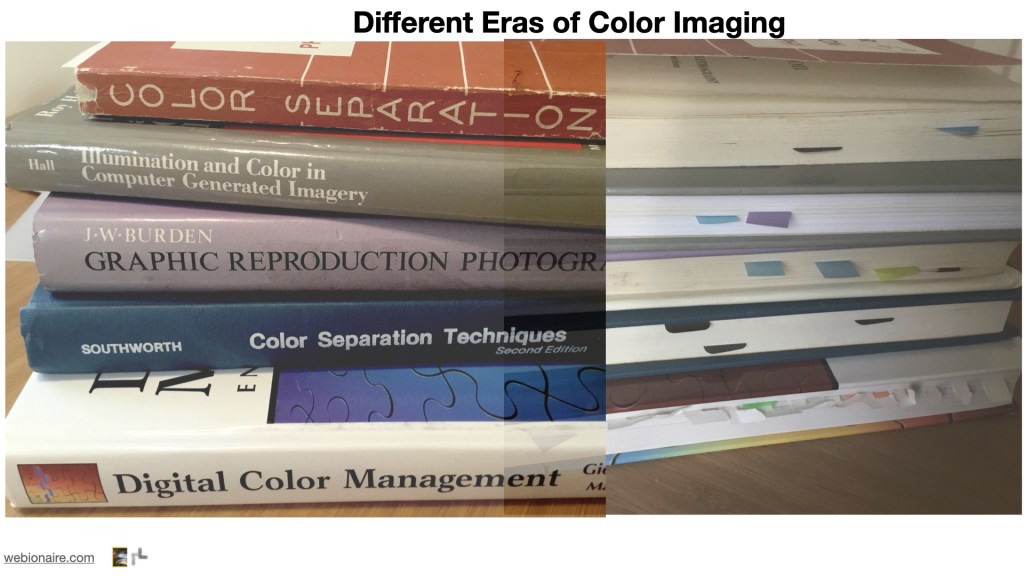
craft skill from the book of Reproductions. These were from ‘inkside’ of the past, along with the current vantagepoint. The titles and the dog-tags for return reading.

Choosing film is premised upon several factors, notably, color response and curve dynamics. Can the separation match the transparency? Can the film render the colors in the transparency as monochromatic approximates. Much, too much, is said about “long straight line” needs of separation and mask films. What you are separating from rarely has as long a linear portion as most BW films; not now, and certainly not in the past when seps were the king of the darkroom.

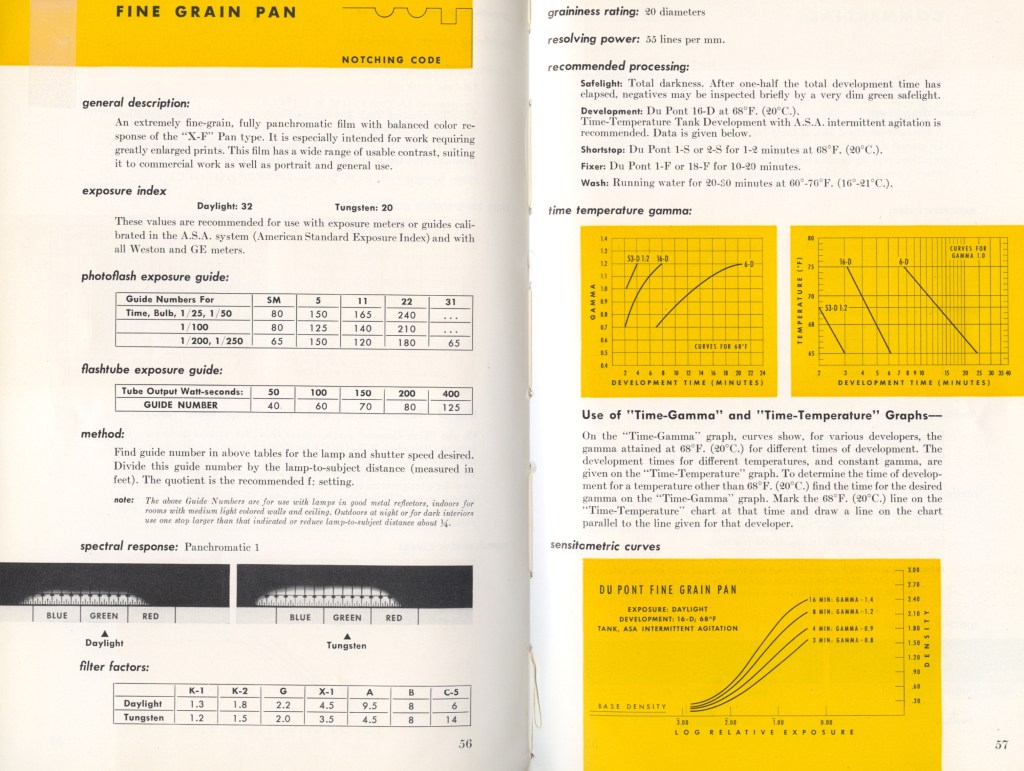
From the past; more for the Rosetta stone. Translating data sheets. Why that film/developer was made.

Dupont Fine Grain Pan: an easy 20x intermediate film. Soup in 6-D or 53-D.

Why Dupont 16D developer: times of 6,7,8,9 minutes gave those gammas (close enough to get you started on separations using Dupont films.

from 2005: Modern vs. Classic. Thin vs. Thick Emulsions’

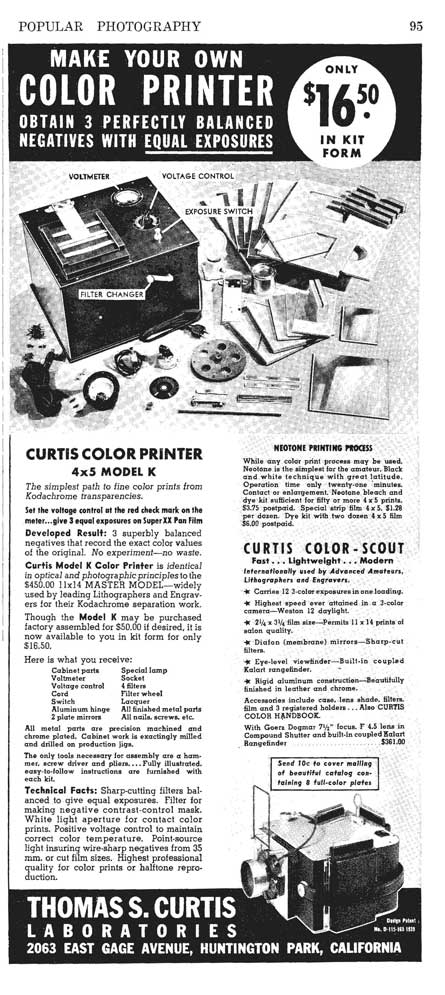
Early form of specialized equipment designed to make separation negatives.

It looks quite “steam punk” in this light. Hardly the item of extreme, near sacred skill-tool of conversation on today’s net world. The virtual barstool has a way of inflating all needs beyond the original.

Making the process sound complex has a purpose: make the teller important.

Balanced pan-chromatism — the secret word on separation negative film.

not Filter Factor, rather Exposure Ratio. Notice the difference in using Heat Absorbing Glass — IR glass was as important as voltage stabilization in the best custom labs. The “4 shift” places all knew this. Not now. The forums think the glass is so negatives don’t pop — change during exposure.

IR and UV affect emulsions… even just a bit. The amount makes significant difference when making seps with a responsive emulsion.

Emulsion TypeRed NegativeGreen NegativeBlue Negative
PanchromaticUse Red filterUse Green filterUse Blue filter
Ortho-chromaticUnsuitable. insensitive to redUse minus-blue or green filteruse minus-green or blue filter
Ordinary (non-colorUnsuitable. insensitive to redUnsuitable. insensitive to greenNo filter needed. UV or minus-green or blue filter.
some types of emulsions will not reach the required gamma on the blue record, even with long development. An inherently higher contrast material can be under-developed to provide a lower gamma negative.

The above table was often used as a test of new employees … did they understand the theory enough to make separations using the “wrong” film or developer. Failure meant not trying. Understanding development scheme on curve shape was a key skill among the proficient lab tech. Use fresh developer. Use consistent agitation, including the rhythm. Blue sep toe usually reaches higher density than the red and green seps. Use this during your density limits, your aims, for the linear portion of your characteristic. In practice, that is part of why we set low limit above 0.40, with 0.30 being the lowest safe value for a separation set.

Adage: Mix for Four. Use Three. — meaning: put only 3 sheets through chemistry that should work for 4 sheets of film.