drilling for silver

bits of things. if you have to moderate the topic, you have the wrong gathering — 

VCP, bring out the prints. generous support of Mark Tarmy. Joshua Farr and Mitch Weiss  curators

What they announce:

Drawn from a remarkable local collection, these prints invite you to get close—see the paper, the grain, the edge of the negative—and slow down with images that carry time and story across generations. It’s a chance to experience iconic photographs as objects, not just pictures on a screen: how they’re printed, toned, and cared for, and why those choices matter to what we see and feel.

The exhibition brings together 36 works by 31 artists, spanning nearly a century of photographic history, with dates ranging from 1916 to 2004. The selection highlights both silver gelatin and platinum prints, offering a rich material and historical range that underscores the enduring power and evolution of the photographic print

UP TO DATE:

They will discuss specific images in the show and their significance from the perspectives of technique, meaning, and place in history. This conversation opens a window into the relationships between artists and collectors, and why photographic prints continue to matter in a screen-saturated world.

IN CONVERSATION: Mark Tarmy & Lynne Weinstein | VCP

the collector’s start:

Like most American business stories, Vermont Plank Flooring was born of a degree of foresight, a little bit of luck, and a lot of hard work.]

Our Story – The History of Vermont Wide Plank Flooring

Instead of collecting stories of drillbits , rather than collecting boxes of future used\ items, he collected photographs .

the why of this aside: Drillbits from one Plant in China are produced at 20 Tons a day.. packaged and over 100 brand going to the United States Germany even Austria… with Austria importing specialists steal from China for their use in machine tool making..

caution of the long tail: people thinking their experience is more useful than it is; that they bring more knowledge than they do . they have a view of a business — they think that that view, and experience applies across all business… ADDITIONAL. the china syndrome:

the problem is some forums are populated by a very few highly skilled honest members … how can you tell; they give references. they show their work. you are welcome to the table ;their ideas grow. they have new stories…

prejudice is often a mask itself.. revealing itself. prejudice is a mask that sometimes shows;it has dominance…you married an asian to dominate one. prejudice is often inscrutable… I can’t be prejudiced I married one; yet you’re married to dominate; reminder, prejudice is about domination…

see YouTube bit test … left as an exercise.


drill bits.. footnote. https://www.ncl.ac.uk/press/articles/latest/2026/02/ancientegyptiandrillbit/ This re-analysis suggests that Egyptian craftspeople mastered reliable rotary drilling more than two millennia before some of the best-preserved drill sets.

imagine having a collection of prints instead of bits n bobs

Continue reading “drilling for silver” →
seeing magenta

ask around the net for dye-transfer information. seek insights, perhaps advice, what you are provided by 2025 search-AI models is counter to insight — confusion is increasing. Dilution over diffusion flourishes. Clicks are the clique formers.

One simple example. Seeking specifics about Kodak’s magenta dye used in Dye Transfer printing.

NB: search used this tree [:: Photrio -> koraks ] getting to an answer about magenta dyes used in Kodak dye-transfer, imbibition printing. Photrio is large site with over a thousand posts related to dye transfer; koraks site is listed as sigline in posts by a moderator taking part in dye-transfer related threads over the past several years. I doubt that K~ has ever made a dye transfer, certainly hasn’t synthesized the dyes. Another example of dilution of knowledge.

The inference engine of AI cannot distinguish quality, meaning accuracy, applicability, from quantity, meaning the number of referral links made over time. [the specific information provided in this conversation is based on general knowledge and does not directly cite specific pages or sections from these references.] Different models often respond that the information on [dye-transfer] is collected from practitioners internet archives.

Kodak CIS-154 Magenta Dye in Imbibition Printing
example response: I want to be transparent that my previous responses were speculative and not directly based on the Kodak publication you mentioned. Providing more details will help me offer a precise and accurate interpretation of the source material.
[I used 5 different engines... none could provide useable, correct answers.. each required, in essence, that I give them direct references, which they then could summarize. ]

Provided that I correct enough, staying with the multiple AI engines, we get somewhere. However, I had to provide a page, a CAS number, then prompt the answer machine with guidance on selection criteria for synthesis. In other words, I had to know much more than any of the AI engines were able to source. I was provided patent references, incorrect, so taking additional time for me to read, and return to prompt for correction. The initial failure though, the one leading through the darkroom help forums sounded, to the untrained, inexperienced, like a correct answer. An answer which would be repeated by the novice.

Since the process is being used by mere handfuls who do gather and exchange information and support these aren’t significant practical matters. The failures keep the stalled busy, out of the way. The lesson is that small errors can be amplified sufficiently to distort information into a contorted arcade reflection of what was.

Dye Transfer Fantasy

Products fail by being used as merit badges, marks of distinction, instead of making art. With the online photoworld, it is enough to say you do, then hide behind a ready alibi. “You can’t see it on the web, it is too analog perfect to be digitized.” They abhor “art-speak” as they engage, mostly in “craft-speak.”

Parrots don’t print. They hate artspeak. They love craftspeak

The market for dye transfer Materials is nonexistent . it is a fantasy . they transfer materials must be made for someone who is using them intently consistently . The firms which can coat Silver sensitive Materials are reducing their small capacity or closing it completely . In 2010 there were several times more coaters than are available now . In the US, of the three firms that could’ve coded Silver sensitive emulsion, two have left that market . Both of those locations coat emulsions for dry lab photography .

For most of the 21st century dye transfer has existed as a small scale competitive conversation transacted online . very little of the discussion has involved experience based opinion .

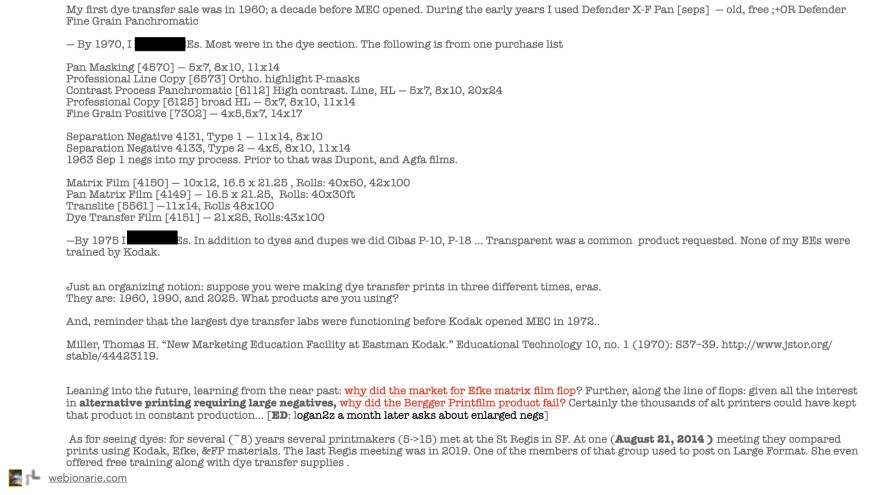
— example order from Pickle Alley days.

 Why didn’t another able coater supply a version of matrix film to the still hungry marketplace after FK’s collapse? Certainly there were coaters with excess capacity along with the ability to formulate their version of the open source Browning/formulation. Even the clamor among the alt-print world for silver solutions to the “make it bigger” topic will not support a lab film. Digital negs rule, even among the darkroom adherents. Oddly, even after many complain about the inferior negatives produced using inkjet / overhead film workflow.

The question ONEIDA posed was about markets for a product once made. If a film sells, others will fill the orders.

EFKE (FK) wasn’t profitable. They couldn’t sell enough film. Matrix film was a risk that failed as revenue.

Bergger Printfilm was a toll coating based upon Efke Printfilm. It was designed, and released to satisfy the ALT photography printmakers searching for solutions to making enlarged negatives for UV sensitive contact processes.

Like AI’s arrogant children, they ignore the question in order to make a point: they know better, not just more, but more as well as better. They don’t need to read the question. Easy as Pie.

Time spent to learn:

Mr. Answerman has accumulated over two years talking about color photography, using as his merit badge knowledge of dye-transfer. This time is if he spends only 5 minutes reading and posting on each of his posts across three frequented forums. Two years is more than enough to master the process. More time than even the name-dropped heros spent.

NB: the durable dye-transfer groups — nope!


  • key patent by Wey and Whiteley.
  • https://en.wikipedia.org/wiki/Debye–Hückel_theory
  • Russell, Chemical Analysis in Photography
  • Croome, Photographic Gelatin
  • Deryagin, Film Coating Theory
  • Zelikman, Making & Coating Photographic Emulsion
  • Gorokhseskii, Spectral Studies of the Photographic Process
  • Duffin, Photographic Emulsion Cheistry

This isn’t tuesday– suppose you were learning a subject that had deep, long-time history, would you start at the end? Which end? This from the early part, that which made the thing possible was a set of references, most of which are lost on the shelves of unvisited libraries. Nonetheless, here, 1945, photochemistry sources used by the original makers of color systems: