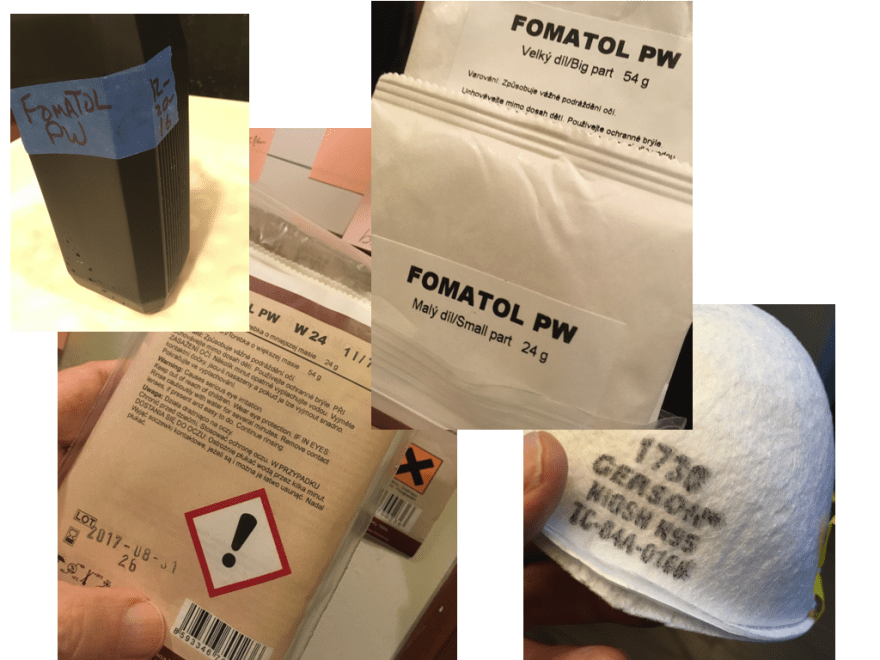
FOMATOL PW: warmtone developer

FOMATOL PW .. MIXING (2017 directions)

Fomatol PW is my standard warmtone developer. I’ve mixed from scratch, bought magic potions, changed proportions many times of the 50 years in the darkroom. This is the developer that satisfies my need. The disadvantages are availability and storage life; it does not have a long shelf life, even unmixed. As a working developer it is slow acting and exhausts quickly. The tray life is just hours. It outlasts an amidol developer, but it is not Dektol (D-72) my other common black-and-white print developer.

My typical developer is Dektol for proofs and edit prints. After selecting work for finals, I use a two tray method of image tuning. Fomatol PW and Moersch SE20C CATECHOL .

The english instruction sheets seem to be a source of wide ranging opinion about the developer agents, as well as the use of this developer. In going thru past notes, downloaded pdfs and, a few online posts of others, I think the product has changed. This change may be because of environmental regulations throughout the world.

At first, it was: “Specially formulated, glycine-hydroquinone” developer.” More recently, it is: “Specially formulated positive developer.” According to the US retailer Freestyle, it does not contain hydroquinone: no need for special shipping tags.

Mixing Fomatol PW

The only odd part of mixing is in understanding that “Big part” means the heavier bag. Both bags are the same size, but are different weights. Mixing directions are otherwise vary clear and simple to follow.

Using Formatol PW

Early directions gave development times based upon dilutions of 1+1, or 1+3; currently, directions are for undiluted stock. Sometimes I use it at 1+1, and have tested it at 1+3. Diluting this developer increases the times into the ‘lith’ timesphere (7 to 17 minutes) without ever getting a strong black. Using this as a stock developer is expensive, but it is worthwhile for my work.

Stock for 4 to 7 minutes using Fomatone, or Retrobrom Sp papers.

Links:

Foma

Freestyle

if it is glycin based? I don’t think it is anymore (since 2016).

see my post on glycin

//TBD. ansco 130 notes : see this

Labnotes: shaping negatives

If changes to development time (rates) controls density peak and range, then highlight density control is achieved readily; a direct relationship exists between development and highlight densities. While controlling shadow separations is not as simple. Shadows are dependent upon the characteristic of Film-Developer mating. Working the exercise of making parametric curves illustrate these points.

The general formulation of developer: Reducing agent, preservative, accelerator, restrainer, solvent.

Restrainers make controlled development (reduction) possible. They can also alter the (size) color of silver in the print. Potassium Bromide making that “Dektol Green” tint. DuPont BB was often used to produce Blue Black (cold tone) of Brovira, Kodabromide papers. Kodak Anti-Fog No. 1 can be used as replacement, or as addition to potassium bromide. Restrainers (aka, anti-foggants) alter contrast of the image. More AF increases contrast of the print.

Characterizing Paper: Labnotes

Packaged developers can be modified. In the 1970s the following chems were used as addenda to Kodak, Ansco, Ilford print developers:

  • Hydroquinone, 4oz
  • Potassium bromide, 1-4 ounces
  • DuPont BB solution, or Kodak Anti-Fog No.1, also AF No.2
  • Elon (Metol), 1 pound
  • Sodium Sulfite, 5 pounds
  • Sodium Carbonate, 1 pound
  • Borax, 1 pound

1970s papers:

CONTRASTKODAK & GAFAGFA
very low contrast11
2
NORMAL grade23
34
high contrast45
5
very high contrast (bang)6
paper grade Rosetta.. convert to LER, ISO(R)

Paper brands:

  • Kodak Medalist (F1 -4), Kodabromide (F-1-4)
  • Agfa Brovira (111 -1-6)
  • GAF Jet (GL 1-4)
  • Ilford Ilfobrome (IB 0-5)
  • GAF Cykora (GL 1-4 ). an old warmtone friend
  • Agfa Portriga Rapid (111 1-4) the most used warmtone paper during Peak Silver printing age.

Contrast Control by Developer Dilution:

Brovira was processed in Dektol 1:3, this produced softer acting developer as adjustment to the higher contrast of Agfa Normal. Dektol (most paper devs) can be used at range of dilutions, that is, straight (stock) up to 1:4. Paper/developers of the silver age changed print tone, going browner (warmer) with increasing dilution. This was due to change in concentration of Hydroquinone/ Elon (metol) ratio. Ilford papers (2024) are built to resist such alterations. These changes make the paper less affected by developer exhaustion or mishandling in the small volume darkroom..

Durst – asking for instructions

Searching the web is easy; too easy. Getting answers is easy, also, too easy. The correct answer is rarely as easy as the online experts make it seem. Google catalogs the words, it doesn’t have a knowledge engine, so can’t access how valid the website is. The assumption of links, references is that more links, more use, means that it is correct. Actually, it means there is a popularity rank to that site. There is a path, a cliche of words. The error of this is circular. More and more seekers are sent to the tent at the end of the well travelled path.

Another example has played out on Large Format Forum:

I asked and was told assembly was “really hard”

as it turns out, it is actually quite easy. Needing only one person, a 24mm socket wrench and knowledge. Reminder, these enlargers were sold without installation support. Photographers with limited mechanical skill put them together in basements, garages all across Europe and America.

the answer:

 put the carrier on the column. 
Because of the spring, turn the main screw  on the left of the arm) to the left, holding it tight, so the weight is released allowing it to be easily mounted. 
Next, lift the (now released of tension) smaller clamp and place it on the lower column, 
turn the big screw back to the right.
 You have a functional baseboard lift mechanism.

Simple enough. So, why does a website that takes pride in keeping analog photography alive, as well as having an elite gathering of knowledgeable sharing avid photographers often (always?) the answer wrong? We already know why you are sent there. google just works that way.

Simple Facts: the thread that gave raise to this example went on for 5 pages, protracted over 9 months. The participants were ones most often seen answering questions on Durst and other darkroom equipment. They post on photrio, as well. Just gathering a rough count shows over 750 threads concerning Durst enlargers on Large Format Forum. That is a count of threads, not posts. That is a whole lot of ‘text’ to get through to find much of value, much of immediate use to someone setting out on a darkroom practice.

Who answered? A German company that refurbishes enlargers.

Why I’m Not Forumatti

TL; I’m not on forums since I have a studio table where people share food, ideas, photographs..

A reason to gather.

Most do to regain something they never had. And, or, to exchange something. Sometimes that something is knowledge; usually, it is just remainders.

Reason is growth; an increased ability or awareness. Career insights. What shows are available, worthwhile seeing – in short, all the followups from an educated artist. At best, the place is adaptable, accommodating to a range of levels. 

who is on?

Mostly the photo fora are manned by the unknown offering advice and counsel to the not-knowing – the early learner being taught by the retired dropout.

The Actual

I have been on and answered questions – the response was mixed. What saved their portfolio effort they appreciated. What suggested an alternate way, they questioned; questioned to the point of rejection of me, doubting my credentials. Seemed strange that I could solve a problem that no one on two different forums could solve, but the alternate mode of working was devils work. Worse, the advice I offered on registration was given to someone just beginning their gum printing.

Would it matter that I’ve an MFA; learned printmaking from Richard Graf, Kathan Brown. Was Linda Connor’s first TA. Classmate of Mandel, Sultan … Taught art, including dye transfer — making collotype plates from the matrix film — making mats out of Tri-X and other films. If it did, how would anyone learn this stuff on a rolling stream of bits? Nope, they doubt because they know themselves, as well as knowing, accepting the obvious bullshit of their online colleagues. They share the lie of online fantasy life — complicit, like children stealing beer at a crowded stadium.

EX1

Any thoughts would be helpful,,, did I say it was driving me nuts??

Raised by the only professional printer frequenting the fora — he asked in two forums. Answers, but no solution. Answers by well known very vocal participants. So, since I was registered I provided the answer:

looks like ‘fisheye’ — in coating the over layer is rejected by the lower coat. cause is contamination. the deposits probably (if you could see them closely) would have a depression in the center down to the lower layer.. the ring is the coating that was supposed to flow over that open area.. yep. they can be brushed in to even out…

Within 6 months, Mr. Desperate was providing one and all the answer to their problems of mixing correctly. No reference given. He learned all of the methods of his portfolio from a group of avid amateurs, turning their answers into his business solution.

EX2

and the lone master who thought my named list was marker of territory ..a claim to ‘his’ value. I’m struggling to remember him. snow on steps. friend of Bret, writer of memoir about all the names he knew.

He missed my directed point that knowing other artists was one of the main values of being an artist. That even corresponding with them was a valuable means of development. Make yourself known, and accessible. Let those who are showing, those who are publishing, know of your work. What you are doing and where you are doing it. One of my mailings was to more than a thousand people. Postcards and postage were costing too much.

On this site is that list — not important for this post. It was part of my christmas list — I sent it in july. Same day for a dozen years. I collected names, addresses and phone numbers of photographers, critics, gallerists for years. I gave those listings to anyone who shared their details. Later, it served as the first mailing list for a beginning New York arts group.

I left. The Forum owner was kind enough to delete my posts and drop my ID from his site.

The short of my suggestion then and even more for now: Don’t just follow. Interact. To become interesting, know interesting people.

Oxymoronics —