between years, without cameras in hand, a conversation among, more than between.
https://carriemaeweems.net/galleries/kitchen-table.html
https://www.artic.edu/exhibitions/9038/dawoud-bey-night-coming-tenderly-black

post modem .. just past the library
between years, without cameras in hand, a conversation among, more than between.
https://carriemaeweems.net/galleries/kitchen-table.html
https://www.artic.edu/exhibitions/9038/dawoud-bey-night-coming-tenderly-black
How we begin something sets limits. We learn by getting beyond those first limits.
Upon considering an action, a life of something – what we think we will do with and for. Will we get to something beyond our not knowing stage. Smallish, naggings from my past. How we got here? questions.
I wanted to make pictures, quickly. I even thought that they could be the way to make a living, but I wanted to make color pictures. This was around 1957. Color was complex, so complex that it seemed unexplainable, almost undoable. It was something for big labs, many people, much money, and probably requiring a long training time. Not something to do for an impatient teen. So, how did I learn to make dye transfer prints?
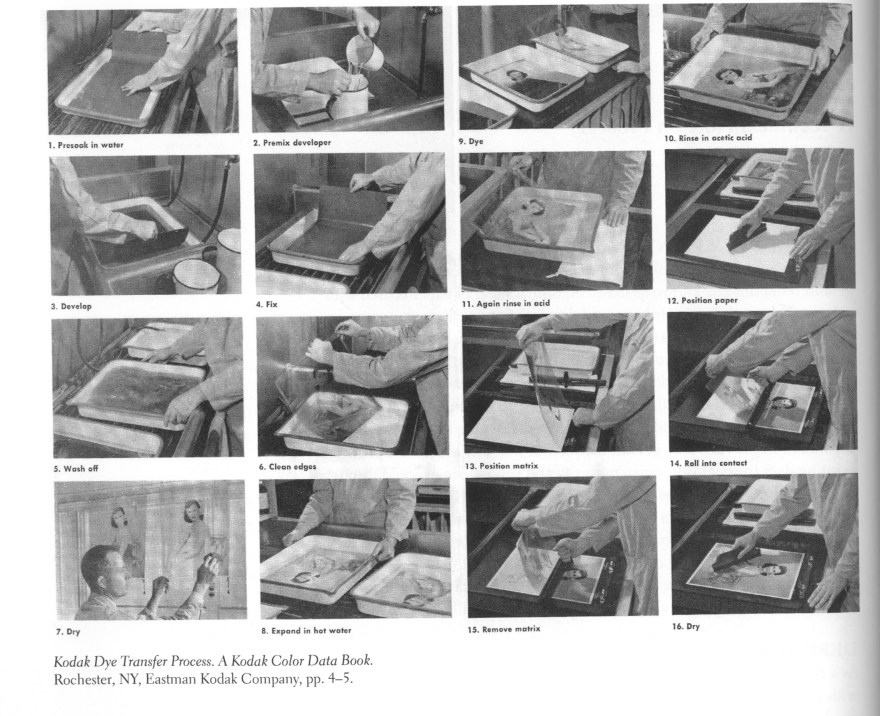
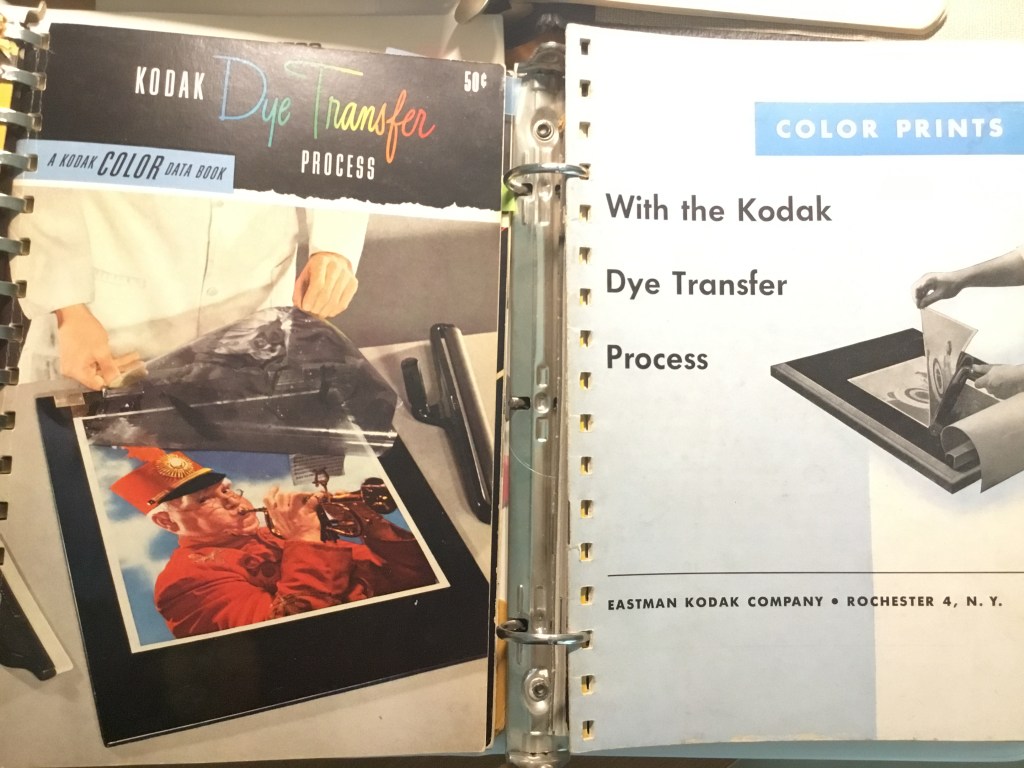
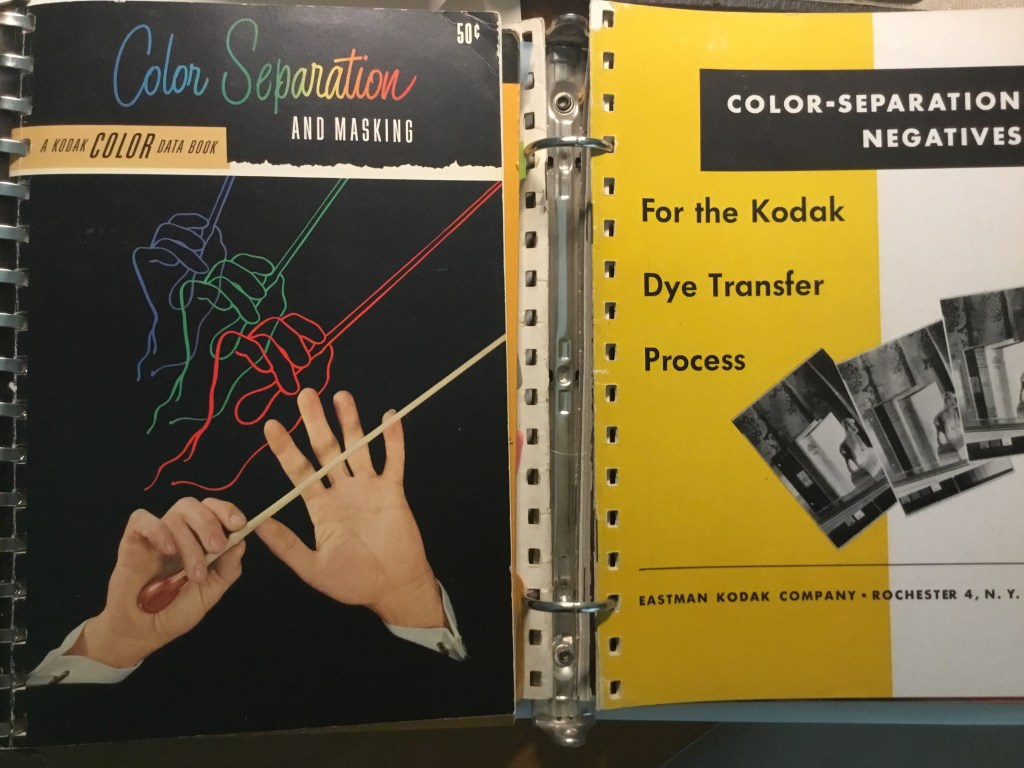
I read. The first things were Kodak publications. Data books. My parents let me build a darkroom in the basement. I built an enlarger using guidance from a magazine dated in the 30s. It worked enough for me to begin the process of gaining skill enough to understand the Kodak Dye Transfer information books.
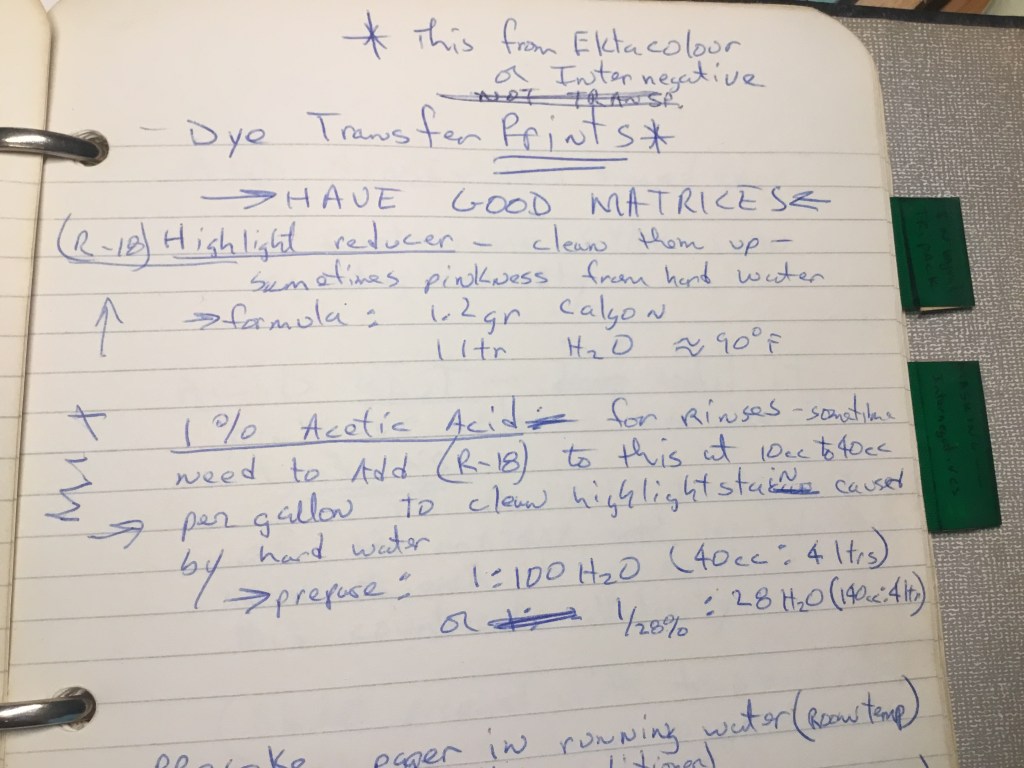
Supplies were extremely expensive, and difficult to get, not every store carried them, nor could even figure how, what to order. At last, my father stepped in — seeing that I was doing chemistry, and science things, he figured it was a good thing. He took me to work, introducing me to the head of the photography lab, where they made dye transfers. I spent the day watching. Walking away with some supplies, but more importantly, a set of worksheets detailing the steps to make prints. There it was, in step by step, easy form, what to do, when, how. No why, but even as a teen I understood that was where I came in. Why is the basic question of life. Everyone begins with that. Everything grows with that.
Pictures are the point.
With my first success; the prints looked like photographs. Photographs that others were making. I was proud, but not satisfied. It seemed so much work; it had taken several months to get to a point that it seemed anyone could get. Just another badge; a box ticked. So, I changed what I was looking at; going back to the origin of my interest. An Outerbridge book teased me into further experiments.
Still a teen, it hit me that dye transfer was a dis-assembly process. It took things apart. The photograph is pulled into separate components. What happens if we put them back, assemble them, in the wrong way?
Bang. I had a rush of discovery, of seeing another world; this world another way. I’d invented a new form.
Except, I wasn’t the first. What was a first for me, wasn’t the first for photography.
Jeannette Klute had gotten there before me. Gotten there by a decade. I was deflated, then delighted. Someone else had discovered the same principle, some of the same patterns. Eventually, I contacted her. After I’d worked as a dye transfer printer, I visited her at Kodak. She was enthusiastic, suggesting I visit Henry Holmes Smith to attend college. It was good advice. I did visit him; while he was appreciative, he didn’t extend a firm hand. I asked myself the standard question: why go to school to learn what I was already doing? I was making very good money. I ignored the draft. And so it goes.
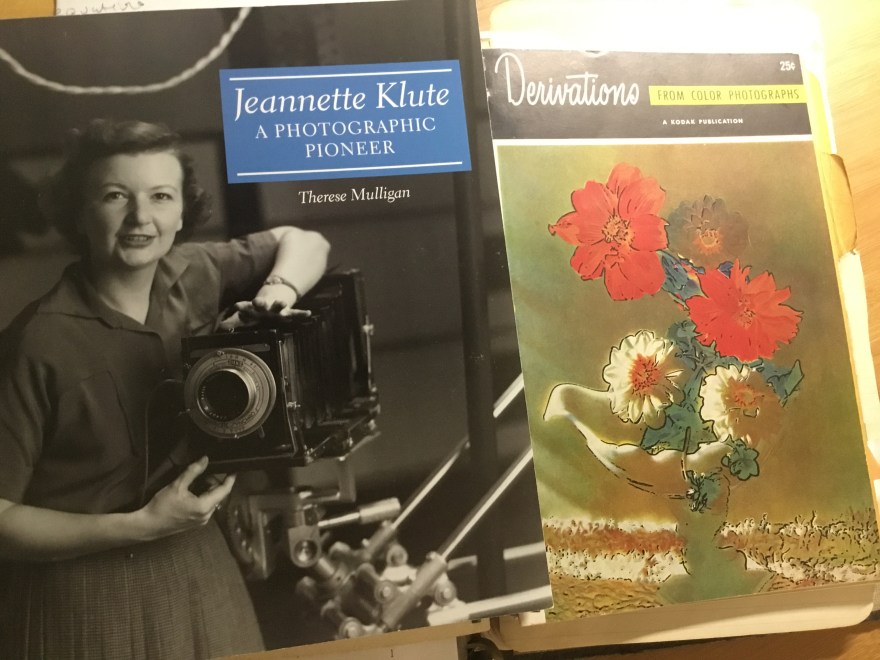
Jeannette Klute (1918 – 2009). About her, a thin book of her life. More importantly, her book for Kodak. She was the secret person for dye transfer for those of us in the field. She could answer anything. kodak 1938 – 1982
People are the real process.
Which brings us to the nature of assistance, or diversion. In this century, learning some things means asking questions of invisible experts, some of whom may know the answer, most of whom don’t even understand the question. Certainly don’t understand the partial question, the hard to formulate early questions of someone new to their journey.
They will answer their question; get you to their destination. You will learn to make their pictures.
Today, this century, forums provide the QA space. Some unknown will answer some unknowing passer. Most of the questions are about prices, definitions, so are easy to answer. Most answers are as useless as the questions. Yet this is where the novice gains first answers to their first questions. I am thinking of two such people; I’ll call them C1, and C2. Each began on different analog photography forums. C2 began on a much more specialized forum, going so far as to limit the camera used. C2 has grown up there; now making pictures very much like most of his teachers. C2 learned to make his pictures, well, he learned to make the pictures others were showing him. That is the most common route. You ask those doing what you want to do. The easy: “how.”
I see the best minds of this generation running down the web asking only “how”.
C1 is from the chemistry, emulsion forum. He asked much more complicated questions; many based upon wide reading of a specific topic that interested him: dye transfer. He provided in-depth notes of his learning; going as far as experimenting in a new direction of making matrix emulsions. Certainly new to the readers of his notes. He has met some skilled emulsion makers. Skilled enough to be able to take him back to the Kodak standard pathway. After a few years on his own, he moved to Rochester, becoming an intern and preparator at Eastman House. Recently, after reviewing his online work, I realized he’d been inspired by Jeannette Klute, also.
C1 leaned much; so much he left his picture quest. Or, perhaps that changed, too. He makes different pictures, giving up on his dye transfer interest. He ran out of drive. He was asking the right questions, seemingly of the right people. It’s just too bad they weren’t picture people.
Craft, at first, seems to block progress. Later, it either lifts you up, or holds you back, beats you down. You won’t know which until much later. The people guiding your craft growth must insure that they don’t block your imagination; at the beginning, image is as fleeting as a dreamer’s memory.
The camera center’s supply cabinet is the junk table of the internet. Finding good stuff among all the bad stuff means sifting, seemingly randomly, through what is presented. Naturally, the novice seeks answers from presumed experts – the foruatti. What makes them an expert? Their say-so.
What they say they know, and what they show they know are the significant elements of your risk.
Because they don’t know what they’re talking about, they don’t see what they’re looking at.
A topic search about ‘tricolor’ turned up a discussion on a large forum. One of the posters remarked that they’d seen something interesting on ebay. They, nicely, posted a link which I followed. One of the high post pontificators pointed out that: “it is broken. Can’t work. I know because.” He didn’t know, but he deflected people. I suppose that he would rather be heard than to say something useful, or meaningful.
It doesn’t always work out. In this case it did. The box of goodies had come from a shop that did direct separations. The extras thrown in (because the seller wanted them gone) included filters, inspector guides, things from a working pre-press shop. Most of the things that anyone interested in making direct seps would need. Did the large forum braggart even look at the link? Did he even think?

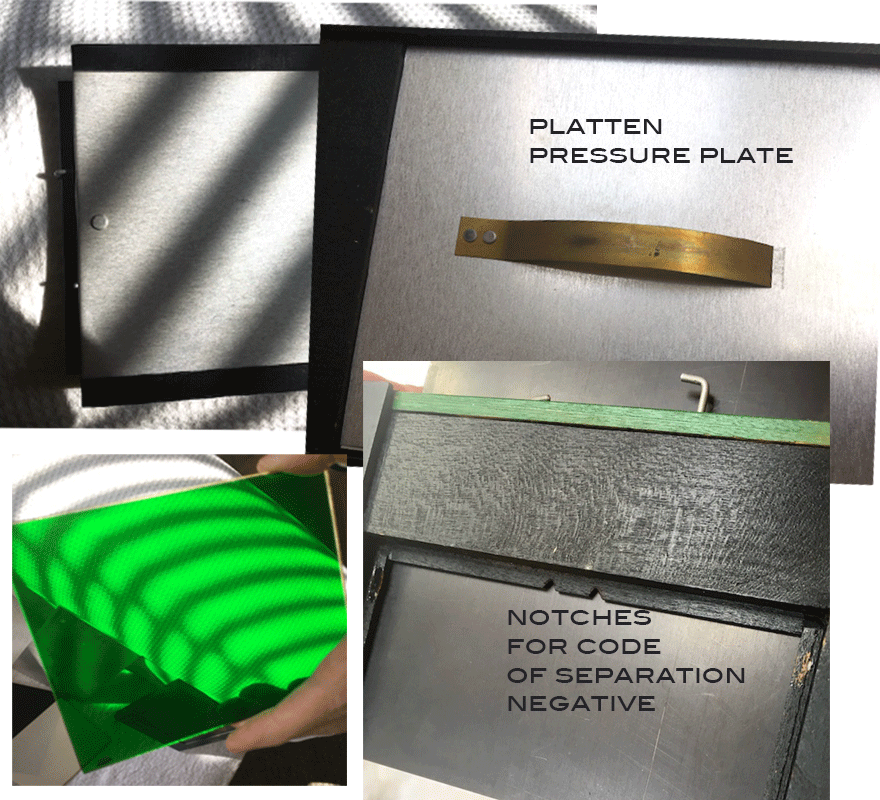
In the picture on the left [‘two size tabs], we see what seems a typical 4×5 film holder. Except, when looking at it edge on, there is a ‘green’ edge, as well as a ‘silver’ back (instead of another slide). The other set of pictures show the elements of this ‘Green’ separation holder. The back slide discloses a platen, pressure-plate that holds the film toward, and against the separation filter (this one is green). You can also notice the notches for coding the separation negative. Those two ‘v’ cutouts would make 2 dark edge marks onto the film. After developing, you would see these on the edge of the film and know which separation this sheet was. Each color has a different notch code.
Direct seps are made with: 25, 58, 47 filters. These are inclusive enough to capture most of the colors of an outdoor scene. They’re available new from several manufacturers. 2020 prices range from $17 each, to $180 each. If you are still forming ideas, and gaining skills, go for the Lee’s (the lower price filters.)
Direct separation; camera-separation; in-camera sep; tricolor — these are the same thing. None of them require us use RGB. Most of the examples you see will be those. If you are making dye transfer prints, these are assumed in the directions and example literature. BUT. they are not required. Any filter ‘separates’ — it is up to you to determine if there is meaning for you.
For further, very old, but worthwhile see this: 1916 Manual
Websites go offline – books are always offline. The book I’d suggest you reference is Spencer’s “Color Photography in Practice” [use “colour” to find more copies. ~ $4]
This is just a pencil, not a paint by number set.
If you do more, I’ll write more.

You must be logged in to post a comment.