
A first general question; common, persistent. Hello Boards, those things filled with barrages of easy to answer technique questions, get this question posed by people thinking technique is the art. Photography is the refuge of the simplified technician’s mind. Get a camera – you’ve something to talk about for years.
The answer they seek will be found in the camera, lens, light, film, chemical, layer style… something. It has to be something they don’t yet know. The easier it is to answer, the more people will return to it.
The limitation they have is just that they cannot abstract properly. They can’t see photographs – they don’t think with their eye, while those they’re chasing do.
The need to duplicate
duplication to break away, or to hold onto as comforter. Most photographers become entangled in zone system effort since the image sets they are copying are distant – at some Federal Parkland, visited only on vacation. The endless sharpening of tools is enough occupation of an otherwise dull life.
Are you duplicating to follow, or to free yourself? All artists talk to other artists, living and dead. By studying the work around you, you will have richer vocabulary – just beware the dictionary you use. Art is a reward for the creative; food for your ongoing nourishment.
Market Markers
Photo District News, among others, has features of ‘how that shot’ was got. This is fuel for advertisers to position their product so that the new photographer has an order list – what do I need to look like the head of the herd. Spending more than 6 months on these items is leaving you behind. The sooner you stop following what others buy to shoot, the sooner you will be a price setter. Financial success is based upon learning your multiplier, not how to make scrims. Learn to look: what does the shadow do; highlight? Can you see the logo? Does it matter? Shoot and look, then show and sell – you will succeed or fail and know it within a few years – definitely by your 30th birthday. Advertising is a beast that eats and shits always.
Art Worlds
Art can sustain the artist forever – that’s the biggest difference between art and commerce. Money always runs out; ideas never do.
How does Sarah Moon get her look?

The character of the question reveals the level of thought, the motive of the aspirant. For example:
There’s something I have been trying to understand all weekend, but I just don’t seem to find the solution: How does Sarah Moon achieve the blurry/unfocused look of her photographs?
They have been puzzling about this an entire weekend, before calling in the answer brigade. This seems about as far as most armchair artists gets. Think, just a bit, then ask for a technique. Photography attracts more of these questions, although watercolor runs a near second. It is expected that some sort of procedure will make the picture “art,” or at least something closer than what they’re producing.
The weekender, vacationing art lover, thinking themself a stymied artist, holds strong opinion of method, skill in craft as foundation, not mere preamble to being called an artist.
If it isn’t hard, how can it be art? — the variant is: “my child could do that”
The novice stage artist is just a few days away from having been the general public. Not exactly. Most of the general public avoids art, thinking it too difficult, too meaningless. The new artist likely begins holding both views. If they hold them too long they will never give themself permission to find the artist in their life.
Nature of the Question
it is a question the early worker, the newly initiated asks — an unsophisticated question, so answering is rarely sophisticated – it wouldn’t be understood. So responses fall into:
- why do you want to know
- have you asked them
- some very elaborated explanation based, usually, upon pure ass grab guessing, but it answers the gossip interest
- … the group then moves onto the next same question
Past Tools

Tools change – products do not stay the same for long; not in a field such as photography, which is subject to stresses in buying sectors – amateur and professional, and the further deeper stratification within each of those broad sectors.
Super Anscochrome 100 & D500 could be processed as negative or transparency (slides). It could also be exposed at EIs from 125 to 1000 by changing the development time from 4.5min to 13 min. This variation was provided in Ansco’s direction sheets – most labs provided these XPROS variations with checkbox choices on the drop-off envelope. Since the film came in rolls and sheets, many professionals used this way to color. The palette wasn’t up to Kodak’s definition – hard to find neutrals. This was just the thing for people less interested in exploring the engineered version of reality needed to sell bridal memories.
ANSCO REFERENCES:
- Duerr, Herman H. (1952): The Ansco Color Negative-Positive Process. In: Journal of the Society of Motion Picture Engineers, 58,6, pp. 465-479. View Quote
- Duerr, Herman H. (1954): Letters to the Editor, “Feature Films on Ansco Color”. In: The British Journal of Photography, January 15, 1954, p. 33.
- Mitchell, Robert A. (1953): The new Ansco Color film and process. In: American Cinematographer, 34,4, April 1953, pp. 166. View Quote
- Pelz, W. (1961): Farbkuppler. Eine Literaturübersicht. In: Mitteilungen aus den Forschungslaboratorien der Agfa Leverkusen-München. Band 3. Berlin, Göttingen, Heidelberg: Springer-Verlag, pp. 111–175, on pp. 113–115 View Quote, on pp. 117–119 View Quote, on pp. 127–135 View Quote, on p. 161 View Quote, on p. 163 View Quote, on pp. 170–172 View Quote and on pp. 173–175. (in German) View Quote
- Ross, Rodger J. (1951): Duplication of Color Images With Narrow-Band Filters. In: Journal of the Society of Motion Picture and Television Engineers, 57,9, pp. 267–274. View Quote
- Rowan, Arthur (1952): ‘The Wild North’ introduces MGM’s new Ansco Color process. In: American Cinematographer, 33,3, March 1952, pp. 106-107, 122-124. View Quote
- Schadlich, Karl (1956): Professional Printing Techniques for Ansco Color Negative-Positive Motion Picture Film. In: Journal SMPTE, Vol. 65, July 1956, pp. 375-377.
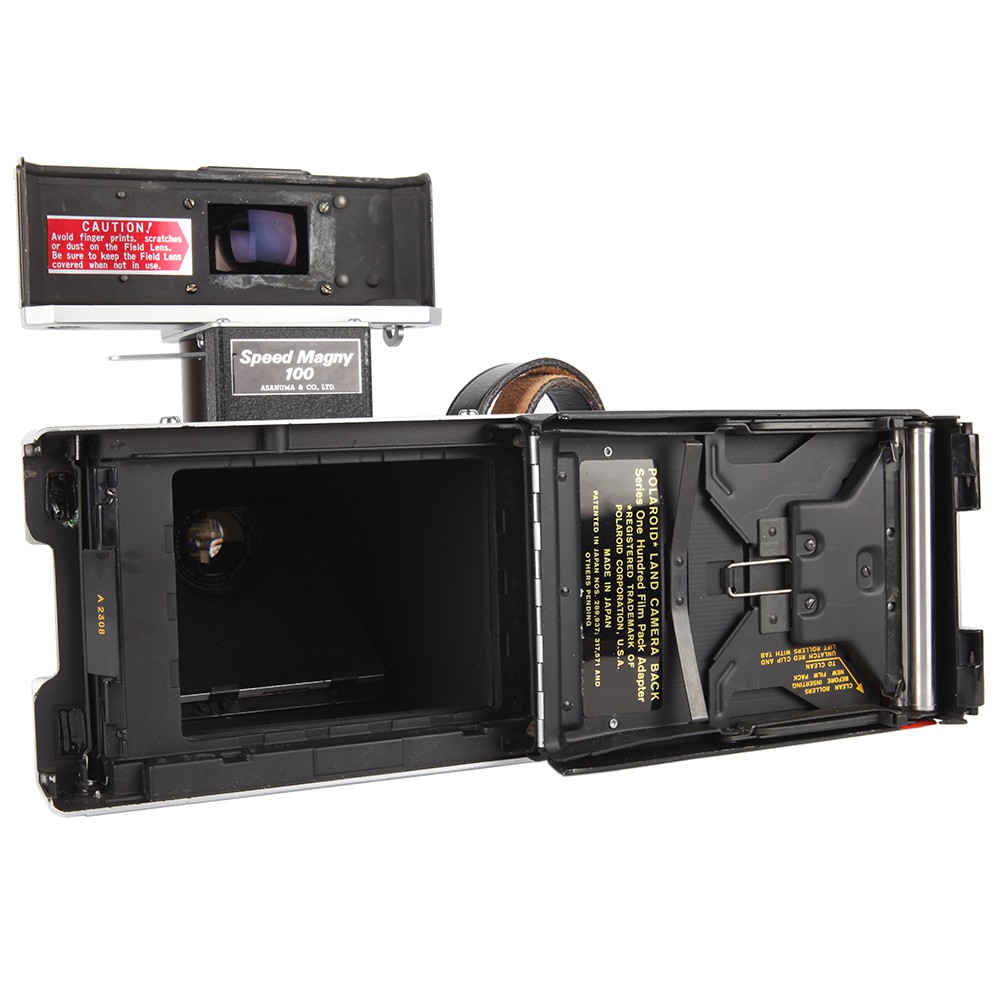
Polaroid film had a similar color scheme. It was natural to replace Ansco with Polaroid after Ansco dropped their sheet film. The Speed Magny was an add-on back for the Nikon F. The Speed Magny was a 3×4 polaroid back which provided the Nikon user the option of shooting Polaroid instead of 35 rolls. Using the Magny with a moderate long lens, a photographer could get drag and push-pull effects with polaroid 665 film using Nikon optics. A good choice for palette and rendition of a dream in color.
Sarah Moon Palette
“I THINK OF COLOUR AS MORE OF A COMMON LANGUAGE. MORE GENEROUS, MORE OPEN, NOT TRANSPOSED, THE LANGUAGE OF THE REAL.” – Sarah Moon

Sarah Moon’s colors are the easiest part of her method. The widely viewed prints are likely Ultrastable prints. Her stuff was first printed by Marc Bruhat of Sillages, Paris – it has been closed for many years. Upon his closing, she had her printing done by Lowe and Ward of PermaPrint Ltd, London.
Her Open Secret
Sarah Moon (Marielle Hadengue) was a model. She learned the fashion world by belonging to it. Her first photographs were for herself. As she matured, her work did. Her style isn’t static, yet if you note the parts of her work that blur, it seems the blur of natural motion – something like a gentle breeze – floating, not blasting by –
So the method: Put something, someone interesting in front of the camera and make pictures without trying to duplicate the graycard vision — move until the pictures capture your moving.
Don’t follow. Dance
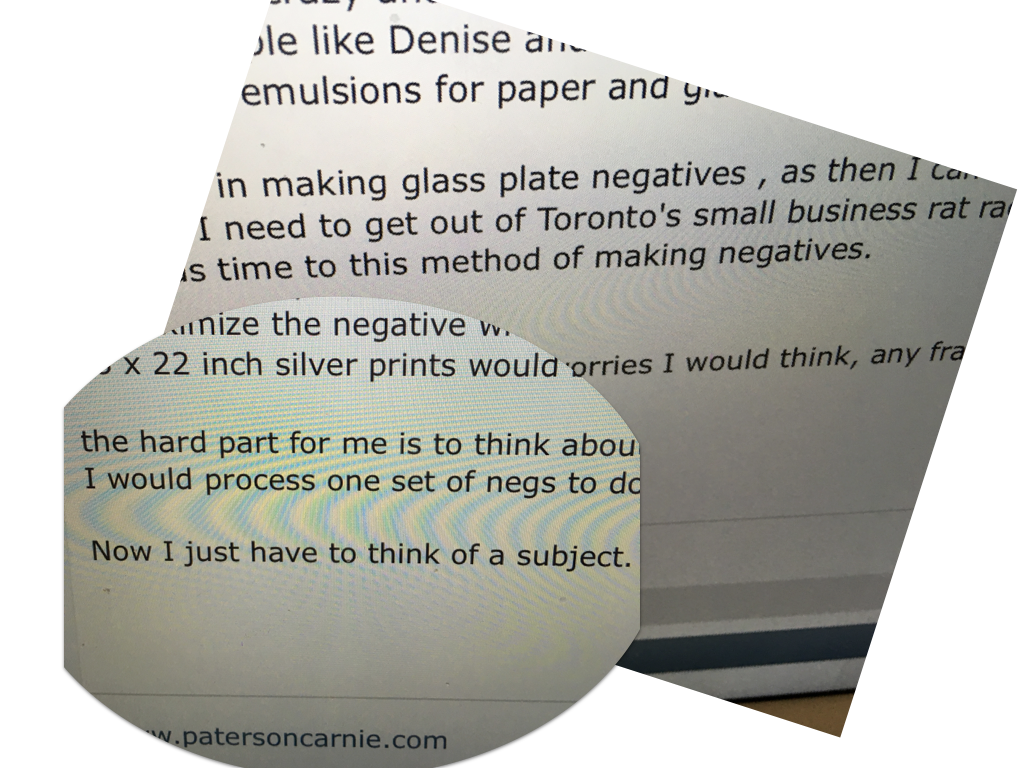 Unless you are a Carnie. Most long time participants in online photo forums limit their discussion to method and technique. They never understand this limits their growth. Carnie is one longtime dedicated participant. He serves as archtypical printmaker. As he notes: Now I just have to think of a subject.


You must be logged in to post a comment.