taking notice: Ingrid Pollard

in the morning IG feed, from someone I follow but don’t know; didn’t know very much about, even. They posted (ukegirl99 ingy pingy) about being awarded the Hasselblad award for 2024. I looked, but didn’t follow up… I don’t put note to the Hasselblad awards, thinking them commercial achievement.

It is easy to overlook things in a world of many things to look at. We look quickly. I do — even though I restrict how much hits my screen — enters my world of books. I know that if I’ve seen her work, the early work, I wouldn’t have noted it, even though the hand-coloring would have appealed. Work has to sustain the artist longer than is usually possible.

Awards make the work something to re-visit. That is more valuable than the dollar amount. In preparing this note to myself, I dug into the Hasselblad award enough to give it value; value because of the artists they have recognized. In one sense, that is what the company+foundation probably hopes happens.

That was that. In reading my email, intending to delete the Hasselblad cast, I saw more about Ingrid Pollard, and the award. Seeing more, I looked for more. Her site: http://www.ingridpollard.com/ No mention, the news is more recent than the website “news” section.

That will change.

[In the video, she recounts her “notification” story. At first, on the phone, she doubted the veracity. It took the email to convince her. In an eWorld, even the one connected because of the phones, we doubt the voice on the other end of the line. Sound isn’t the eye. We prefer text. That thing we can read, show, share. The sound of the distant other is gone in a click.]

From the email: the Hasselblad Award honours individuals whose work significantly impacts the field and pushes artistic boundaries. Ingrid Pollard, the 44th recipient of the Hasselblad Award, joins an exclusive group of previous Hasselblad Award laureates, including Ansel Adams (1981), Cindy Sherman (1994), Hiroshi Sugimoto (2001), Dayanita Singh (2022), and 2023 laureate, Carrie Mae Weems.

Quite a list. Diverse, brought about by the years of an expanding photography world.

  • 1981, Adams. USD 20,000. “With clarity and precision, he visualized the spectacular vistas and rich native details of the Western United States. In 1942 Ansel Adams developed the “zone system” which employs careful sensitometric control and adjustments of exposure and development. As an artist, a teacher, and a master of photographic technique, Ansel Adams’ influence has been felt by successive generations of photographers from all over the world.”

  • 1999, Sherman. SEK 500,000. “Much of her work has been concerned with the position of women in a consumerist and media-driven society, and with the ironies and contradictions of contemporary women’s lives. She can also be seen as a significant “re-inventor” of two important traditions in photographic art – the photo surrealism of the 1930s and the photo-based conceptual art of the 1960s. Cindy Sherman’s influence on successive generations of artists and photographers has been, and continues to be, immense.“

  • 2001, Sugimoto.  SEK 500,000. “Inspired by Renaissance paintings and early 19th century photography, and using a large format camera, Sugimoto achieves a wide range of tones in a body of work that reflects his great love of detail, his outstanding technical mastery and – above all – his fascination with the paradoxes of time.”

  • 2022, Singh. SEK 2,000,000. ““Through photography she records and shapes the stories told within the structure of the archive before turning it into a new form. Her works are moving in several senses of the word: the audience is both touched by and is encouraged to touch the images. “ https://youtu.be/3tgMr5lnA3c?si=PEWKChMlfqlH_Wkk

  • 2023. Weems. SEK 2,000,000. ” “When Carrie Mae Weems first appeared on the scene four decades ago, her work was instantly iconic, even if it took time for the world to recognize it as such. As her vision has evolved in intuitive, unpredictable ways, it has only become more essential.” –-Jury chair, Joshua Chuang

Power of Dog Story

A western film set in Montana, filmed in New Zealand. A re-westernized examination, so the meta goes, about machismo — destructive mannerisms of maleness.

The movie unrolls like a silent era film. Every plot point made in pantomime deliberateness. So much so, you know by the middle of the movie what the ending will be. Unless, as my gang said, you sit in the back of the bus.

Wyoming in New Zealand. Coming to terms with changes of an age. A movie I’d hoped to rewatch. Instead, it is a movie I watched, will consider, probably not watch again. I’ve too many other films, books, tasks to do. I don’t think I will get more from another watching than from some other film a first time.

The movie in one scene: the rabbit in the pile of timbers. By now the masculine and the feminine are coming together to stick a post into the hole. A rabbit runs under a pile of timbers. A game begins: toss timbers aside until the rabbit runs. 

He can’t. He is injured. The female man lifts the rabbit to comfort it — seeing it is injured, snaps its neck. 

The clear morality point: men kill the weak . These two men are gay. One clearly, the other remaining hidden, like a dog in the distant hill— only some can see.

Not an easy point for the larger audience: the dangerous persons in this film are gay. perhaps that is just the contrarian me. The widower’s son is the killer. 

Toxic masculinity – come upance, originally told in 1967 by Thomas Savage. The movie is composed with simplified symbolism. References to the dead, the posers, the educated seer. It is of its time, the fading sixties, and the looking back to a baby-boomer whistle vision of the 20s.

Those who liked the film:

>> On April 6, 2023, it ranked number 15 on The Hollywood Reporter‘s list of the “50 Best Films of the 21st Century (So Far),” calling it a “brilliantly uncomfortable chamber piece about corrosive masculinity fed by sexual repression” and a “psychodrama whose epic scope is echoed in its majestic landscapes.”

>>August 24, 2023, it ranked number 8 on Collider‘s list of “The 20 Best Drama Movies of the 2020s So Far,” saying that Campion “unravels an understated love story in the heart of the American west, and shows how forcing someone to conform can lead to tragic circumstances.”

>> The March 2022 issue of New York magazine included the film as one of “The Best Movies That Lost Best Picture at the Oscars”.


FOCUS: Todd Walker

gallery notes from 70s. origin story of photography entering the world of walls for the people.

San Francisco early years of photography into art gallery. the wall and the bins were filled with unknowns, and early risers. Todd Walker was making a transition and name. His work was an early pathway into the alt-photo world. When alt meant “not Kodak” and a precedent to Post-Industrial photography.

Focus Gallery was founded by Helen Head Johnson (1916-1989) in 1966 on Union Street in San Francisco. She had worked for the de Young Museum as public relations director. She decided to open a “people’s gallery.” Over the nineteen year span of Focus Gallery, she presented over 300 exhibitions, showing work of more than 500 photographers. She closed the gallery in 1985.

Grapestake gallery was functioning in the period 1970-1986.

I remember the bins for photographs. Bins had prices. Prints were in plastic, much like a record store.

Helen Johnston left her private photography collection to the de Saisset Museum, the Oakland Museum of California, and the San Francisco Museum of Modern Art.

The show prior to Todd Walker’s was Eikoh Hosoe’s.

  • 1969, Aug :” enclosed is check for sale of portfolio at $9.00 less gallery commission of one third… Glad you are not dependent on our sales to keep the wolf from the door! I always say.. can promise no sales.. but certainly can promise exposure.

  • Sept 1969, from Todd: “Thank you for the check and most especially for the invitation to show in your gallery. Do you have a drawing or measurements of the gallery space so I can plan the number of prints and how they might fit?”

  • 1969, Nov 14: “dates for exhibition would be Feb 3-28. We instal over the weekend…. the other show will be by Tom Baird…we could use about 40 to 45 prints….. Am wondering what you plan to show? Would it be the same show as was “Camera Work?”

  • Dec 1969, from Todd: “I would also like to print the announcment and will get it to you two weeks ahead of time. I think the show should just be called Photographs by Todd Walker.

    FG: [announcement photos] if you have both abstract and representational probably representational would be better.. … printing enough copies of the announcement to send us copies for our mailing list of about 400 mostly poster sources and regular customers?

  • Jan 6, 1970: Received of Todd Walker. three portfolios and a sample to sell for $30 less gallery commission of one third and 450 announcements. [HJ]

    [HJ] We don’t have them (openings). However if there are photographers that you would want to see and might not have a chance to see them otherwise we could arrange one.

  • Feb, 1970: [HJ] … and I’m so glad we have the explanation for the techniques. There has already been much favorable commen on it. … Could you send us about two more press pictures? The one most representative of the show… The landscape is just too dark for newspaper reproduction and besides I’m afraid they would think it was not really representative of your show.

  • June 1970: [HJ] … I hear so many wonderful reports of what you are doing.. how exciting is your present work. We were fortunate to have had it at Focus. .. enlcosed is a check for the sale of the 16 print portfolio (30) less gallery commission and thank you!

    Aug, 1970: [HJ] Enclosed is check for sale of one of your portfolios … Your show at Focus was one of the best we ever had..

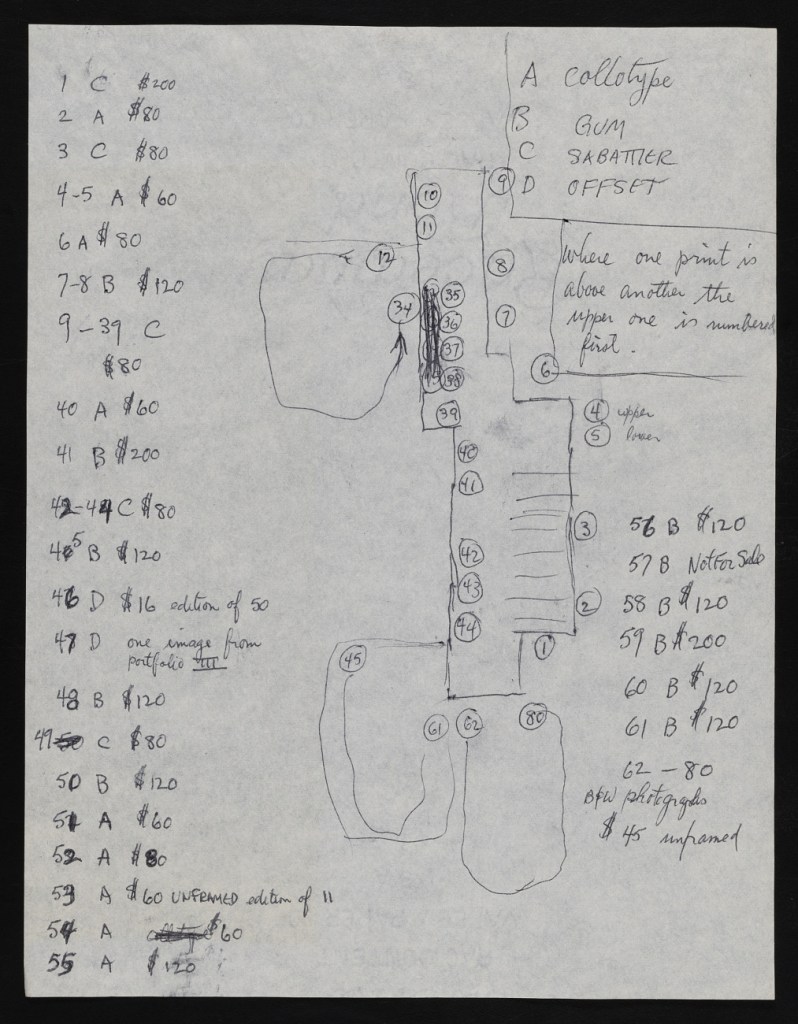
Todd Walker Focus Gallery layout with prices

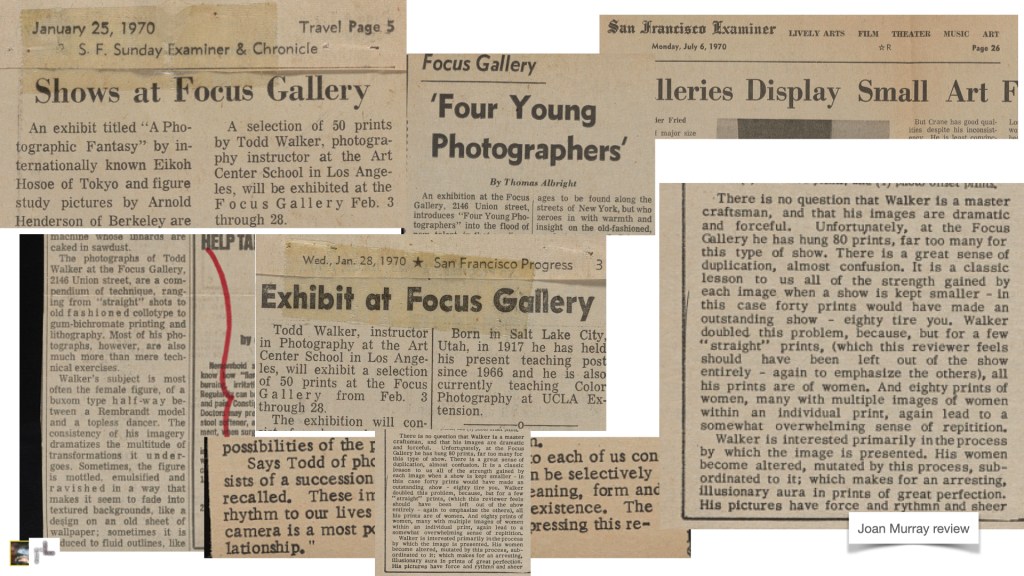
Arts coverage in the 70s was printed in Travel sections of papers. It fell into foundation journalism, being somewhat enlarged form of a Press Release. Some reviews were only that, a re-write for space.

1970 Press clippings; Focus Gallery shows.

Todd Walker: “Reality to each of us consists of a succession of images which can be selectively recalled. These images provide the meaning, form and rhythm to our lives as they relate us to existence The camera is a most powerful means of expressing this relationship.”

Joan Murray (reviewing): ” Unfortunately, at the Focus Gallery he has hung 80 prints, far too many for this type of show. There is a great sense of duplication, almost confusion. It is a classic lesson to us all of the strength gained by each image when a show is kept smaller. … Walker is interested primarily in the process by which the image is presented. His women become altered, mutated by this process, subordinated to it; which makes for an arresting, illusionary aura in prints of great perfection.”