Daisuke Yokota

Born: 1983- //  Yokota is part of a 
generation of young artists using photography in subversive 
new ways. His approach combines multiple rephotographing 
and printing, applying acid or flame to the end results, and 
making one-off prints and books from unexpected materials 
in staged public performances. Yokota is working out of, and 
pushing forward, a Japanese tradition of photobook-making 
that harks back to the visceral experimentation of the Provoke 
generation 

I don’t make work to express my feelings, it’s more like burning them

the Zine form: “A self published limited edition zine, the publication marks one of Yokota’s earliest printed works. Experimental and distinct to his book-making process, SITE is a series of images which displays the artist’s photographic approach in exploring both memory and time. With SITE, Yokota chose to experiment with both photoshop and digital forms of image distortion.” https://www.shashasha.co/en/book/site

“His practice consists in constantly revisiting his own archive of personal photographs by adding layers of accidents, in order to metaphorically signify the superimposition of states of consciousness and memories. Of- ten referring to the principles of echo and reverb, Yokota also establishes links between visual and musical fields. One could say that he captures ‘noise’ in the broadest sens of the word.

Daisuke Yokota is the author of numerous critically-acclaimed artist’s books, either handmade and self-published or realized with various publishers.” https://jeankentagauthier.com/en/artistes/presentation/5/daisuke-yokota

DAISUKE YOKOTA — For Color Photographs, I worked with layered sheets of unused, large-format color film, experimenting with the development before scanning them. Generally, photography exists to record reality. The present development of technology ignores the material. Originally, needless to say, film negatives generated the image, and there was paper to stabilize it. In short, photography is a combination of images without the mass and the matter [film and paper]. For
Color Photographs, I focused on this material side. https://purple.fr/magazine/ss-2016-issue-25/daisuke-yokota/

note the foils included… how they overlay.

finally, flashback, only because it makes those of the hobby board wonder…

very clear explanation that leaves those expecting their method to be the only method, mis-interpreting the steps

the first group of amateur, the most common type, understand only what they know how to do.

Dead Cat Bounce: Tetenal

In 2018, Tetenal failed causing the photo-world to shimmy and shake. Was this the end, or just a climax in a potboiler.

Tetenal came back only to fail again in 2023. This is the way at the end of life. The crash is never complete; until there is no where else to fall.

Chemistry is the profit of the chemical photography business. Emulsions are there so that chemicals will be bought, used, and replaced. Cameras are there for the lenses and films, etc. No chemical means no chemical darkroom; means no paper. The way is clear. It is just lost in the fog of romantic versions of truth. Few want to admit they are on a dead horse; fewer will put that horse down.

This is not a work-horse, it is only a hobby-horse, as such it will not last. Farriers live because horses don’t have to be made, they do the work themselves, unlike emulsions and XTOL.

Reportedly, Tetenal spent about €500,000 (~$574,000) to acquire the license to produce CD3 and CD4 color developers — and apparently they split the bill with Fuji to save money. That is one of the reasons why Unicolor chemistry, for example, is not available in the E.U. No small company or startup could afford such certification and thus Tetenal is the only manufacturer of CD3 and CD4 within the European Union.

<< from 2018 report of Tetenal’s death.

Kodak relied upon Tetenal for Xtol, HC-110, and ECN chemicals.

Why the company failed with full orders, even backorders… the hopeful thought it would be brought back to life, since there is so much vigor in the “recovering analog community” — like alcoholics giving each other bad advice over bad coffee.

It failed again because there aren’t enough multiples of profit in each sale, and there aren’t sufficient sales to maintain a fully managed industry. Gas stations on the interstate make more money in a quarter than Kodak+Ilford make in a year. Fujifilm is the only company that is built upon a large profit foundation; that is from other sectors of its well managed organization.

Adox is claiming, hoping with that claim, that their ability to maintain chemical making will sustain them. This as they also seem to regularly acknowledge that there is little profit in BW paper. Profits from their chemistry funds their research and development of other product lines (assuming color film).

The arc has been clear for more than a decade: people use roll film intending to scan it. Some are beginning to see the other way.

— If I need a camera for film AND a digital camera to scan that film…. why don’t I skip the mechanical/chemical step, going directly to the digital camera?

Might just be bragging rights. Some claim to life-forces unseen. Anyway, people continue to pray for anther Dead Cat Raising.

See. Stop. Click

We walk around, make our way to or from something. If we look with easy eyes, arrangements, occasions, even sounds prompt attention. Further inspection, reaction. Most of us, for most of the time are more involved with something else to see what is seeable. People drive thousands of miles without seeing what they drive past so they can do what they think is expected; do what the great-one did.

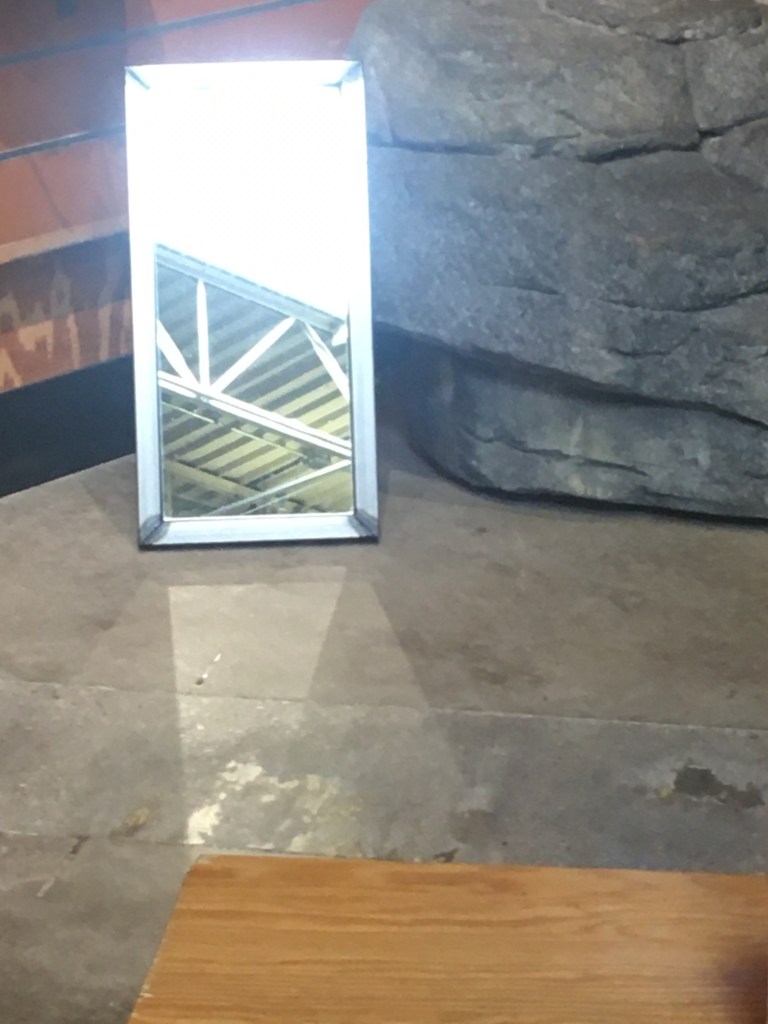
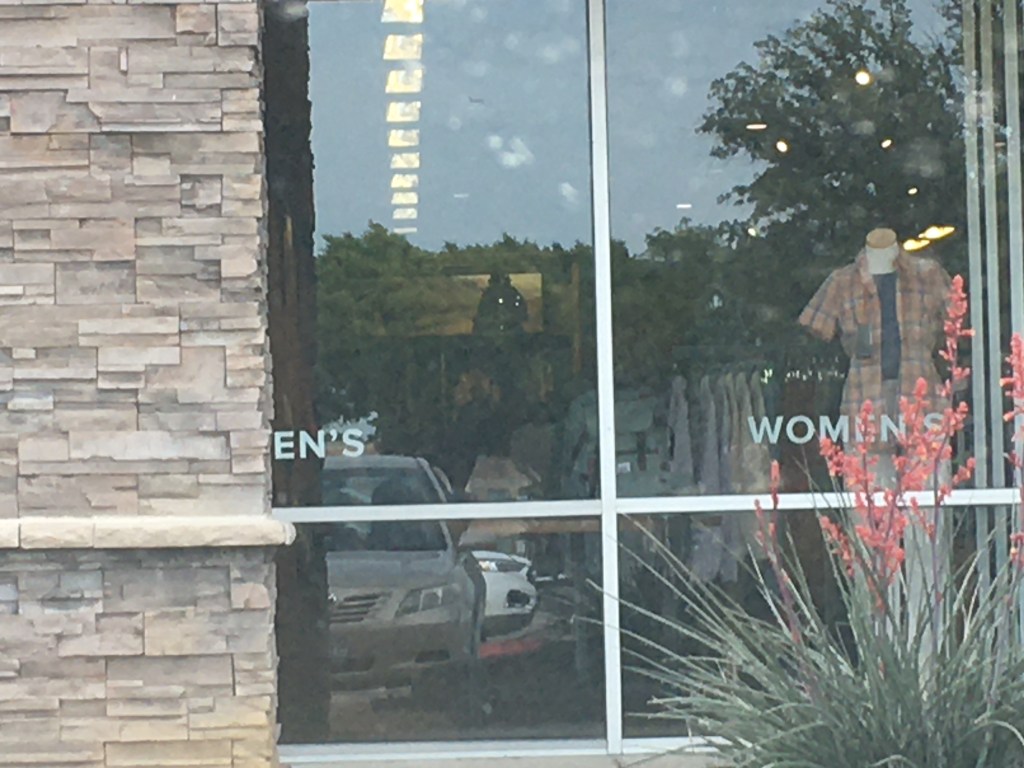
Three instances of misses, and the effort of making them. These are all part of the infinite roll. They aren’t edited; not even change of exposure. They remain direct phonecaptures.

I notice something — not a snake. has a shiny part. So, I make an exposure. This assures that the angle, first surface of the render is made.

walking closer, make another exposure.. it will need post to succeed. As it is, it fails.

Inside, a mirror and shop display. It must be something. Feels like it, because of the light patterns. As I adjust my position things arrange themselves. Three tries. I’m tempted to move the mirror; even the bench. I don’t. This isn’t a studio shot. If it were, I’d feather the lights. Make changes to the surface of the mirror. Dulling spray applied locally.

Three it didn’t work. If it had been on film no chance of getting that image — film that could have done it would be cinema film.

Outside; windows with words. Breaking the scene into one word pulled apart. It fails. The bush that would do the main “obscuring” isn’t dense enough. This could be retouched. Not certain this is worth the effort, given the format of the file — too low pixel density. Is it worth the return with the Phase Back?

We can see before we can walk. We can walk before we read. Everything leads us toward understanding.

If you think it might be something, make it into that something. If you can’t; if it just doesn’t work, make the effort anyway, otherwise, you won’t know, and if you don’t know, you don’t learn. The main learning isn’t about the how of things. It is the other part of things.