(this is part of the articles on fora persons – who quits, who stays – what do they achieve)
Forums are populated by people in search. Support groups attract people needing support. Large Format Photography Forum has a few very dedicated members that provide a good indicator of types of people who consider themselves dedicated, having answers, being creative, probably consider themselves caring. Each group, in particular, those groups that have a position that is in decline within the large Real World, dedicate themselves to demonstrating the methods and modes of their path. LFPF holds a stated goal of “encouraging and enlarging” the use of large format photography.
Randy Moe …
“I dropped out at $20…”
why would this be important to him? Maybe it maintains support of his personae, support for his avatar presentation to the members of the bachelor herd. He is poor. Please help me. Thanks for the freebies.
small claims
Oh, maybe: ‘smart people don’t overspend, they make or make do.’
//BUT DID HE?
NOPE… this is that listing. I was the other bidder, c***b.
Randy was bidder BS
randy moe is B***S
/
They don’t gain knowledge… I am not on the forums; they serve only as research subject for me. The knowledge they distribute is conjecture and opinion… most of it not even from proficient or productive practitioners.
anyone with access to a community college library has access to more ideas about art, and more instruction in technique of photography
Oh, I was the one with the formula for Kodak Retouching fluid that “smelled right” …
The Secret Ingredient == staybellite ester #10
How do I know? Easy, I used to make and sell retouching chemicals…
silicon valley has never been the truth of place. it is merely the truth of capitalism. It exists only as a word; one invented as a throw away phrase used to sell a newsletter. An offhand remark. Not really a valley; now just a symbol, a pointer to money.
it was never truth: not when the place was picker shacks for prune season, not now that it is coder condos.
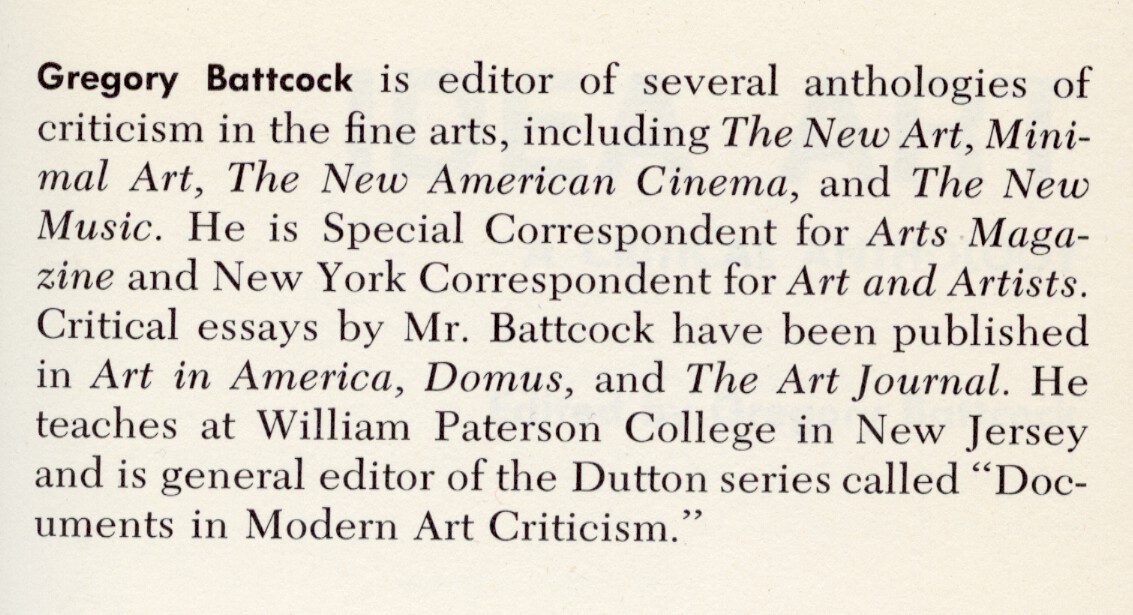
Critical anthology of pivotal texts edited by Gregory Battcock. Essays “Monuments for Nowhere or Anywhere,” by Dore Ashton; ” “Art in the Service of the Left?,” by Battcock; “The Relevance of Ecology,” by Jonathan Benthall; “The Fake as More,” by Cheryl Bernstein; “Problems of Criticism,” by Jack Burnham; “Art After Philosopy, I and II,” by Joseph Kosuth; “The Art Workers’ Coalition,” by Lucy Lippard; “The Eruption of Anti-Art,” by Ursula Meyer; “It’s Only Words,” by John Perreault; “Four Interviews,” Arthur Rose [Robert Barry, Douglas Huebler, Joseph Kosuth, Lawrence Weiner]; “Art and Words,” by Harold Rosenberg; “On Exhibitions and the World at Large: A Conversation with Seth Siegelaub”; “Documentation in Conceptual Art,” by Lawrence Weiner, Daniel Buren, Mel Bochner, and Sol LeWitt; “The Decline and Fall of the Avant-Garde,” by Robert Hughes; and “Les Levine Replies,” by Les Levine. “By 1970 it was clear that a new type of art was emerging in the New York and European art worlds. Quickly labeled Conceptual Art or Idea Art, the form encompassed an extraordinary variety of works. What they all seemed to have in common was a rejection of the ‘bourgeois’ aspects of traditional art. Works of Idea Art frequently did not actually exist as objects. Rather, the remained ideas; often, what did exist was only some kind of documentation referring to the concept. The chief purpose of this anthology is to present in a direct way some of the action, diversity, and rationale behind Idea Art. And it attempts to do so by presenting the students and educator with some of the original and important theoretical documents that helped set the direction of the new artistic emphasis.” –– from book’s back cover.





You must be logged in to post a comment.