Durst – asking for instructions

Searching the web is easy; too easy. Getting answers is easy, also, too easy. The correct answer is rarely as easy as the online experts make it seem. Google catalogs the words, it doesn’t have a knowledge engine, so can’t access how valid the website is. The assumption of links, references is that more links, more use, means that it is correct. Actually, it means there is a popularity rank to that site. There is a path, a cliche of words. The error of this is circular. More and more seekers are sent to the tent at the end of the well travelled path.

Another example has played out on Large Format Forum:

I asked and was told assembly was “really hard”

as it turns out, it is actually quite easy. Needing only one person, a 24mm socket wrench and knowledge. Reminder, these enlargers were sold without installation support. Photographers with limited mechanical skill put them together in basements, garages all across Europe and America.

the answer:

 put the carrier on the column. 
Because of the spring, turn the main screw  on the left of the arm) to the left, holding it tight, so the weight is released allowing it to be easily mounted. 
Next, lift the (now released of tension) smaller clamp and place it on the lower column, 
turn the big screw back to the right.
 You have a functional baseboard lift mechanism.

Simple enough. So, why does a website that takes pride in keeping analog photography alive, as well as having an elite gathering of knowledgeable sharing avid photographers often (always?) the answer wrong? We already know why you are sent there. google just works that way.

Simple Facts: the thread that gave raise to this example went on for 5 pages, protracted over 9 months. The participants were ones most often seen answering questions on Durst and other darkroom equipment. They post on photrio, as well. Just gathering a rough count shows over 750 threads concerning Durst enlargers on Large Format Forum. That is a count of threads, not posts. That is a whole lot of ‘text’ to get through to find much of value, much of immediate use to someone setting out on a darkroom practice.

Who answered? A German company that refurbishes enlargers.
Following Old Trails

following another’s footsteps makes you a tourist not a guide

Arriving Late

You may miss the plot, the arc of what came before, and think the ending is the story.

//

You begin in the footsteps of others; you walk behind them before you make your own path. you follow their path, retaking their footsteps, you learn how to do it: you follow the technical. the technical, if it’s amidol and azo, lead you into a narrowing market space; an expensive place in which you have to solve technical and  the economic, before you can set yourself free enough to solve your own problems; the problems that you define. This dalliance keeps the romance without requiring esthetic commitment. To keep yourself from realizing this, you rationalize the affair, calling it Printmaking.

The Printmaker Excuse

thinking that the problem to solve is just a printmaker one, your task becomes making yourself into a printmaker. this is codeword for saying you don’t have to have an image concept, an origin aesthetic; rely upon an aesthetic concept that’s been done. You can follow the prepared guidebook. Picture types come prepared with payment. you already know what you’re going to point the camera at. Maybe a rock, or sunset, a girl..

How bout a girl on a rock at sunset

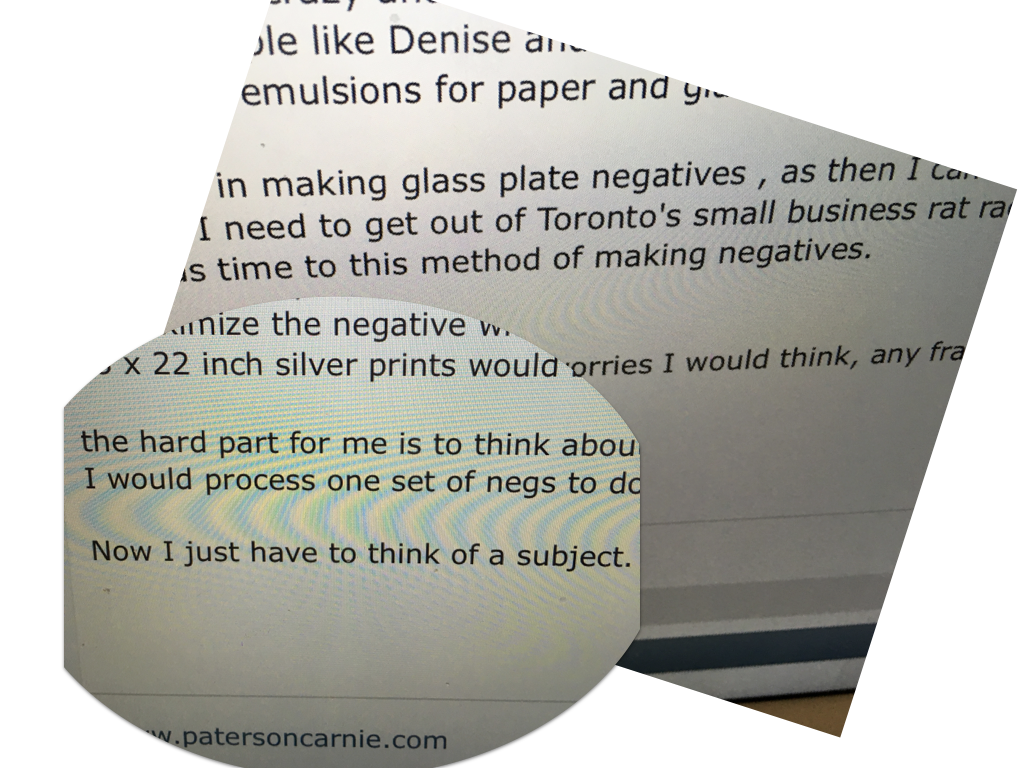
massArtistsLF.001Unless you are a Carnie. Most long time participants in online photo forums limit their discussion to method and technique. They never understand this limits their growth. Carnie is one longtime dedicated participant. He serves as archtypical printmaker. As he notes: Now I just have to think of a subject.
 

Simple Complex

The simplified process of Weston becomes a complicated process without a manufacture. Mistaking the wand for the magic. No one bemoans the end of Weston’s light bulb, neither do they ask the type of contact frame used. Charis on a dune, with perfect drop shadow is more important than bulb, camera, developer, or paper. Translation is never better by reading a more accurate dictionary.

Take What You Need

Rather than taking from Weston the specifics, take the general, the bigger constant — work simply, but work a lot. Use what is at hand until it runs out. Then find another.

What Weston did was point his camera well. He, also, was first on the calendar; it was his footprint you saw on the dune. If you’re going to follow, follow the awareness, not the technical.  that is the artist’s move, not the salesman’s gambit.

References & Notes

early printing was platinum requiring contact prints, which he abandoned when it became scares and expensive. He switched to Azo and Amidol in California. [Newhall 1984, p. 110.]

  • weston bad portrait studio .. retail portraits need retouching . big neg makes easier
  • contact prints on slow paper
  • paper no longer produced
  • weston switches paper, but keeps camera
  • improves exposure quickly adopting Weston meter. more single negative exposures. cheaper, easier field work.. more images
  • At Pt Lobos he worked on the edge of the coast.. a long distant horizontal — down was detail, up was the line — the distance marker.

webionaire links AMIDOL CHLORIDE PAPER

[3 of 3: Nov 10, 17]

Amidol Tales

The elixir, or the light… or just a developer that stains everything; these days it makes a great hair dye.

A REASON: amidol developer permits ‘water bath’ development better than any other common developer. A water bath is a second tray with only water; this is used during development as a control and evaluation step. Develop in amidol, then put print into the water tray. Examine the print [under safelight] for density & contrast. Return the print to the amidol tray is more density is needed.

Amidol was a developer used by the Cahoona Weston – that alone makes the tripod carrying acolytes tremble. If you don’t have his life, his world, his meaning, at least you can have his method. Big Bad Amidol and Big Bad Camera. I consider this chicken bones; there is no magic in the ash.

The workshop world is filled by takers being taken.

amidolstory.001.png
chinese amidol

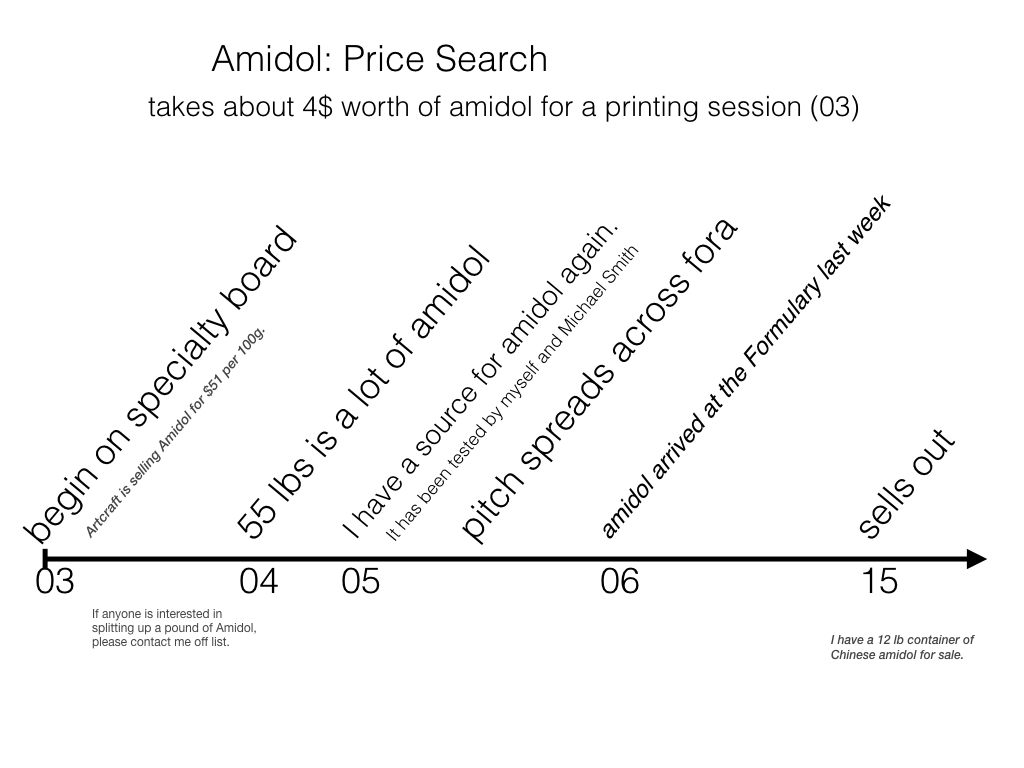
It took 3 years to get the amidol. A lot of hours, effort away from that drive toward meaningful art. It was 9 years later that G. Davis sold off the big barrel. Hope it was worth it. Was he just converting excess to cash, or taking a wiser cash position of a failed dream. Why couldn’t Bud at formulary take it? Probably because they couldn’t sell it either. There is no magic in leftover history, not even the remains of chemical induced zealotry .

Why Oh Why

their motivation wasn’t to save money. that may have been a rational catalyst, but the effort was maintained by some other commitment. Even the commitment to save money was prompted by their need to use the product. What was that need+drive is a much more interesting topic to me

The time and social energy expended had to have some reward, otherwise they are just drained, wasted flow away from an esthetic drive. The simple fact is that the work of Smith and Chamlee is easy bake – the questions they are solving are elementary. Davis has provided a small set of results that edge into beginning terrain, but they quit, having no updates or expansion in years. Perhaps his energy failed him – his techno quest faltered, faith failing him. His sig lines call us toward biblical lands of Matthew and salvation – hard to hold onto a barrel of hair dye if Jesus is calling the faithful and you’re left behind.

take aways:

  • No silver bullet. No magic christian.
  • In search of price. Searching for the silver bullet.
  • Silver users in search of the perfected cheap bullet.
  • After the magic bullet instead of the magic.
  • buying their magic instead of making it.

References & Notes:

amidol supply:

people:

webionaire links AMIDOL CHLORIDE PAPER

[1 of 3: Nov 6, 17]