The Written Web

exists, hypertext, however,  not so much .. The written web replaced the blog. The blog was managed by a person who traveled from blog blog by links.. now those written pieces are hosted on commercial space.. you provide the filler to their ads or you buy off the space…

Facebook doesn’t seem to permit the buy off; you will never own any piece of Facebook .. that’s also the path of Reddit..you are filler. . Substack you buy, as you can with WordPress..

The commercial web gave you ease of technical and took away your rights of privacy and profit .. you no longer have control because the technology has control… The things of the world have always been the world; owners of the things , even if they are digital things, own you

TELLING TALES

again and again. Making them taller, making your shadow longer. Done to impress the civilian, the non-participant, the one on the sidelines. Making a grand stand.

The difference between the part-timer and the full-timer. The committed and the interested in getting a story to tell. A tattoo for table talk. These aren’t scars, the are scarves.

Much of this can be seen in all message/gossip boards.. both among the “bro-vets” and the pho-photogs. As much about glorification of their small efforts..

They bought the boots, the perfect laces, compass and map; have taken a course on following course, even going so far as hiring a guide, once. And, now, the laces are knot free, the map is in a drawer, somewhere. 

The online answer boards are the ending gasp of film, chemical lab photography. They wouldn’t believe this. They don’t believe it. How could they be the ones killing what they want to survive. With error. Error of fact. By error of purpose is the greater weight the new would have to overcome. 

Why Didn’t You Make Dye Transfers

Everybody loved dye transfer. Nobody made them. Why? This century, this time span one and all bemoan the death of a friend they never knew. Never even visited.

  • supplies were a phone call away
  • documentation was available free, or for minimal charges
  • workshops were held at getaway photo shops.
  • several colleges held courses
  • trade schools were in major cities, or by mail-order

A simple enough question . with likely very few answers — honest, introspective responses.

The obvious response: there aren’t any materials . What about when there were — why didn’t you buy the Efke film? Assuming you were an adult in 1990, why didn’t you buy Kodak dye transfer material ?

And for those of you who did buy the materials: why didn’t you use them ?

Continuing along this expansion, for those of you who bought Materials and took a workshop, why didn’t you use dye transfer as your print process?

If you were drawn to dye transfer enough to buy the materials and take the training, why didn’t you expand your skills and become a die transfer printer?

Why do people buy beyond use : compulsion vs obsession. The ownership vs the authorship. Do they believe themselves stewards?

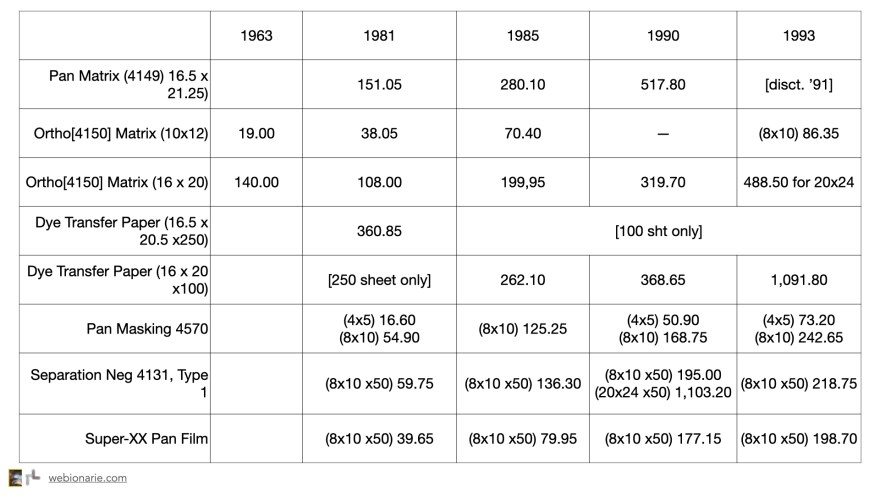
Catalog prices for some Dye Transfer supplies. These are the retailer list price. Labs paid much less.

Consider: Giffen vs Veblen goods. The professional depended on the supplies. The hobbyist didn’t. 1981 was a break year for Kodak’s process. By 1986, the decision had been made to let the process run out the clock. During this time, the larger labs had a decreasing dye transfer business. It was maintained as a prestige factor attracting interest but resulting in few projects. Small specialist labs grew in the eighties; even the best known added other processes to their sales brochure. “Now, the finest Black and White from the finest Color Lab.” — 1987 —

Kodak chose not to license, nor sell the process[ 1981,2] . Wonder why? In their final run of product, the only supply sold completely was Tanning developer. Nope, not even all the matrix film was sold. Not even the Pan Matrix. So it goes…. much of the film and paper was held in store for years.

and then it was recycled. The Fotokemika branded Efke matrix film also saw few buyers.

Maybe there is a market for the Coffee Mug, the Trucker Hat, the Film Vest… not the film… Sell the tchotchke, maybe the tattoo, no need for the mats and blanks.

Monthday

As the month rolls over, I charge the ‘tronics carried on my walks. These guys are a decade old, which seems forever. The covers are wearing. Adhesives failing, but only to a point, a physical pressure point — where my hand has made a mark. The cliche of using objects.

I have multiple batteries which I cycle thru the charge-use cycle. Much of the work from these serve as prompts — training my eye-foot coordination. If my digital comp skills were better, my time in chair more patient, then I would use them in extended form. As soon as I write that, I feel the need to grow. Plant myself into learning, meaning, disciple into effort until a solution happens. Perhaps.

A bit of Burke’s [5/5/1897 – 11/19/1993] grammar: the PENTAD — act, scene, agent, agency, and purpose

  • act: “names what took place, in thought or in deed”
  • scene: “the background of the act, the situation in which it occurred”
  • agent: “what person or kind of person performed the act”
  • agency: “what means or instruments he used”
  • purpose: though not formally defined like the others, this is the motive.

Osborn expands this: “… a truly rigorous attempt to account for a single work on the grounds of poetics alone should force recognition that it is necessary to go beyond poetics-in-particular to language-in-general…”

Back to Burke: ““any nomenclature necessarily directs the attention into some channels rather than others. This can be obvious, such as how different academic subjects direct the attention, or more subtle. Burke illustrates the latter point with an example of how photos of the same objects using different color filters reflected and deflected his attention in different ways, depending on the filter “ [ concept is: terministic screens]

Ref:

  • Osborn, Neal J. “Toward the Quintessential Burke.” The Hudson Review 21.2 (1968): 320.
  • Burke, Kenneth. Language as Symbolic Action: Essays on Life, Literature, and Method. (Berkeley: University of California Press, 1966) 16.

Theory will not make pictures. The obvious reason I take walks is to enter the think, walk, do momentums.

Your turn.