check batt day

One must from time to time attempt things that are beyond one’s capacity.”-Pierre-Auguste Renoir 

the first of the month; time to check electronics in the studio and the lab.

in or out? when you put the camera, meter, whatsit away, what is your cleanup and storage protocol? Perhaps you haven’t considered the question. When you’re done, do you leave stuff in the bag or on a shelf.

In my commercial world, the process of ending one thing was prep for the next.

In the age of the professional studio every assignment had a set up and a teardown time. cameras along with all equipment were cleaned at shoots end; repairs needed were noted.. before a shoot the equipment was checked; this included batteries for those portable electric items. items which were stored a long time while being assumed always at the ready were checked monthly; batteries being swapped out, freshly charged ones being put into service. For Equipment cage operations someone in charge of the cage followed the procedure with every equipment check-in and check-out. Schools of journalism instilled the discipline in their students which likely spread throughout that industry.

I keep batteries out of infrequently used darkroom equipment, but do keep batteries in the actively used cameras. Lightmeters are not stored more than a week with batteries enclosed. When the meter is being stored, it is stored with its battery put into a bag-box with a tag marked with dates. If the meter is going out pn location it is tested with vtvm. Field kits always include tested spares.

Equipment Poor:

It is also a time to prune, to dead-head equipment. If it isn’t being used, since I’m not a collector, and it is a dust collector, I consider passing it along. 

Emergency in the gun-belt states. Most of the US experiences competitive power failures. So the Free Markup has devised the house-batt. I keep batteries in flashlights; along side these are 8-hour candles. And so it goes.
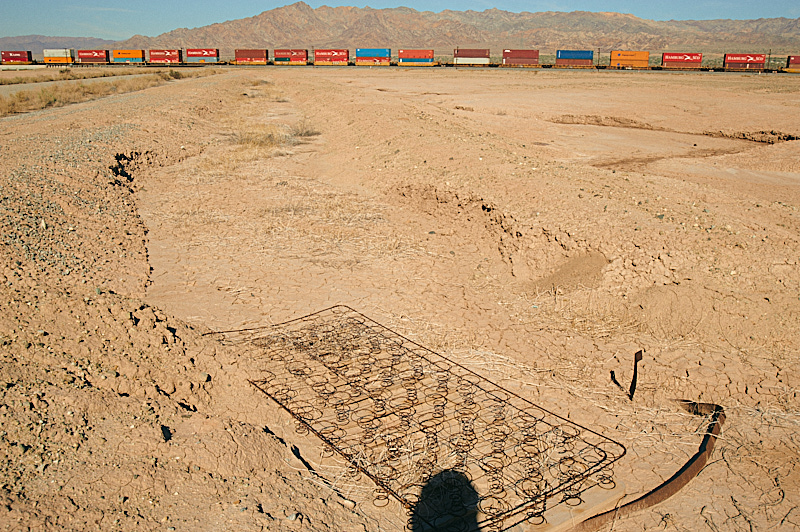
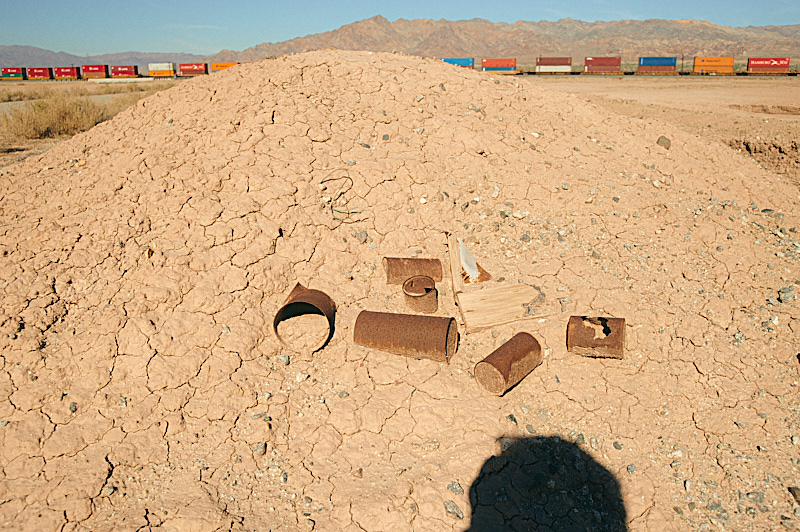
There remains the ground of difference between being awake and being aware
Why Didn’t You Make Dye Transfers

Everybody loved dye transfer. Nobody made them. Why? This century, this time span one and all bemoan the death of a friend they never knew. Never even visited.

  • supplies were a phone call away
  • documentation was available free, or for minimal charges
  • workshops were held at getaway photo shops.
  • several colleges held courses
  • trade schools were in major cities, or by mail-order

A simple enough question . with likely very few answers — honest, introspective responses.

The obvious response: there aren’t any materials . What about when there were — why didn’t you buy the Efke film? Assuming you were an adult in 1990, why didn’t you buy Kodak dye transfer material ?

And for those of you who did buy the materials: why didn’t you use them ?

Continuing along this expansion, for those of you who bought Materials and took a workshop, why didn’t you use dye transfer as your print process?

If you were drawn to dye transfer enough to buy the materials and take the training, why didn’t you expand your skills and become a die transfer printer?

Why do people buy beyond use : compulsion vs obsession. The ownership vs the authorship. Do they believe themselves stewards?

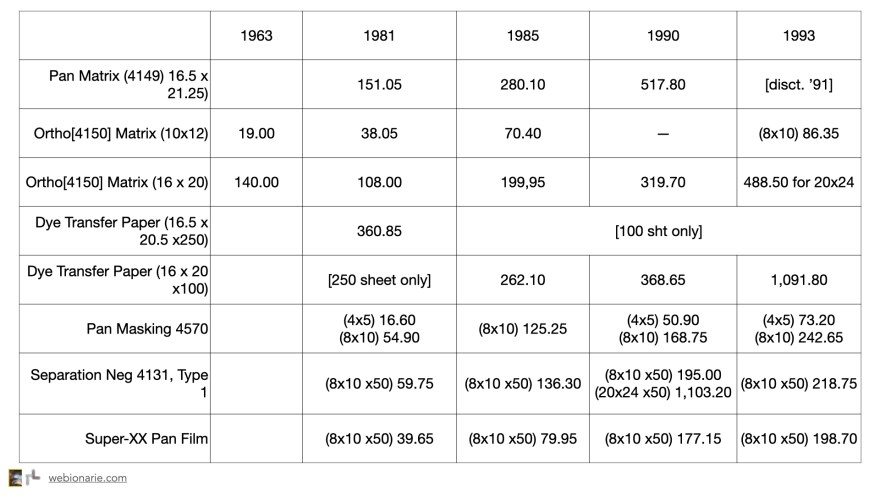
Catalog prices for some Dye Transfer supplies. These are the retailer list price. Labs paid much less.

Consider: Giffen vs Veblen goods. The professional depended on the supplies. The hobbyist didn’t. 1981 was a break year for Kodak’s process. By 1986, the decision had been made to let the process run out the clock. During this time, the larger labs had a decreasing dye transfer business. It was maintained as a prestige factor attracting interest but resulting in few projects. Small specialist labs grew in the eighties; even the best known added other processes to their sales brochure. “Now, the finest Black and White from the finest Color Lab.” — 1987 —

Kodak chose not to license, nor sell the process[ 1981,2] . Wonder why? In their final run of product, the only supply sold completely was Tanning developer. Nope, not even all the matrix film was sold. Not even the Pan Matrix. So it goes…. much of the film and paper was held in store for years.

and then it was recycled. The Fotokemika branded Efke matrix film also saw few buyers.

Maybe there is a market for the Coffee Mug, the Trucker Hat, the Film Vest… not the film… Sell the tchotchke, maybe the tattoo, no need for the mats and blanks.