We walk around, make our way to or from something. If we look with easy eyes, arrangements, occasions, even sounds prompt attention. Further inspection, reaction. Most of us, for most of the time are more involved with something else to see what is seeable. People drive thousands of miles without seeing what they drive past so they can do what they think is expected; do what the great-one did.
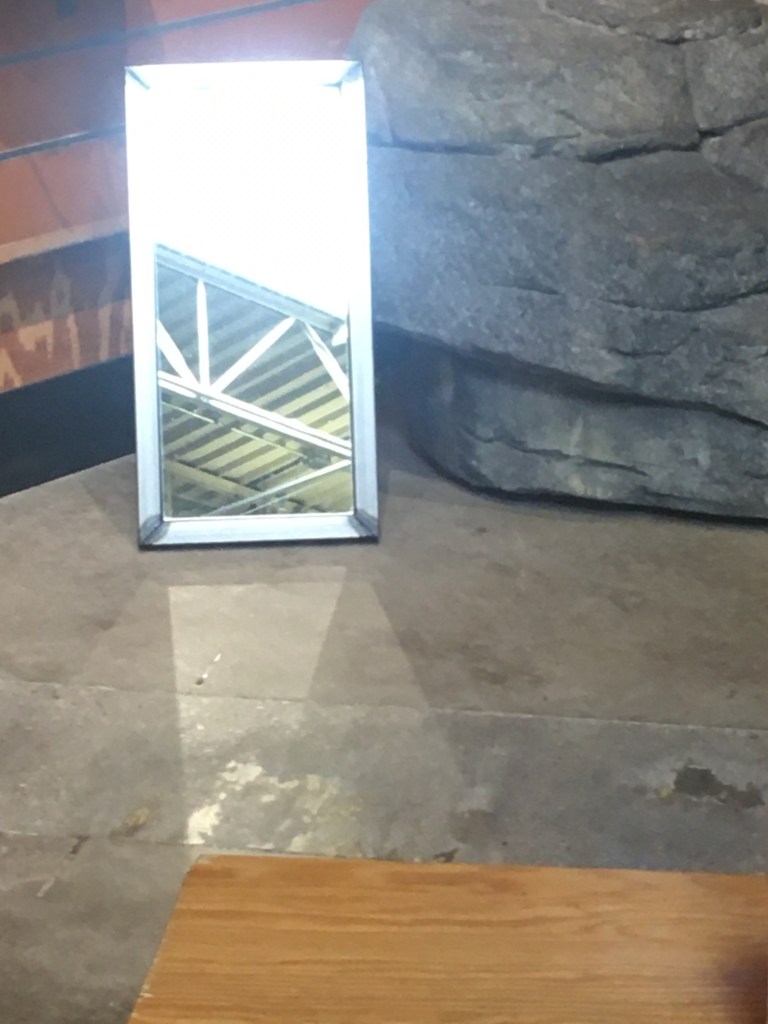
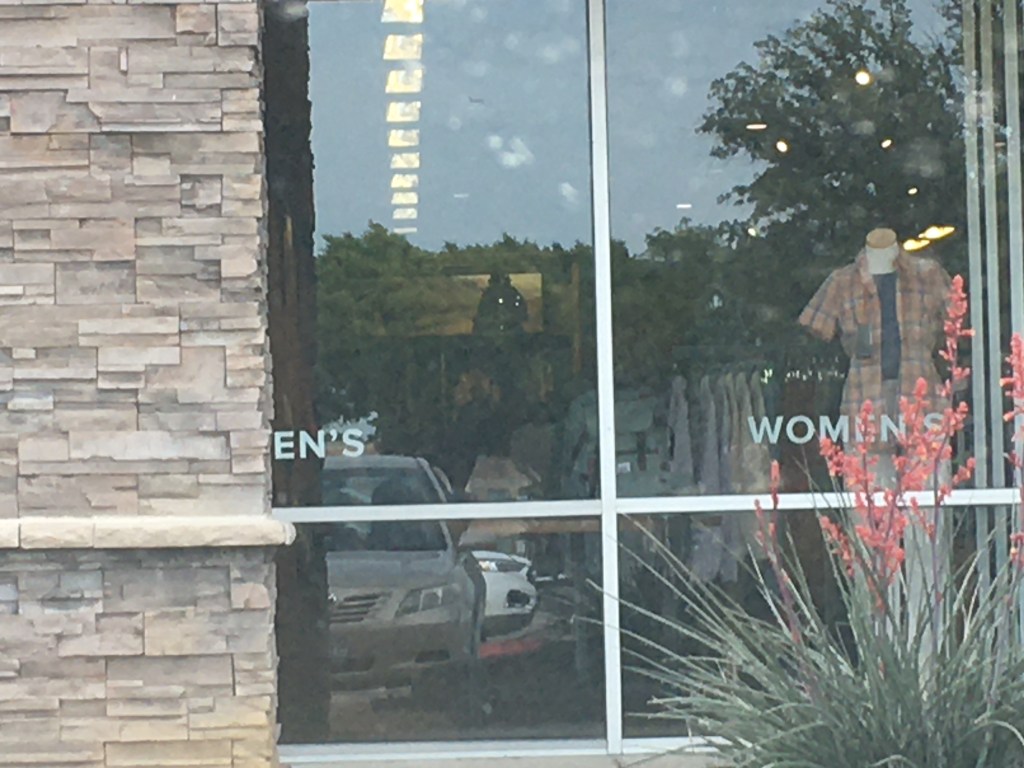
Three instances of misses, and the effort of making them. These are all part of the infinite roll. They aren’t edited; not even change of exposure. They remain direct phonecaptures.
I notice something — not a snake. has a shiny part. So, I make an exposure. This assures that the angle, first surface of the render is made.
walking closer, make another exposure.. it will need post to succeed. As it is, it fails.
Inside, a mirror and shop display. It must be something. Feels like it, because of the light patterns. As I adjust my position things arrange themselves. Three tries. I’m tempted to move the mirror; even the bench. I don’t. This isn’t a studio shot. If it were, I’d feather the lights. Make changes to the surface of the mirror. Dulling spray applied locally.
Three it didn’t work. If it had been on film no chance of getting that image — film that could have done it would be cinema film.
Outside; windows with words. Breaking the scene into one word pulled apart. It fails. The bush that would do the main “obscuring” isn’t dense enough. This could be retouched. Not certain this is worth the effort, given the format of the file — too low pixel density. Is it worth the return with the Phase Back?
We can see before we can walk. We can walk before we read. Everything leads us toward understanding.
If you think it might be something, make it into that something. If you can’t; if it just doesn’t work, make the effort anyway, otherwise, you won’t know, and if you don’t know, you don’t learn. The main learning isn’t about the how of things. It is the other part of things.
How we begin something sets limits. We learn by getting beyond those first limits.
Upon considering an action, a life of something – what we think we will do with and for. Will we get to something beyond our not knowing stage. Smallish, naggings from my past. How we got here? questions.
I wanted to make pictures, quickly. I even thought that they could be the way to make a living, but I wanted to make color pictures. This was around 1957. Color was complex, so complex that it seemed unexplainable, almost undoable. It was something for big labs, many people, much money, and probably requiring a long training time. Not something to do for an impatient teen. So, how did I learn to make dye transfer prints?
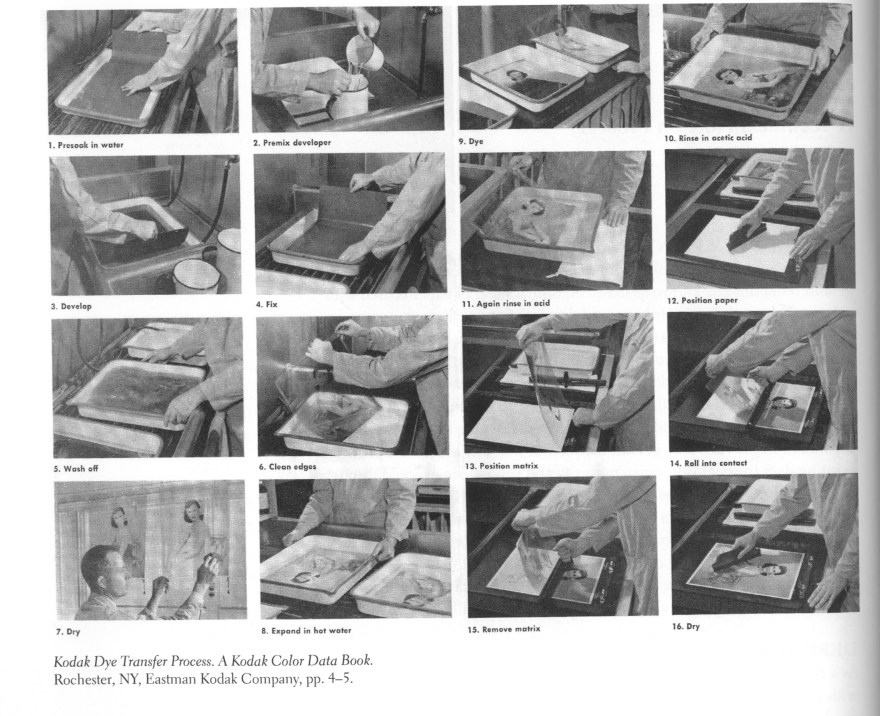
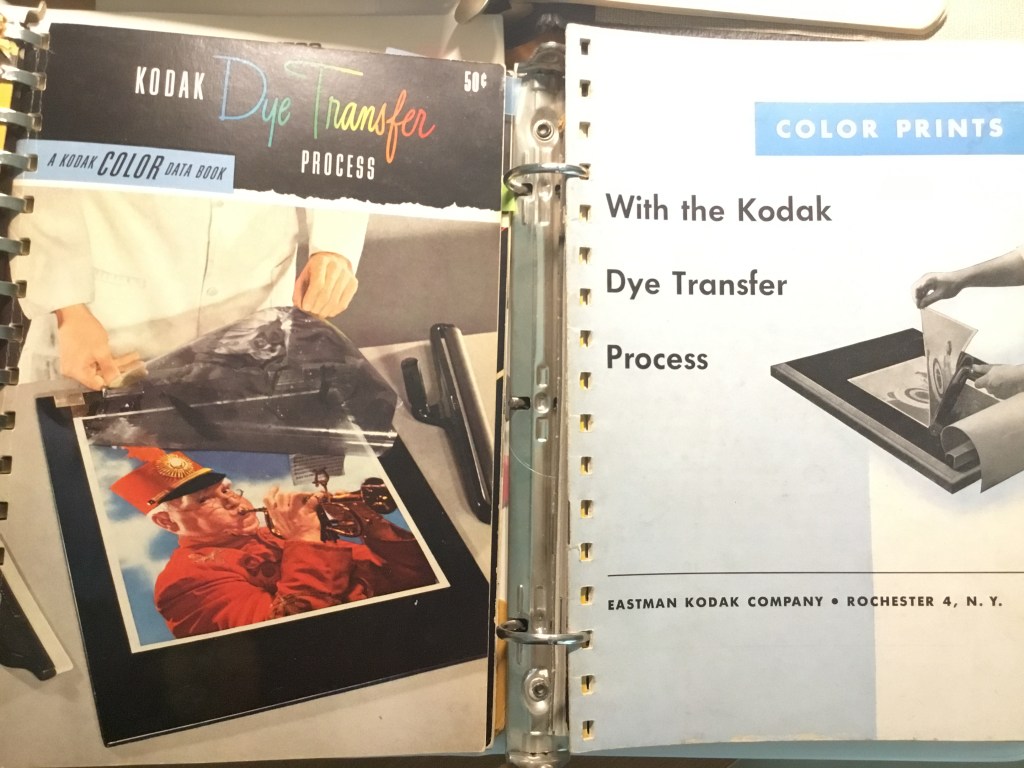
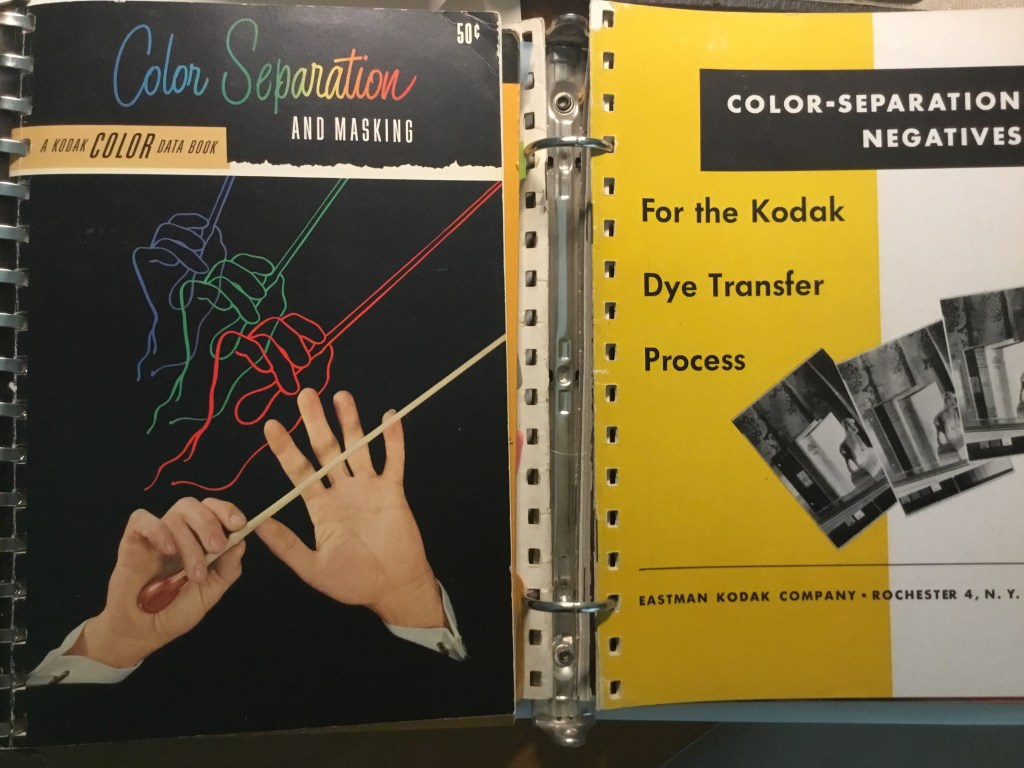
A Kodak Color Data Book
I read. The first things were Kodak publications. Data books. My parents let me build a darkroom in the basement. I built an enlarger using guidance from a magazine dated in the 30s. It worked enough for me to begin the process of gaining skill enough to understand the Kodak Dye Transfer information books.
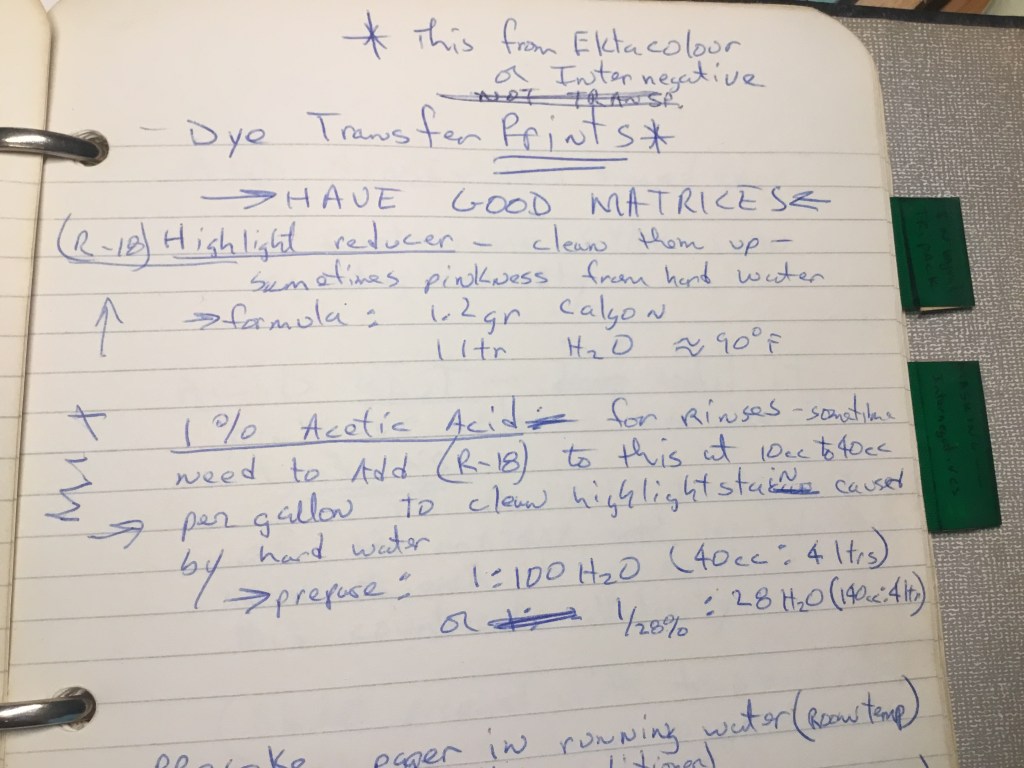
Supplies were extremely expensive, and difficult to get, not every store carried them, nor could even figure how, what to order. At last, my father stepped in — seeing that I was doing chemistry, and science things, he figured it was a good thing. He took me to work, introducing me to the head of the photography lab, where they made dye transfers. I spent the day watching. Walking away with some supplies, but more importantly, a set of worksheets detailing the steps to make prints. There it was, in step by step, easy form, what to do, when, how. No why, but even as a teen I understood that was where I came in. Why is the basic question of life. Everyone begins with that. Everything grows with that.
Pictures are the point.
With my first success; the prints looked like photographs. Photographs that others were making. I was proud, but not satisfied. It seemed so much work; it had taken several months to get to a point that it seemed anyone could get. Just another badge; a box ticked. So, I changed what I was looking at; going back to the origin of my interest. An Outerbridge book teased me into further experiments.
Still a teen, it hit me that dye transfer was a dis-assembly process. It took things apart. The photograph is pulled into separate components. What happens if we put them back, assemble them, in the wrong way?
Bang. I had a rush of discovery, of seeing another world; this world another way. I’d invented a new form.
Except, I wasn’t the first. What was a first for me, wasn’t the first for photography.
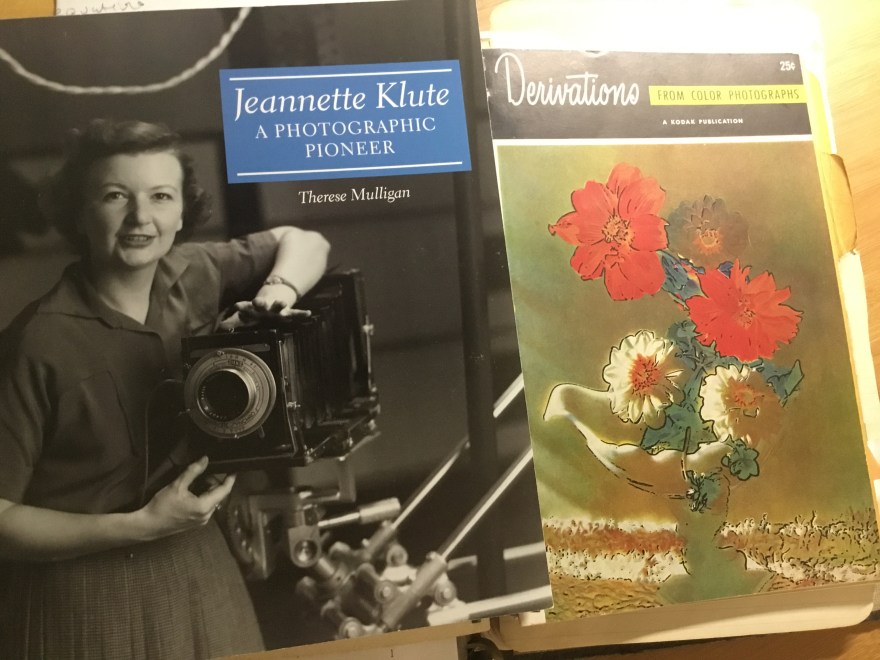
Jeannette Klute had gotten there before me. Gotten there by a decade. I was deflated, then delighted. Someone else had discovered the same principle, some of the same patterns. Eventually, I contacted her. After I’d worked as a dye transfer printer, I visited her at Kodak. She was enthusiastic, suggesting I visit Henry Holmes Smith to attend college. It was good advice. I did visit him; while he was appreciative, he didn’t extend a firm hand. I asked myself the standard question: why go to school to learn what I was already doing? I was making very good money. I ignored the draft. And so it goes.
Jeannette Klute (1918 – 2009). About her, a thin book of her life. More importantly, her book for Kodak. She was the secret person for dye transfer for those of us in the field. She could answer anything. kodak 1938 – 1982
People are the real process.
Which brings us to the nature of assistance, or diversion. In this century, learning some things means asking questions of invisible experts, some of whom may know the answer, most of whom don’t even understand the question. Certainly don’t understand the partial question, the hard to formulate early questions of someone new to their journey.
They will answer their question; get you to their destination. You will learn to make their pictures.
Today, this century, forums provide the QA space. Some unknown will answer some unknowing passer. Most of the questions are about prices, definitions, so are easy to answer. Most answers are as useless as the questions. Yet this is where the novice gains first answers to their first questions. I am thinking of two such people; I’ll call them C1, and C2. Each began on different analog photography forums. C2 began on a much more specialized forum, going so far as to limit the camera used. C2 has grown up there; now making pictures very much like most of his teachers. C2 learned to make his pictures, well, he learned to make the pictures others were showing him. That is the most common route. You ask those doing what you want to do. The easy: “how.”
I see the best minds of this generation running down the web asking only “how”.
C1 is from the chemistry, emulsion forum. He asked much more complicated questions; many based upon wide reading of a specific topic that interested him: dye transfer. He provided in-depth notes of his learning; going as far as experimenting in a new direction of making matrix emulsions. Certainly new to the readers of his notes. He has met some skilled emulsion makers. Skilled enough to be able to take him back to the Kodak standard pathway. After a few years on his own, he moved to Rochester, becoming an intern and preparator at Eastman House. Recently, after reviewing his online work, I realized he’d been inspired by Jeannette Klute, also.
C1 leaned much; so much he left his picture quest. Or, perhaps that changed, too. He makes different pictures, giving up on his dye transfer interest. He ran out of drive. He was asking the right questions, seemingly of the right people. It’s just too bad they weren’t picture people.
Craft, at first, seems to block progress. Later, it either lifts you up, or holds you back, beats you down. You won’t know which until much later. The people guiding your craft growth must insure that they don’t block your imagination; at the beginning, image is as fleeting as a dreamer’s memory.
following another’s footsteps makes you a tourist not a guide
Arriving Late
You may miss the plot, the arc of what came before, and think the ending is the story.
//
You begin in the footsteps of others; you walk behind them before you make your own path. you follow their path, retaking their footsteps, you learn how to do it: you follow the technical. the technical, if it’s amidol and azo, lead you into a narrowing market space; an expensive place in which you have to solve technical and the economic, before you can set yourself free enough to solve your own problems; the problems that you define. This dalliance keeps the romance without requiring esthetic commitment. To keep yourself from realizing this, you rationalize the affair, calling it Printmaking.
The Printmaker Excuse
thinking that the problem to solve is just a printmaker one, your task becomes making yourself into a printmaker. this is codeword for saying you don’t have to have an image concept, an origin aesthetic; rely upon an aesthetic concept that’s been done. You can follow the prepared guidebook. Picture types come prepared with payment. you already know what you’re going to point the camera at. Maybe a rock, or sunset, a girl..
How bout a girl on a rock at sunset
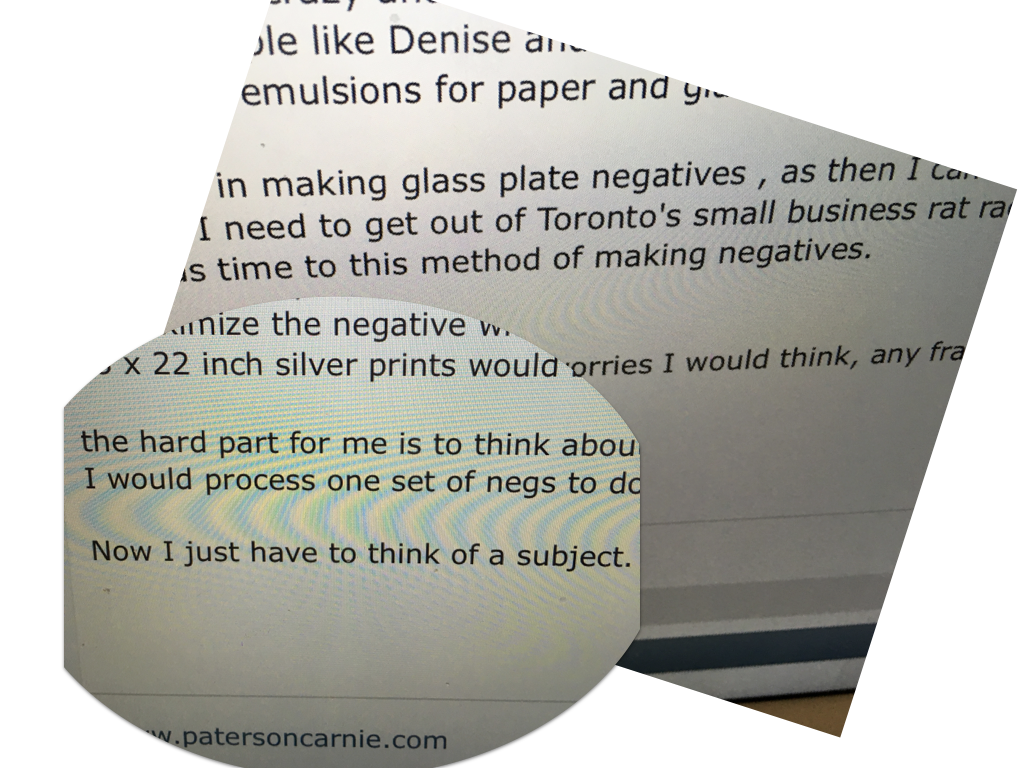
Unless you are a Carnie. Most long time participants in online photo forums limit their discussion to method and technique. They never understand this limits their growth. Carnie is one longtime dedicated participant. He serves as archtypical printmaker. As he notes: Now I just have to think of a subject.
Simple Complex
The simplified process of Weston becomes a complicated process without a manufacture. Mistaking the wand for the magic. No one bemoans the end of Weston’s light bulb, neither do they ask the type of contact frame used. Charis on a dune, with perfect drop shadow is more important than bulb, camera, developer, or paper. Translation is never better by reading a more accurate dictionary.
Take What You Need
Rather than taking from Weston the specifics, take the general, the bigger constant — work simply, but work a lot. Use what is at hand until it runs out. Then find another.
What Weston did was point his camera well. He, also, was first on the calendar; it was his footprint you saw on the dune. If you’re going to follow, follow the awareness, not the technical.— that is the artist’s move, not the salesman’s gambit.
References & Notes
early printing was platinum requiring contact prints, which he abandoned when it became scares and expensive. He switched to Azo and Amidol in California. [Newhall 1984, p. 110.]
weston bad portrait studio .. retail portraits need retouching . big neg makes easier
contact prints on slow paper
paper no longer produced
weston switches paper, but keeps camera
improves exposure quickly adopting Weston meter. more single negative exposures. cheaper, easier field work.. more images
At Pt Lobos he worked on the edge of the coast.. a long distant horizontal — down was detail, up was the line — the distance marker.



 Unless you are a Carnie. Most long time participants in online photo forums limit their discussion to method and technique. They never understand this limits their growth. Carnie is one longtime dedicated participant. He serves as archtypical printmaker. As he notes: Now I just have to think of a subject.
You must be logged in to post a comment.