
Everybody loved dye transfer. Nobody made them. Why? This century, this time span one and all bemoan the death of a friend they never knew. Never even visited.
- supplies were a phone call away
- documentation was available free, or for minimal charges
- workshops were held at getaway photo shops.
- several colleges held courses
- trade schools were in major cities, or by mail-order
A simple enough question . with likely very few answers — honest, introspective responses.
The obvious response: there aren’t any materials . What about when there were — why didn’t you buy the Efke film? Assuming you were an adult in 1990, why didn’t you buy Kodak dye transfer material ?
And for those of you who did buy the materials: why didn’t you use them ?
Continuing along this expansion, for those of you who bought Materials and took a workshop, why didn’t you use dye transfer as your print process?
If you were drawn to dye transfer enough to buy the materials and take the training, why didn’t you expand your skills and become a die transfer printer?
Why do people buy beyond use : compulsion vs obsession. The ownership vs the authorship. Do they believe themselves stewards?
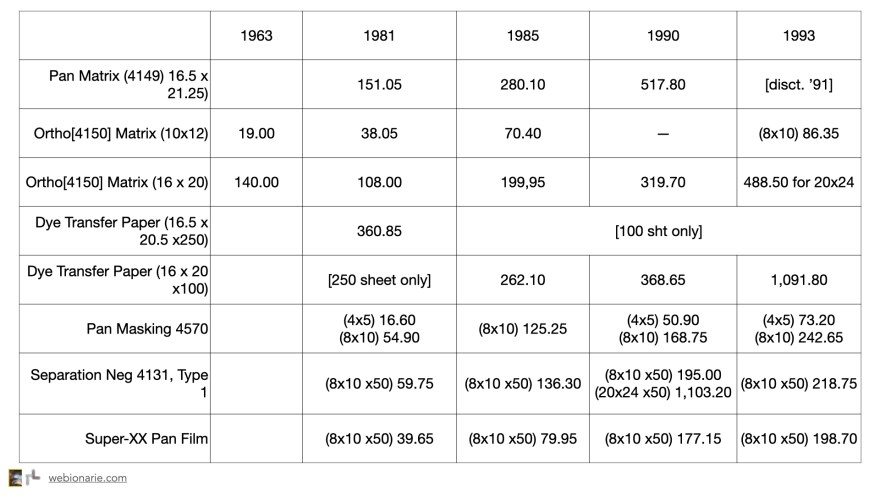
Consider: Giffen vs Veblen goods. The professional depended on the supplies. The hobbyist didn’t. 1981 was a break year for Kodak’s process. By 1986, the decision had been made to let the process run out the clock. During this time, the larger labs had a decreasing dye transfer business. It was maintained as a prestige factor attracting interest but resulting in few projects. Small specialist labs grew in the eighties; even the best known added other processes to their sales brochure. “Now, the finest Black and White from the finest Color Lab.” — 1987 —
Kodak chose not to license, nor sell the process[ 1981,2] . Wonder why? In their final run of product, the only supply sold completely was Tanning developer. Nope, not even all the matrix film was sold. Not even the Pan Matrix. So it goes…. much of the film and paper was held in store for years.
and then it was recycled. The Fotokemika branded Efke matrix film also saw few buyers.
Maybe there is a market for the Coffee Mug, the Trucker Hat, the Film Vest… not the film… Sell the tchotchke, maybe the tattoo, no need for the mats and blanks.

You must be logged in to post a comment.