techday: Fog isn’t

crossover.

Knowledge stays in the fog of the past. Terminology that changes isn’t written in dictionaries of the future. Since those who use the term have left the field, those who were never in the field, those who weren’t trained or apprenticed, the story of original meaning, that of direct relationship, those people no longer enforce the meaning.

A crossover was a place, a part in a machine. Just as film machines at a place where the racks could be pulled out or pushed back into the line for additional processing. Pulling or processing from the soup.

Upon the diminution of film as primary image former, commercial labs ceased. Small labs can survive in small markets, erratic markets; dead cat bounces feed a starvation diet.

What (who) remains: people who could have worked in the big time but chose to take a hobby land approach. They learned from the magazines… those who don’t understand the process, those who look for why it won’t work; like a poorly trained law-clerk.

These people hear a word, and cling to the new found term, in hunger for a position of knowledge among others in the darkening room. They apply it widely. To almost every approximation, the word can be fit, it will be chived into use.


Kodak filters for flashing

FilterColorPurpose
47 or 47Bbluereduce yellow density in print
44Acyanreduce red density
58greenreduce magenta density
32magentareduce green density
25 or 29redreduce cyan density
32yellowreduce blue density in print
effect of color flashing

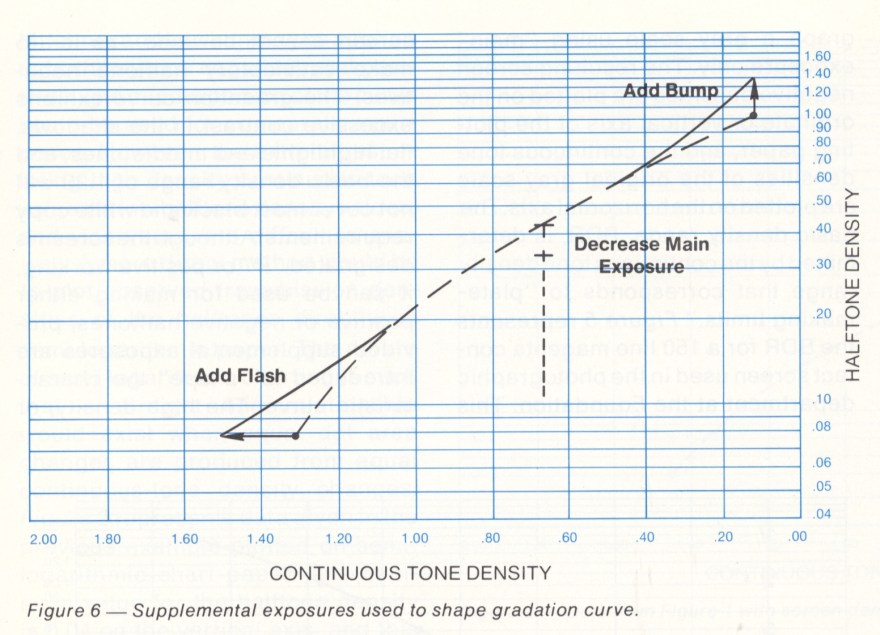
Darkroom lab exposure have 3 stages of exposure possible. Think of them as being in relation to sequence of exposure to the unprocessed emulsion. An exposure before the image exposure, the image forming exposure, and the last being after the image has been exposed. These exposures combined are used to shape the curve shape of the finished image. This method was a key skill in pre-press labs. It was also used by commercial dye-transfer labs to a lesser degree, mainly because few labs had staff skilled in both commercial processes. Industry divided the knowledge into market segments, not the schools.

  • bump [HL] exposure is short exposure without mask or screen
  • flash [S] exposure is short exposure prior to copy, mask, or screen.. also a Raw, or Blank exposure
  • main exposure controls location of midpoint as well as mid-tone scale. Developing is used to provide range of these scales.

In practice, this required multiple (2, or 3) light sources. One was the enlarger, the other(s) were lamps, likely modified to hold filters. In the typical shop, with such a setup, we routinely altered the crossover points of a characteristic curve.

It wasn’t a bad thing, it was routine, controlled, essential…

for more see
overnights: oct5 ’23

[santamaura] failed engineers need singular meaning words.

failed: what’s another word for early retirement. redundant. not essential to the future of the company. past production of such insufficient value to warrant retaining for future efforts of ” air industry.” Not able to define a future in the company. Time to write letters on concrete.

see the sun without definition. why does it being ‘meaningless’ (meaning too many things)( he hates variables, demands equations of constants) why does meaning less cause such anxiety.

A: because you are excluded.


you could -- interactions changes
types: opinions become anti rather than of positive
-- woodburytype phd: asks, can't get answer cause braggarts -- without info, gossip from other's opinions
no pictures: no way of comparing. whose brag is bigger
--
the diffraction distraction -- a diffraction function
.... can't show; can't say ... no way of exchange... limited vocabulary -- small, shrinking dictionary.
the flight of the bumbling bee


factual + conceptual erros — blindness :: resentment : division. not letting them win

[viva voce \ a precis ]

FOCUS: Todd Walker

gallery notes from 70s. origin story of photography entering the world of walls for the people.

San Francisco early years of photography into art gallery. the wall and the bins were filled with unknowns, and early risers. Todd Walker was making a transition and name. His work was an early pathway into the alt-photo world. When alt meant “not Kodak” and a precedent to Post-Industrial photography.

Focus Gallery was founded by Helen Head Johnson (1916-1989) in 1966 on Union Street in San Francisco. She had worked for the de Young Museum as public relations director. She decided to open a “people’s gallery.” Over the nineteen year span of Focus Gallery, she presented over 300 exhibitions, showing work of more than 500 photographers. She closed the gallery in 1985.

Grapestake gallery was functioning in the period 1970-1986.

I remember the bins for photographs. Bins had prices. Prints were in plastic, much like a record store.

Helen Johnston left her private photography collection to the de Saisset Museum, the Oakland Museum of California, and the San Francisco Museum of Modern Art.

The show prior to Todd Walker’s was Eikoh Hosoe’s.

  • 1969, Aug :” enclosed is check for sale of portfolio at $9.00 less gallery commission of one third… Glad you are not dependent on our sales to keep the wolf from the door! I always say.. can promise no sales.. but certainly can promise exposure.

  • Sept 1969, from Todd: “Thank you for the check and most especially for the invitation to show in your gallery. Do you have a drawing or measurements of the gallery space so I can plan the number of prints and how they might fit?”

  • 1969, Nov 14: “dates for exhibition would be Feb 3-28. We instal over the weekend…. the other show will be by Tom Baird…we could use about 40 to 45 prints….. Am wondering what you plan to show? Would it be the same show as was “Camera Work?”

  • Dec 1969, from Todd: “I would also like to print the announcment and will get it to you two weeks ahead of time. I think the show should just be called Photographs by Todd Walker.

    FG: [announcement photos] if you have both abstract and representational probably representational would be better.. … printing enough copies of the announcement to send us copies for our mailing list of about 400 mostly poster sources and regular customers?

  • Jan 6, 1970: Received of Todd Walker. three portfolios and a sample to sell for $30 less gallery commission of one third and 450 announcements. [HJ]

    [HJ] We don’t have them (openings). However if there are photographers that you would want to see and might not have a chance to see them otherwise we could arrange one.

  • Feb, 1970: [HJ] … and I’m so glad we have the explanation for the techniques. There has already been much favorable commen on it. … Could you send us about two more press pictures? The one most representative of the show… The landscape is just too dark for newspaper reproduction and besides I’m afraid they would think it was not really representative of your show.

  • June 1970: [HJ] … I hear so many wonderful reports of what you are doing.. how exciting is your present work. We were fortunate to have had it at Focus. .. enlcosed is a check for the sale of the 16 print portfolio (30) less gallery commission and thank you!

    Aug, 1970: [HJ] Enclosed is check for sale of one of your portfolios … Your show at Focus was one of the best we ever had..

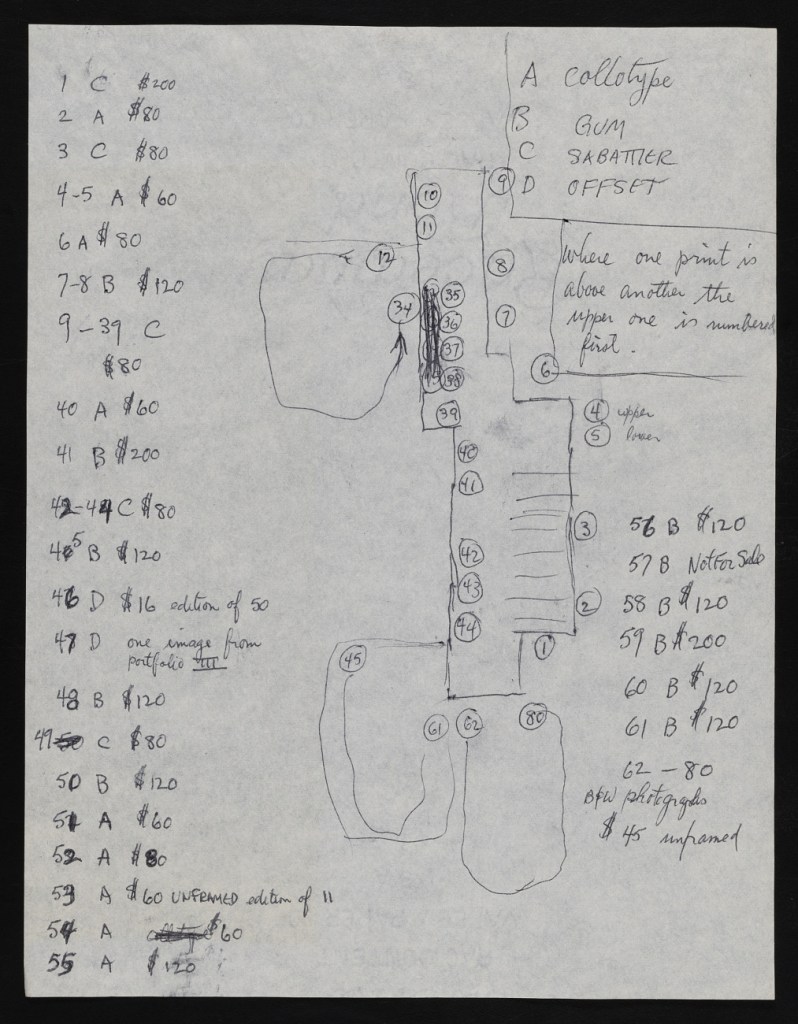
Todd Walker Focus Gallery layout with prices

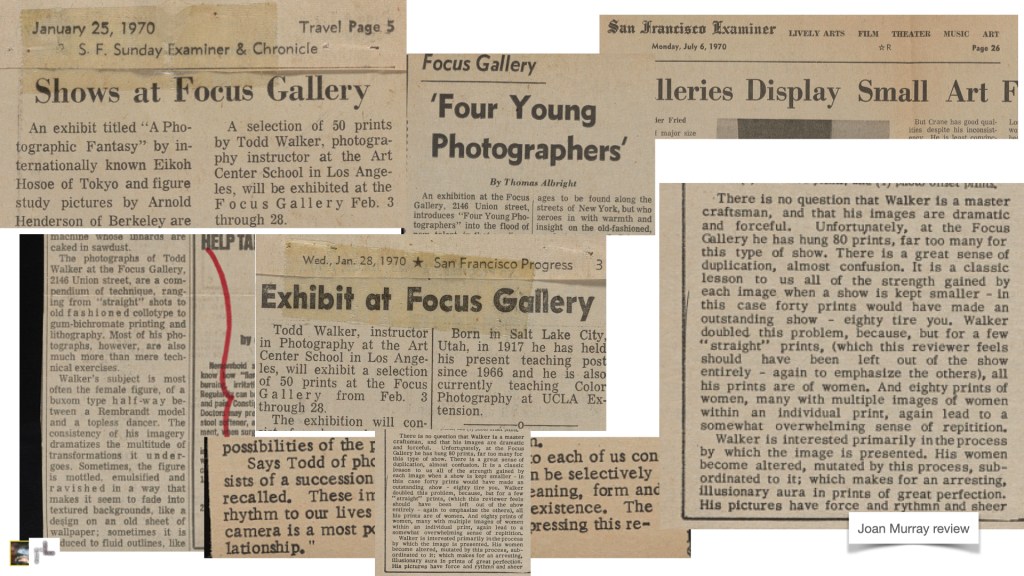
Arts coverage in the 70s was printed in Travel sections of papers. It fell into foundation journalism, being somewhat enlarged form of a Press Release. Some reviews were only that, a re-write for space.

1970 Press clippings; Focus Gallery shows.

Todd Walker: “Reality to each of us consists of a succession of images which can be selectively recalled. These images provide the meaning, form and rhythm to our lives as they relate us to existence The camera is a most powerful means of expressing this relationship.”

Joan Murray (reviewing): ” Unfortunately, at the Focus Gallery he has hung 80 prints, far too many for this type of show. There is a great sense of duplication, almost confusion. It is a classic lesson to us all of the strength gained by each image when a show is kept smaller. … Walker is interested primarily in the process by which the image is presented. His women become altered, mutated by this process, subordinated to it; which makes for an arresting, illusionary aura in prints of great perfection.”