Dead Cat Bounce: Tetenal

In 2018, Tetenal failed causing the photo-world to shimmy and shake. Was this the end, or just a climax in a potboiler.

Tetenal came back only to fail again in 2023. This is the way at the end of life. The crash is never complete; until there is no where else to fall.

Chemistry is the profit of the chemical photography business. Emulsions are there so that chemicals will be bought, used, and replaced. Cameras are there for the lenses and films, etc. No chemical means no chemical darkroom; means no paper. The way is clear. It is just lost in the fog of romantic versions of truth. Few want to admit they are on a dead horse; fewer will put that horse down.

This is not a work-horse, it is only a hobby-horse, as such it will not last. Farriers live because horses don’t have to be made, they do the work themselves, unlike emulsions and XTOL.

Reportedly, Tetenal spent about €500,000 (~$574,000) to acquire the license to produce CD3 and CD4 color developers — and apparently they split the bill with Fuji to save money. That is one of the reasons why Unicolor chemistry, for example, is not available in the E.U. No small company or startup could afford such certification and thus Tetenal is the only manufacturer of CD3 and CD4 within the European Union.

<< from 2018 report of Tetenal’s death.

Kodak relied upon Tetenal for Xtol, HC-110, and ECN chemicals.

Why the company failed with full orders, even backorders… the hopeful thought it would be brought back to life, since there is so much vigor in the “recovering analog community” — like alcoholics giving each other bad advice over bad coffee.

It failed again because there aren’t enough multiples of profit in each sale, and there aren’t sufficient sales to maintain a fully managed industry. Gas stations on the interstate make more money in a quarter than Kodak+Ilford make in a year. Fujifilm is the only company that is built upon a large profit foundation; that is from other sectors of its well managed organization.

Adox is claiming, hoping with that claim, that their ability to maintain chemical making will sustain them. This as they also seem to regularly acknowledge that there is little profit in BW paper. Profits from their chemistry funds their research and development of other product lines (assuming color film).

The arc has been clear for more than a decade: people use roll film intending to scan it. Some are beginning to see the other way.

— If I need a camera for film AND a digital camera to scan that film…. why don’t I skip the mechanical/chemical step, going directly to the digital camera?

Might just be bragging rights. Some claim to life-forces unseen. Anyway, people continue to pray for anther Dead Cat Raising.

See. Stop. Click

We walk around, make our way to or from something. If we look with easy eyes, arrangements, occasions, even sounds prompt attention. Further inspection, reaction. Most of us, for most of the time are more involved with something else to see what is seeable. People drive thousands of miles without seeing what they drive past so they can do what they think is expected; do what the great-one did.

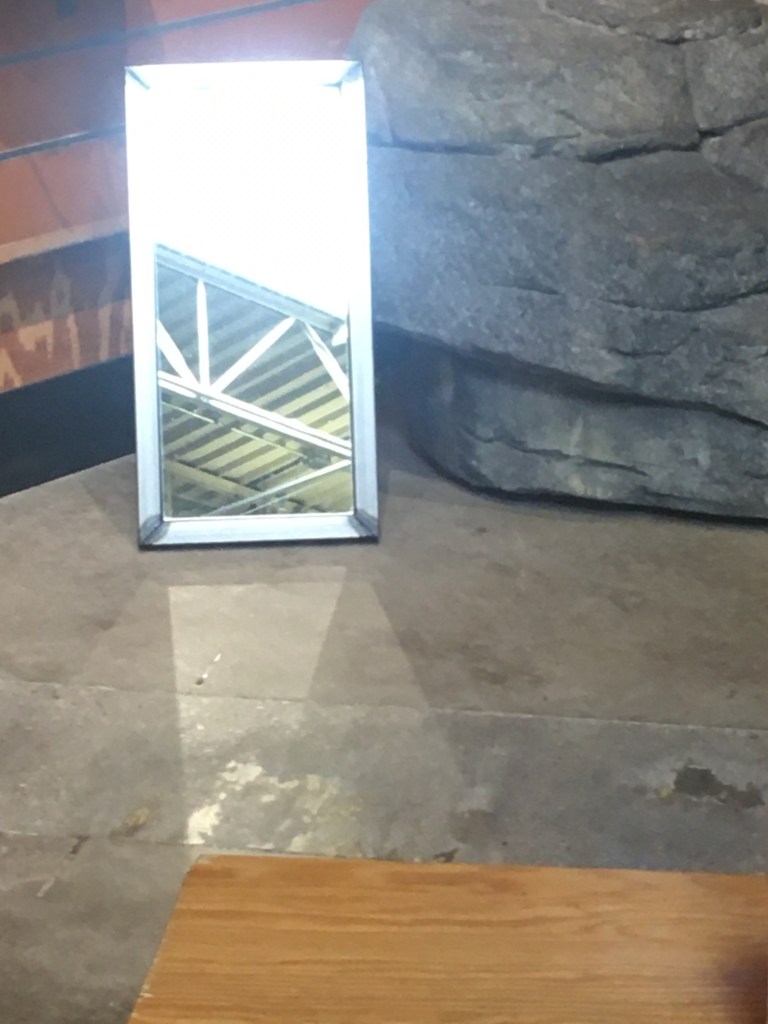
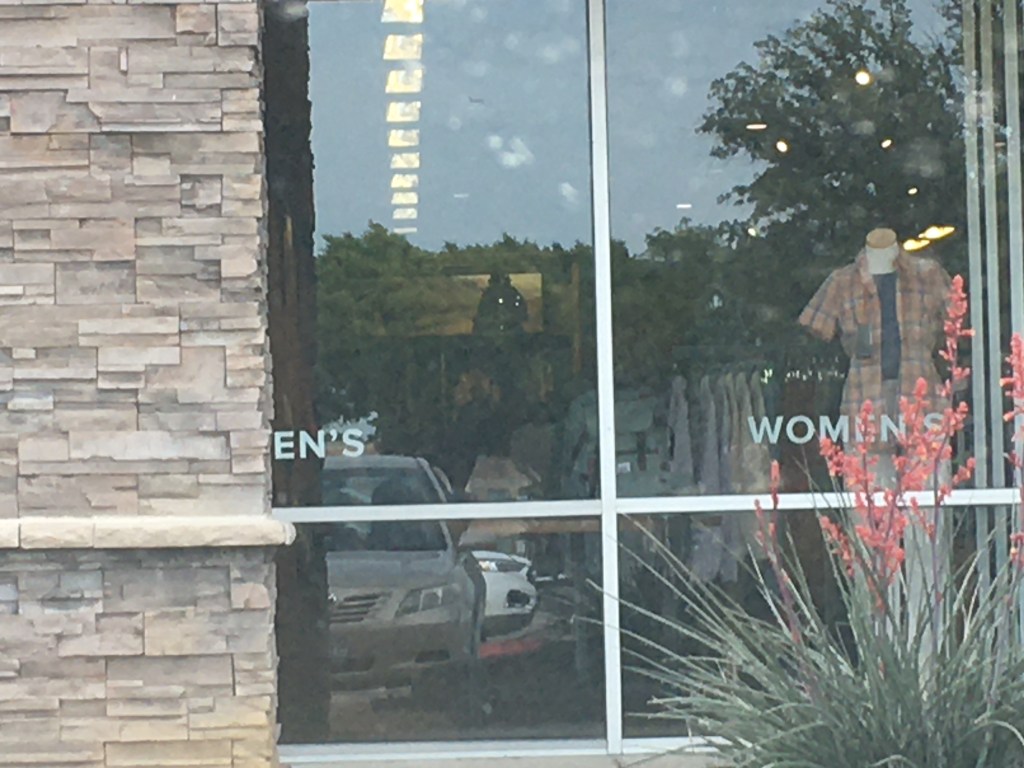
Three instances of misses, and the effort of making them. These are all part of the infinite roll. They aren’t edited; not even change of exposure. They remain direct phonecaptures.

I notice something — not a snake. has a shiny part. So, I make an exposure. This assures that the angle, first surface of the render is made.

walking closer, make another exposure.. it will need post to succeed. As it is, it fails.

Inside, a mirror and shop display. It must be something. Feels like it, because of the light patterns. As I adjust my position things arrange themselves. Three tries. I’m tempted to move the mirror; even the bench. I don’t. This isn’t a studio shot. If it were, I’d feather the lights. Make changes to the surface of the mirror. Dulling spray applied locally.

Three it didn’t work. If it had been on film no chance of getting that image — film that could have done it would be cinema film.

Outside; windows with words. Breaking the scene into one word pulled apart. It fails. The bush that would do the main “obscuring” isn’t dense enough. This could be retouched. Not certain this is worth the effort, given the format of the file — too low pixel density. Is it worth the return with the Phase Back?

We can see before we can walk. We can walk before we read. Everything leads us toward understanding.

If you think it might be something, make it into that something. If you can’t; if it just doesn’t work, make the effort anyway, otherwise, you won’t know, and if you don’t know, you don’t learn. The main learning isn’t about the how of things. It is the other part of things.

American West

when trivia becomes the reason for the gathering. Weekenders, devoted members of the Snobby Hobby discuss work turning to the meaningless, quickly.

It may not mean anything, yet it fills the time of those without much effort.

Let’s get to the work… they can’t. What they can say about their work is how it was done. Even after decades, the conversation is at how-to.

speaking from rumor. once heard becomes the word.

The why-for of considering their campfire stories. Do they propose a mode of looking without understanding who, what it excludes. What, the how and the who they condone (or condemn) matters, perhaps, even more as the world of profession recedes into the past. There are amateurs and then again others. The nature of a field mixed without common ground is my interest.

Richard Avedon

Baldwin and Avedon. Nothing Personal [ https://www.newyorker.com/magazine/2017/11/13/richard-avedon-and-james-baldwins-joint-examination-of-american-identity ] was my preferred book. Baldwin’s writing was my prompt. Many years later, I see Avedon as a masterful photographer. A maker of cliches rather than a perpetuator of them. His story is that of many commercial photographers, although he was able to move from the commerce to collection with help from the Amon Carter.

 Philip Gefter’s book, “What Becomes a Legend Most,” argues for Avedon’s place as one of the 20th century’s most consequential photographers.

Laura Wilson documented the project’s gestation and birth in her book “Avedon at Work: In the American West.” Published in 2003. She learned the most necessary “craft” of photography — dealing with the world. The following video at the Amon Carter hits several key points in her method.


Modernage

Founded by Ralph Baum in the 1950′s, New York’s Modernage Photographics pioneered many of the most advanced darkroom techniques in the last half of the 20th Century. A master photographer and technician, Baum was to champion the notion that the art of the photographic print was equally important to the creation of the photographic negative that served as its inspiration. Name Drop: Josef Cernovics; Michael J. Masucci 


1985 Amon Carter shows Avedon In the American West

Deborah Bright (spe exposure) publishes Mother Nature and Marlboro Men… about landscape photography and western spaces

Click to access Bright-Marlboro_LAndscape.pdf