drilling for silver

bits of things. if you have to moderate the topic, you have the wrong gathering — 

VCP, bring out the prints. generous support of Mark Tarmy. Joshua Farr and Mitch Weiss  curators

What they announce:

Drawn from a remarkable local collection, these prints invite you to get close—see the paper, the grain, the edge of the negative—and slow down with images that carry time and story across generations. It’s a chance to experience iconic photographs as objects, not just pictures on a screen: how they’re printed, toned, and cared for, and why those choices matter to what we see and feel.

The exhibition brings together 36 works by 31 artists, spanning nearly a century of photographic history, with dates ranging from 1916 to 2004. The selection highlights both silver gelatin and platinum prints, offering a rich material and historical range that underscores the enduring power and evolution of the photographic print

UP TO DATE:

They will discuss specific images in the show and their significance from the perspectives of technique, meaning, and place in history. This conversation opens a window into the relationships between artists and collectors, and why photographic prints continue to matter in a screen-saturated world.

IN CONVERSATION: Mark Tarmy & Lynne Weinstein | VCP

the collector’s start:

Like most American business stories, Vermont Plank Flooring was born of a degree of foresight, a little bit of luck, and a lot of hard work.]

Our Story – The History of Vermont Wide Plank Flooring

Instead of collecting stories of drillbits , rather than collecting boxes of future used\ items, he collected photographs .

the why of this aside: Drillbits from one Plant in China are produced at 20 Tons a day.. packaged and over 100 brand going to the United States Germany even Austria… with Austria importing specialists steal from China for their use in machine tool making..

caution of the long tail: people thinking their experience is more useful than it is; that they bring more knowledge than they do . they have a view of a business — they think that that view, and experience applies across all business… ADDITIONAL. the china syndrome:

the problem is some forums are populated by a very few highly skilled honest members … how can you tell; they give references. they show their work. you are welcome to the table ;their ideas grow. they have new stories…

prejudice is often a mask itself.. revealing itself. prejudice is a mask that sometimes shows;it has dominance…you married an asian to dominate one. prejudice is often inscrutable… I can’t be prejudiced I married one; yet you’re married to dominate; reminder, prejudice is about domination…

see YouTube bit test … left as an exercise.


drill bits.. footnote. https://www.ncl.ac.uk/press/articles/latest/2026/02/ancientegyptiandrillbit/ This re-analysis suggests that Egyptian craftspeople mastered reliable rotary drilling more than two millennia before some of the best-preserved drill sets.

imagine having a collection of prints instead of bits n bobs

Continue reading “drilling for silver”
Index Prints

The idea print. Collecting visuals. Stages of the darkroom process. Beyond the wild guess. Looking more than once, while looking at more than one. Building the comparative response.

This index is from the librarians, not the linguists. /’ that it contains so much contradictory information that a verbal message is needed to fix its meaning ‘/ 

WHY make contact sheets — to see the roll, thereby providing selection by comparison.. provides an editorial overview as it reveals your progression of action in the event-scene.

The key point of this post is using “jigs” as aid to determining exposure of a print. They provide an efficient way to make several attempts, or tests of settings in making darkroom prints. Typically, they are used to determine exposure setting, however, they could also be used to test changes in contrast filters, or color balance filtration, since while the “flaps” are closed, enlarger settings may be changed.

These devices are the commercial form of what was frequently a kludge made by the printer from cardboard, tape, or, perhaps, scavenged sheet film holders. My initial, 1960s version was made using scrapped film holders. These were sold by the cardboard box full at the surplus stores.

The start point. finding a way in the dark. What is the exposure setting for darkroom materials. Color or black-white paper exposure must be tested; determined by making trial exposures. These are called “test strips” — strips, small samples of the material you will use to make your print.

Durst Test Print Tool
Ways of making test strips.

Drawing patterns, making conclusions.
Index prints are also known as “contact sheets,” or “proof sheets.” Most uses of these are as first edit device for selecting among negatives/slides. The exposure, contrast and processing controls are sometimes lax. I try for a first best use setting for the most interesting of the negatives. This sheet serves as my point of search into my file of pictures. Rather than shuffling through the negatives, I shuffle through my index prints. These prints, in some cases, provide my an easy notepad of what was printed and when. The details of the printing will be in a print/darkroom notebook.


What is the start point of making a darkroom exposure

By using test jigs, I was able to characterize film for making separations for dye transfer in as few as 6 sheets of film. A morning’s work. It was sixty years later that a boastful amateur told a student of mine that wasn’t possible.

Good to know. #OIC

Why Didn’t You Make Dye Transfers

Everybody loved dye transfer. Nobody made them. Why? This century, this time span one and all bemoan the death of a friend they never knew. Never even visited.

  • supplies were a phone call away
  • documentation was available free, or for minimal charges
  • workshops were held at getaway photo shops.
  • several colleges held courses
  • trade schools were in major cities, or by mail-order

A simple enough question . with likely very few answers — honest, introspective responses.

The obvious response: there aren’t any materials . What about when there were — why didn’t you buy the Efke film? Assuming you were an adult in 1990, why didn’t you buy Kodak dye transfer material ?

And for those of you who did buy the materials: why didn’t you use them ?

Continuing along this expansion, for those of you who bought Materials and took a workshop, why didn’t you use dye transfer as your print process?

If you were drawn to dye transfer enough to buy the materials and take the training, why didn’t you expand your skills and become a die transfer printer?

Why do people buy beyond use : compulsion vs obsession. The ownership vs the authorship. Do they believe themselves stewards?

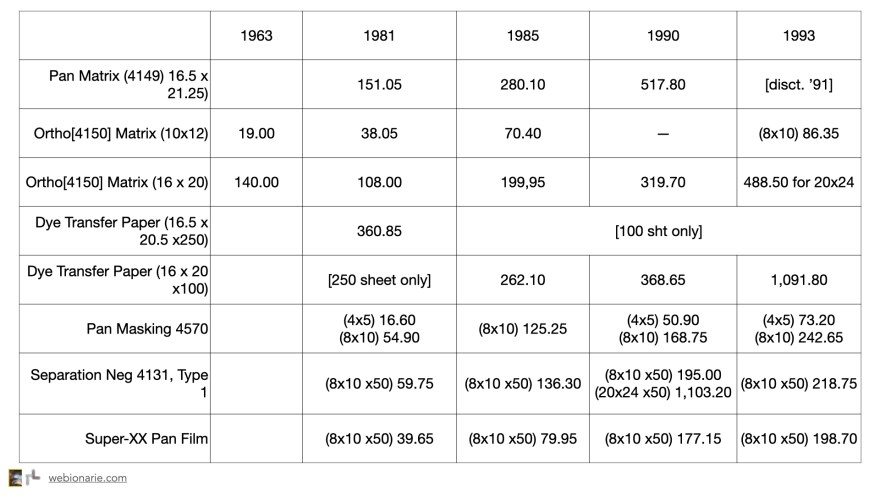
Catalog prices for some Dye Transfer supplies. These are the retailer list price. Labs paid much less.

Consider: Giffen vs Veblen goods. The professional depended on the supplies. The hobbyist didn’t. 1981 was a break year for Kodak’s process. By 1986, the decision had been made to let the process run out the clock. During this time, the larger labs had a decreasing dye transfer business. It was maintained as a prestige factor attracting interest but resulting in few projects. Small specialist labs grew in the eighties; even the best known added other processes to their sales brochure. “Now, the finest Black and White from the finest Color Lab.” — 1987 —

Kodak chose not to license, nor sell the process[ 1981,2] . Wonder why? In their final run of product, the only supply sold completely was Tanning developer. Nope, not even all the matrix film was sold. Not even the Pan Matrix. So it goes…. much of the film and paper was held in store for years.

and then it was recycled. The Fotokemika branded Efke matrix film also saw few buyers.

Maybe there is a market for the Coffee Mug, the Trucker Hat, the Film Vest… not the film… Sell the tchotchke, maybe the tattoo, no need for the mats and blanks.